Russian Swear Words, Mat, and Euphemisms
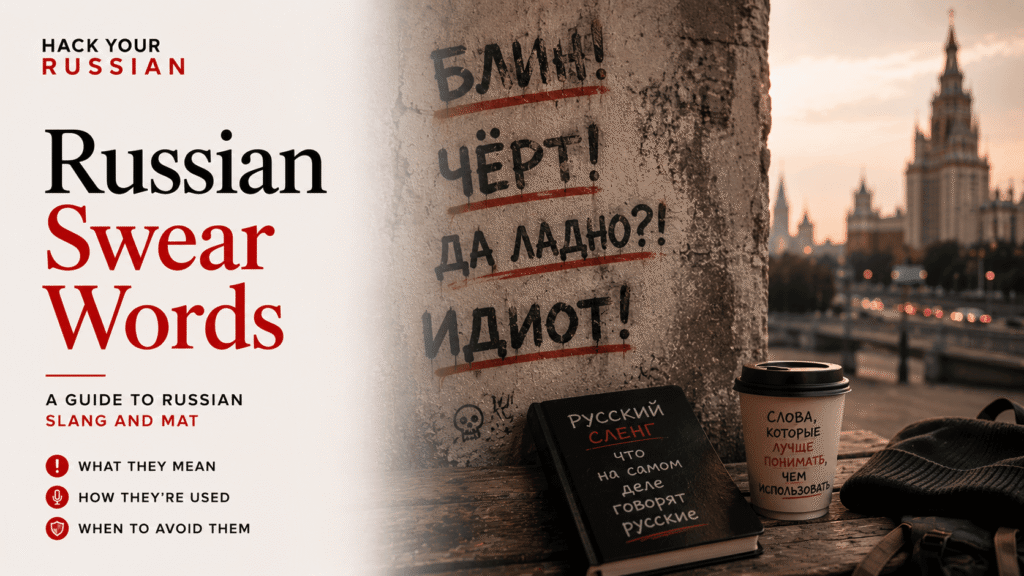
Russian swear words are a big part of informal spoken Russian. You can hear them in movies, YouTube videos, podcasts, memes, street conversations, and emotional everyday speech. Some of these words are mild and almost harmless, while others belong to мат, the strongest and most vulgar layer of Russian profanity. If you want more everyday informal vocabulary, start with these Russian slang words.
But most importantly, Russian swear words are a part of the Russian language whether we want it or not. And we can even say that it’s somewhat a part of our culture because one cannot imagine a Russian language without curse words. And no, it’s not because Russian natives are rude and impolite people who constantly want to insult someone or to grumble about life (which is somewhat true). Russian curse words actually serve as the means to express emotions (both negative and positive). There are situations when simple words are not enough to describe how happy or frustrated a person is. So, in simple words, Russian swear words and their euphemisms help people convey their real emotions. Like we say in Russian, one swear word worth a thousand of words (Вместо тысячи слов). But, of course, Russian natives perfectly understand when to use and when not to use swear words. Just as in any other language, there are situations when swearing is strictly prohibited (in public places, on TV, in formal situations, etc.).
In this lesson, you will learn the difference between Russian swear words, slang, euphemisms, and strong mat. You will also see safer alternatives that Russian people use to express surprise, frustration, anger, or admiration without sounding too vulgar. For safer communication, learn polite Russian words and phrases first.
This lesson is not here to encourage you to swear in Russian. The goal is to help you understand real spoken Russian, avoid awkward situations, and choose words that match the context. You can also learn how to speak Russian like a native without relying on swear words.
Table of Contents
Why You Should Learn Russian Swear Words Carefully
Russian swear words are powerful, emotional, and very common in informal speech. You may hear them in movies, YouTube videos, podcasts, memes, street conversations, and even in casual conversations between friends.
But there is a big difference between understanding Russian swear words and using them yourself.
As a Russian learner, you do not need to swear in Russian to sound natural. In fact, if you use strong Russian curse words in the wrong situation, you may sound rude, aggressive, immature, or even offensive. However, it is still useful to recognize these words, because they often appear in real spoken Russian.
The safest approach is this:
Understand strong swear words, but use softer alternatives and euphemisms.
This way, you can follow real conversations without accidentally sounding too vulgar.
Russian Mat vs. Everyday Swearing
In Russian, there is a difference between general rude language and мат. The word мат refers to the strongest layer of Russian profanity. These words are usually connected with taboo topics and can sound extremely rude.
Not every rude Russian word is мат. Some words are just informal, emotional, or impolite. Others are euphemisms — softer replacements for stronger swear words.
For example:
| Type | Russian | English idea | Tone |
|---|---|---|---|
| Very soft | блин | damn / shoot | mild |
| Soft | чёрт | damn / devil | mild |
| Informal | офиге́ть | wow / no way | casual |
| Rude | дура́к | fool / idiot | rude |
| Strong | бля / блядь | fuck / damn | vulgar |
Safer Russian Swear Word Alternatives
If you want to express emotion in Russian without sounding too vulgar, use euphemisms. These words are common, expressive, and much safer than strong profanity.
| Russian | English idea | Tone |
|---|---|---|
| бли́н! | damn! / shoot! | very common, mild |
| чёрт! | damn! | mild |
| ё-моё! | oh my! / gosh! | mild, emotional |
| капе́ц! | that’s crazy / that’s bad | informal |
| офиге́ть! | wow / no way | informal |
| ничего́ себе́! | wow! / no way! | safe |
| вот э́то да! | wow! / well, well! | safe |
| ужа́с! | terrible! / awful! | neutral |
| кошма́р! | nightmare! / awful! | neutral |
| жесть! | that’s intense / brutal | informal |
Examples:
Бли́н, я забы́л ключи́.
Damn, I forgot the keys.
Чёрт, я опозда́ла.
Damn, I’m late.
Ё-моё, как хо́лодно!
Oh my, it’s so cold!
Капе́ц, я ничего́ не понима́ю.
Damn / this is crazy, I don’t understand anything.
Офиге́ть, как краси́во!
Wow, how beautiful!
Ничего́ себе́! Ты уже́ вы́учил ру́сский алфави́т?
Wow! You’ve already learned the Russian alphabet?
These expressions are much safer for Russian learners than strong curse words.
Video lesson “Russian Swear Words”
The Russian language is incredibly rich — and that also applies to Russian swear words. It’s truly amazing how many variations of swear words Russian people have created. Some of them are extremely rude or even disgusting (especially those related to human reproductive organs), so it’s best to avoid using them altogether.
That’s why Russians came up with euphemisms for the strongest swear words. You can safely use these euphemisms without worrying about being judged — just remember not to use them in formal situations, such as official meetings, at work, or during job interviews.
Watch the next video lesson to learn more about this topic!
Exclamations and swear euphemisms
“Блин” — The Safest Russian Swear Euphemism
Бли́н literally means “pancake”, but in everyday Russian it is also used as a very common euphemism for a stronger swear word.
It is similar to English “damn”, “shoot”, or “oh no” depending on the situation.
Examples:
Бли́н, я забы́ла телефо́н до́ма.
Damn, I forgot my phone at home.
Бли́н, ну почему́ так до́рого?
Damn, why is it so expensive?
Бли́н, я не зна́ю, что де́лать.
Damn, I don’t know what to do.
Бли́н, как краси́во!
Wow / damn, how beautiful!
This word is very common in informal Russian speech. It is not elegant, but it is much safer than strong swear words.
“Чёрт” — A Mild Way to Say “Damn”
Чёрт literally means “devil”, but it is also used as a mild swear word. It can express frustration, surprise, or irritation.
Examples:
Чёрт, я опозда́л.
Damn, I’m late.
Чёрт, я забы́л пароль.
Damn, I forgot the password.
Чёрт возьми́!
Damn it!
Что за чёрт?
What the hell?
Be careful: Что за чёрт? is stronger than simple чёрт. It is still not as vulgar as мат, but it sounds more emotional.
“Капец” — When Something Is Bad, Crazy, or Intense
Капе́ц is a very common informal word. It can describe something bad, shocking, intense, or unbelievable.
Depending on context, it can mean something like “damn”, “that’s crazy”, “that’s awful”, or “we’re screwed.”
Examples:
Капе́ц, как я уста́ла.
Damn, I’m so tired.
Капе́ц, ско́лько люде́й!
Wow, so many people!
Ну всё, капе́ц.
Well, that’s it. We’re screwed.
Это про́сто капе́ц.
This is just crazy / awful.
Капе́ц, я не ожидáла.
Wow, I didn’t expect that.
Капе́ц is not formal, but it is very common in spoken Russian.
“Офигеть” — Surprise, Shock, or Strong Emotion
Офиге́ть is an informal word used to express surprise, shock, admiration, or disbelief. It can be positive or negative.
Examples:
Офиге́ть!
No way! / Wow!
Офиге́ть, как до́рого!
Wow, that’s so expensive!
Офиге́ть, как ты хорошо́ говори́шь по-ру́сски!
Wow, you speak Russian so well!
Я офиге́ла, когда́ э́то услы́шала.
I was shocked when I heard that.
— feminine speaker
Я офиге́л, когда́ э́то уви́дел.
I was shocked when I saw that.
— masculine speaker
This word is very useful for understanding real spoken Russian, but it is still informal. Avoid it in formal writing or professional situations.
“Фиг” — A Softer Substitute
Фиг is a useful informal word that often replaces stronger taboo words. It appears in many common expressions.
| Russian | English idea |
|---|---|
| фигня́ | nonsense / rubbish / no big deal |
| нифига́ себе́! | wow! / no way! |
| на фига́? | what for? / why? |
| до фига́ | a lot |
| фи́г с ним | forget it / whatever |
| фи́г зна́ет | who knows |
Examples:
Э́то фигня́.
That’s nonsense / That’s nothing serious.
Нифига́ себе́!
Wow! / No way!
На фига́ тебе́ э́то?
What do you need this for?
Там бы́ло до фига́ наро́ду.
There were tons of people there.
Фи́г с ним, забы́ли.
Whatever, let’s forget it.
These phrases are very common in spoken Russian, but they are still informal.
For more casual phrases with similar tone, learn different ways to say ‘I don’t care’ in Russian.
Quick Tone Guide
| Expression | Tone | Safe to use? |
|---|---|---|
| ничего́ себе́ | surprised, safe | yes |
| вот э́то да | surprised, safe | yes |
| ужа́с | negative, neutral | yes |
| кошма́р | negative, neutral | yes |
| бли́н | mild slang | mostly yes, not formal |
| чёрт | mild swear word | mostly yes, not formal |
| капе́ц | informal slang | with friends |
| офиге́ть | informal slang | with friends |
| фигня́ | informal | with friends |
| дура́к / ду́ра | insulting | avoid |
| идио́т | insulting | avoid |
| бля́дь | vulgar | recognize, avoid |
| хуй / пизда́ / еба́ть | very vulgar mat | recognize, avoid |
If your goal is to sound natural but not rude, the best words to actively use are: ничего́ себе́, вот э́то да, бли́н, чёрт, капе́ц, and офиге́ть.
If you are a beginner, start with basic Russian phrases for beginners before using slang or swear words.
Learning how to say “Don’t worry” in Russian is quite useful, but depending on the situation, you may also need other useful phrases: learn how to praise someone in Russian, how to encourage someone in Russian, and how to wish luck in Russian. These phrases will help you react naturally when someone does something well, feels nervous, or needs support.
Want more lessons like this? Explore my Russian learning resources.
You can also browse my free Russian video lessons.
If you have recently started to learn Russian language, then you absolutely need to get my free guide ‘Essential Russian Words and Expressions to Understand Spoken Russian’.
This guide also contains audio files so that you can listen to these phrases on the go: while driving, walking, doing sport or brushing your teeth. Make sure that you repeat these phrases yourself and try to imitate my accent.
It’s also very important to know how to pronounce Russian words correctly as not every Russian letter is pronounced the same way as it’s written. There are certain Russian pronunciation rules that are really easy to learn.
If you wish to speak Russian, you should absolutely learn how to use Russian cases. Check the most comprehensive guides to Russian cases:

Common Mistakes Learners Make with Russian Swear Words
1. Using strong words too early
Some learners hear Russian mat in movies or from friends and immediately start using it. This can sound unnatural or rude. It is better to understand these words first and use softer alternatives.
2. Swearing in formal situations
Even mild words like бли́н, капе́ц, or офиге́ть can sound inappropriate in formal situations. In a job interview, meeting, or official email, avoid them.
3. Insulting people directly
There is a difference between saying Бли́н, как сло́жно! and Ты дура́к! The first expresses emotion. The second insults a person.
4. Forgetting stress
Russian stress changes pronunciation. Learn words with stress from the beginning: капе́ц, офиге́ть, дура́к, идио́т, бля́дь.
5. Thinking all slang is safe
Not all slang is equal. Some slang is playful, some is rude, and some is vulgar. Always check tone before using a new expression.
FAQ
What is Russian mat?
Мат is the strongest layer of Russian profanity. It includes very vulgar words and expressions that are not appropriate in polite or formal situations.
Should Russian learners use swear words?
Russian learners should first learn to understand swear words, not use them actively. Strong swear words can sound rude, aggressive, or unnatural if used in the wrong context.
What is the safest Russian swear word alternative?
One of the safest and most common euphemisms is бли́н. It literally means “pancake”, but in informal speech it can mean “damn”, “shoot”, or “oh no”.
Is “блин” rude?
Бли́н is informal and not elegant, but it is much softer than strong Russian swear words. It is common in casual speech, but you should avoid it in formal situations.
What does “капец” mean?
Капе́ц is an informal word that can mean “damn”, “that’s crazy”, “that’s awful”, or “we’re screwed”, depending on context.
What does “офигеть” mean?
Офиге́ть is an informal word used to express surprise, shock, admiration, or disbelief. For example: Офиге́ть, как краси́во! — “Wow, how beautiful!”