
Russian grammar books that finally make sense
Clear explanations, real stories, and grammar that clicks — written by a native Russian teacher for English speakers who are tired of feeling lost.
Russian grammar books that work differently
Russian grammar doesn’t have to feel overwhelming. These books break down Russian cases, verbs, sentence structure, and grammar patterns into clear, practical explanations designed specifically for English speakers learning Russian independently. Most Russian textbooks were designed for classrooms, not self-study. These were built from scratch for the independent learner.
📖 Stories, not sentences
Russian grammar is introduced through real contexts and short narratives — the way your brain actually absorbs new patterns.
🧠 Explanations that finally make sense
Written for English speakers, with analogies, visual tables, and zero assumed knowledge of linguistics jargon.
🎧 Audio companion for pronunciation
Every key example includes a QR code linking to native-speaker audio. Read and listen together — the way languages stick.
✅ Progressive exercise system
Each chapter builds on the last. Exercises go from recognition → production → free writing — like a personal tutor in book form.
Master Russian Cases Step by Step
Russian cases are one of the biggest challenges for learners — but they don’t have to feel impossible. This collection of books breaks down each Russian case into clear explanations, practical examples, natural sentences, and step-by-step exercises designed to help you finally understand how Russian grammar actually works in real life.
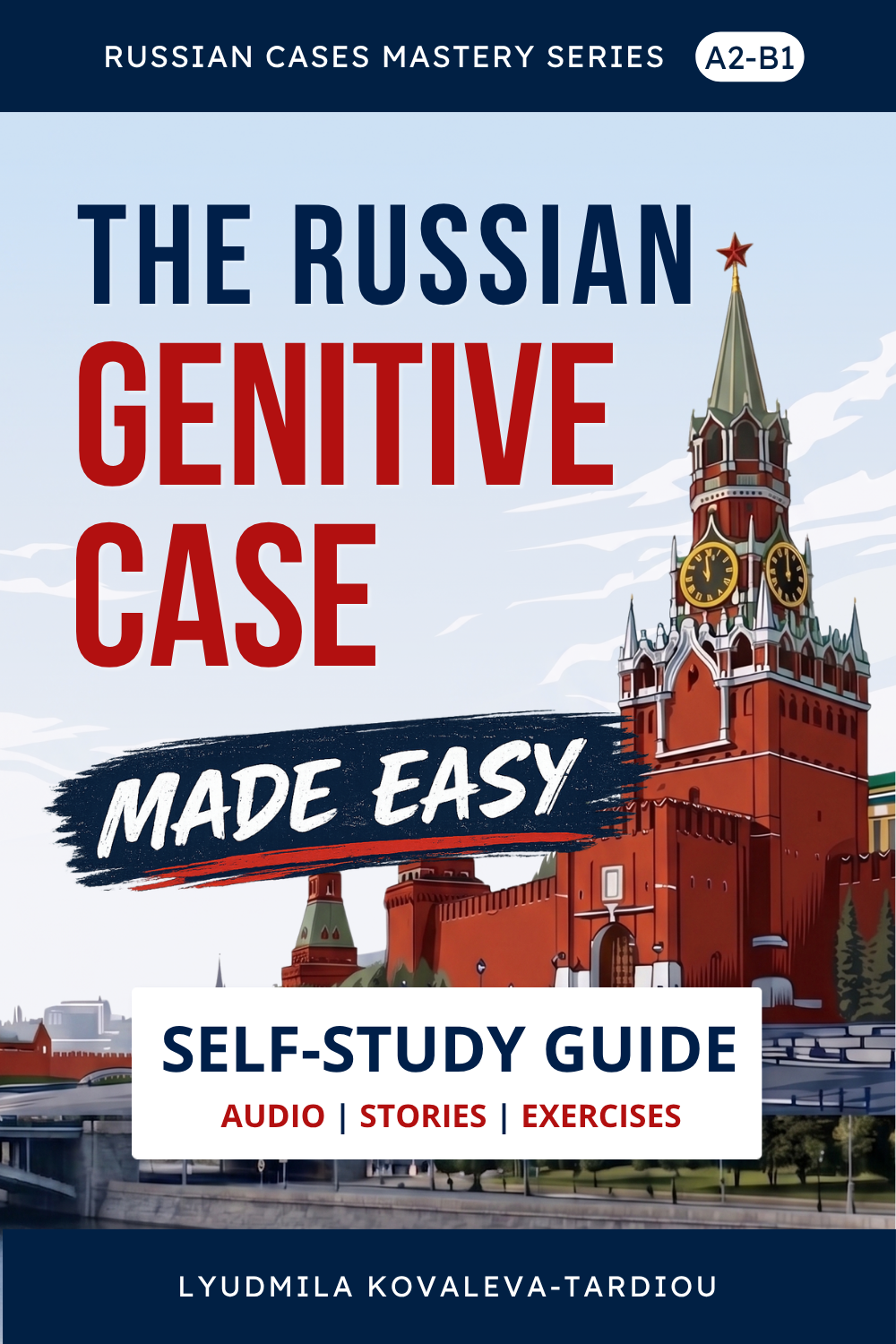
Russian Genitive Case
If the Nominative case is the “King” of Russian grammar (because it names things), the Genitive case is undoubtedly the “Queen”. It is the second most frequently used case in the Russian language. While textbooks often give you dry definitions, the secret to understanding the Genitive is simple: it is the case of relationship, scope, and limits. The Russian Genitive Case Made Simple is a practical, step-by-step guide designed specifically for English-speaking learners who want to truly understand – not just survive – the Russian Genitive case.
Russian Accusative Case
The Russian Accusative case changes form based on the noun’s animacy. For inanimate objects, it answers “Что?” (What?) and matches the Nominative case. For animate objects, it answers “Кого?” (Who(m)?) and resembles the Genitive case, depending on gender.
Russian Prepositional Case
The Russian Prepositional case is one of the easiest, especially compared to the Genitive and Accusative cases. It’s used only with prepositions, and its endings are limited, making it simple to form. However, knowing when to use it isn’t always straightforward.
Russian Instrumental Case
The Russian Instrumental case indicates the means by which an action is performed, whether it’s a person, object, or thing. In Russian it’s called “твори́тельный паде́ж” from the verb “твори́ть” (to create). It also appears in various less obvious situations.
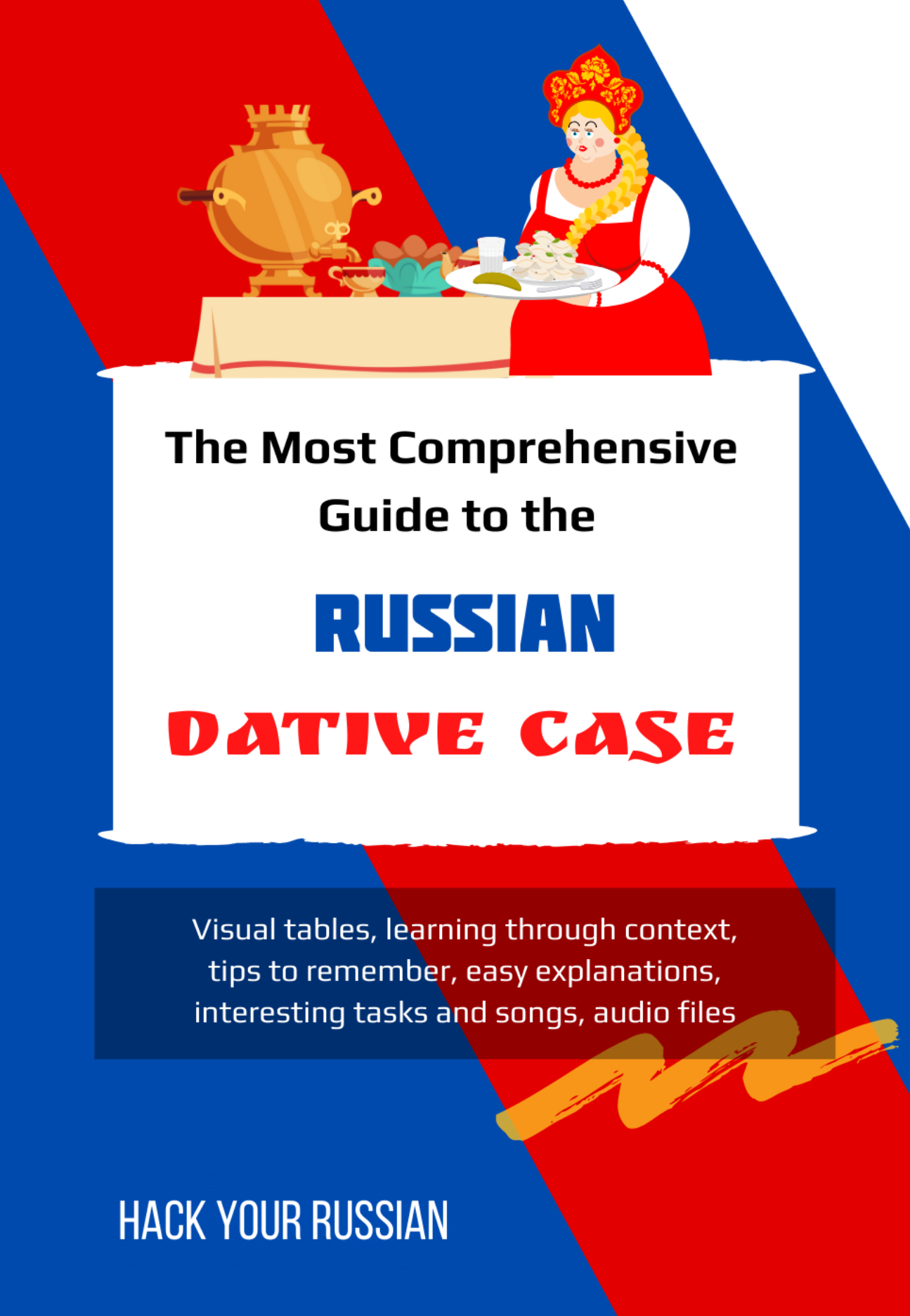
Russian Dative Case
The Russian Dative case mainly shows the connection between a giver and a recipient, whether physical, emotional, or otherwise. In Russian it is called “да́тельный паде́ж” from the verb “дать” (to give – a perfective form). It’s also used in many less obvious situations, so learning all its functions is important.
Frequently asked questions about these Russian grammar books
Are these Russian grammar books suitable for complete beginners?
Yes — these Russian grammar books are specifically designed for beginners and English speakers starting Russian from scratch. The explanations are written in clear, simple language and gradually introduce Russian grammar step by step instead of overwhelming you with complicated terminology all at once.
However, it’s highly recommended to learn the Russian alphabet first before diving into grammar. You can start with these free lessons here: Learn the Russian Alphabet.
Some books are fully beginner-friendly, while others are better suited for learners who already know basic Cyrillic and A1-level Russian. Each resource is designed to help you build confidence progressively and understand Russian more naturally over time.
Which Russian case should I start with?
A great place to start is the Genitive Case because it’s one of the most frequently used Russian cases in everyday speech. You’ll encounter it constantly when talking about quantity, possession, negation, dates, and “there is/there isn’t” structures. You can start learning it here: Russian Genitive Case Guide
After that, the Accusative Case is usually the easiest next step because it’s closely connected to the Genitive and shares similar patterns — especially with masculine animate nouns. Think of them as “grammar siblings.” You can explore it here: Russian Accusative Case Guide.
The other Russian cases — Prepositional, Instrumental, and Dative — are also extremely important, but they can be learned in almost any order afterward. The good news is that the Genitive and Accusative books already introduce and reference other cases naturally throughout the explanations and examples, helping you gradually build familiarity with the entire Russian case system step by step.
What makes these books different from traditional Russian textbooks (Penguin, Routledge, etc.)?
Most traditional Russian textbooks are designed for university classrooms with a teacher guiding the learning process. These books are created specifically for independent learners — with clear explanations, learner-friendly structure, practical examples, complete answer keys, audio companions, and a more natural, human approach to learning Russian.
Instead of feeling like a dense academic lecture, the experience is designed to feel closer to learning with a personal tutor.
Are the books focused on conversational Russian or academic grammar?
These books are designed to help you learn real Russian through grammar — not just memorize grammar rules in isolation. The goal is not simply to “study cases,” but to use them as a tool for understanding and using the Russian language naturally.
Instead of artificial textbook sentences, you’ll find real-life examples, natural dialogues, contextual vocabulary, and stories built around the most common Russian words and patterns used by native speakers. The grammar explanations are practical and learner-friendly, but the language itself stays authentic and connected to real communication.
How long does it take to complete each book?
Most learners complete a single book in about 6–10 weeks when studying around 30–45 minutes a day. The books are designed for steady, meaningful progress — not rushed memorization. Taking time to absorb the explanations, examples, and exercises is an important part of the learning process.
Is there an answer key included?
Yes — every book includes a complete answer key to help you study Russian independently with confidence. You can immediately check your answers, understand your mistakes, and reinforce what you’ve learned without needing a teacher beside you.
Why are Russian cases difficult for English speakers?
Russian cases can feel difficult for English speakers because English has almost completely lost its case system over time, while Russian still relies on it heavily in everyday speech. In Russian, word endings constantly change depending on the role of the word in the sentence — something that doesn’t really happen in modern English.
At first, this can feel overwhelming because learners try to memorize endless tables and rules. But the real key is understanding patterns and seeing cases repeatedly in meaningful context. Once you start encountering them through real examples, stories, dialogues, and natural sentences, Russian cases begin to feel much more logical and intuitive over time.
What makes the “Hack Your Russian” method different?
The “Hack Your Russian” approach focuses on helping learners understand Russian naturally instead of overwhelming them with academic explanations and memorization-heavy methods.
Rather than treating grammar as isolated theory, the method combines clear explanations, real-life examples, contextual vocabulary, stories, dialogues, pronunciation awareness, and natural repetition to help Russian gradually start making sense as a living language.
The goal is not just to “know grammar rules,” but to recognize patterns automatically, understand authentic Russian more easily, and build confidence step by step through meaningful exposure to the language.
Will I understand Russian sentence structure better after these books?
Yes — one of the main goals of these books is to help you naturally understand how Russian sentences are actually built. Instead of only explaining grammar rules theoretically, the books use multiple learning techniques that make Russian sentence structure easier to “feel” and recognize intuitively.
You’ll work with:
simple high-frequency example sentences
interlinear texts
TPRS-style stories
songs and contextual repetition
question-based learning that shows the same structure from different angles
The TPRS stories are especially helpful because they repeat sentence patterns through variations and questions, helping your brain absorb Russian word order and grammar more naturally. Each grammar concept is introduced through practical, easy-to-understand sentences designed to help you “hack” the system instead of memorizing abstract rules mechanically.