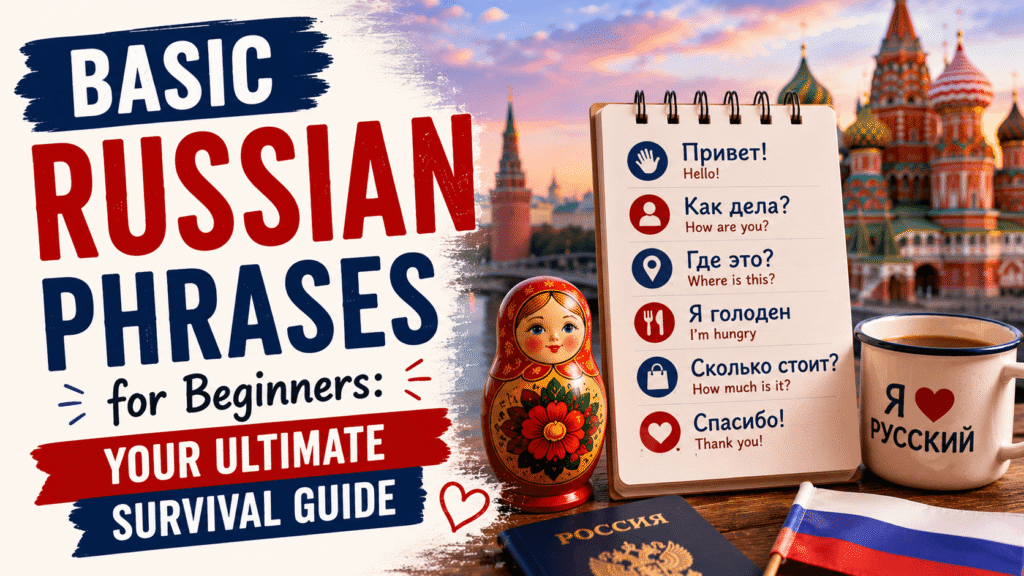
Learning basic Russian phrases is one of the fastest ways to start speaking Russian, even if you are a complete beginner. You do not need to understand every grammar rule before saying your first words. In fact, short everyday phrases help you build confidence, recognize common sentence patterns, and get used to the sound of the Russian language.
Before you start memorizing the phrases below, try to learn them as complete expressions, not as separate words. For example, do not only learn зову́т as an isolated verb. Learn the full phrase: Как тебя́ зову́т? This way, you will be able to use it naturally in a real conversation.
Here are a few simple tips:
- Read each phrase aloud several times.
- Pay attention to the stress mark in Russian words.
- Repeat the phrase after a native speaker if you have audio or video.
- Try to create your own mini-dialogue with each phrase.
- Use the formal version when speaking to strangers, older people, teachers, or people in a professional situation.
Russian may look difficult at first because it uses the Cyrillic alphabet, but once you learn the letters and a few pronunciation rules, many words become much easier to read and remember.
Table of Contents
Formal and Informal Russian: Ты vs Вы
One important thing beginners should know is that Russian has two main ways to say “you”: ты and вы.
Ты is informal. You use it with friends, children, family members, and people you know well.
Вы is formal or plural. You use it with strangers, teachers, older people, clients, or in polite situations.
For example:
Как тебя́ зову́т? (What is your name?) — informal
Как вас зову́т? (What is your name?) — formal or plural
Both phrases are correct, but they are used in different situations. If you are not sure which form to choose, it is safer to start with вы. Russian speakers will usually tell you if you can switch to ты. You can learn more on this topic in my video lesson “How to address people in Russian. Вы vs ты”.
Essential Russian Phrases for Real Conversations
The phrases below are not just random words to memorize. They are practical expressions you can use when meeting Russian speakers, traveling, watching Russian videos, or starting your first conversations online.
Как тебя́ зову́т? — What is your name?
This is one of the first questions you should learn in Russian. It literally means something like “How are you called?” but in natural English we translate it as “What is your name?”
Use Как тебя́ зову́т? in informal situations. If you want to be more polite, say:
Как вас зову́т? (What is your name?) — formal

Как тебя́ зову́т? (What is your name?)
Меня́ зову́т… — My name is…
This is the most common way to introduce yourself in Russian. You simply add your name after the phrase:
Меня́ зову́т Мила (My name is Mila).
You can also say: Я Мила (I am Mila).
But Меня́ зову́т… sounds more natural when you are introducing yourself for the first time.

Меня́ зову́т… (My name is…)
If you want to learn more on how to introduce yourself and other people in Russian, you can watch a free Russian video lesson “How to introduce yourself and others in Russian”.
Я учу́ ру́сский язы́к — I am learning Russian
This phrase is extremely useful for beginners because it immediately tells native speakers that you are still learning. Many Russian speakers will slow down or explain things more clearly if they know you are a learner. Russian people respect a lot those who wish to learn Russian language as they believe that this the most difficult language in the world .

Я учу́ ру́сский язы́к (I am learning Russian language)
You can also say:
Я то́лько начина́ю учи́ть ру́сский (I am just starting to learn Russian).
Я немно́го говорю́ по-ру́сски (I speak a little Russian).
Пожа́луйста, говори́те ме́дленнее (Please speak more slowly).
Я не понима́ю — I don’t understand
Do not be afraid to use this phrase. It is much better to say Я не понима́ю than to pretend that you understood everything. The majority of Russian language speakers will be happy to give you explanations.

Я не понима́ю (I don’t understand)
You can make it more polite by adding извините or пожалуйста:
Извини́те, я не понима́ю (Sorry, I don’t understand).
Пожа́луйста, повтори́те (Please repeat).
You may also hear:
Я не по́нял (I didn’t understand). — said by a man
Я не поняла́ (I didn’t understand). — said by a woman
The difference is that Я не понима́ю means “I don’t understand” in general or right now, while Я не по́нял / Я не поняла́ means “I didn’t understand” in a specific situation. You should later learn other ways to say “I don’t understand” in Russian to sound like a native.
Как дела́? — How are you?
Как дела́? is one of the most common Russian phrases. It is usually translated as “How are you?” but the literal meaning is closer to “How are things?”

Как дела́? (How are you?)
In Russian, this question can be more personal than in English. Sometimes people really expect an answer, not just a quick “fine.” Of course, in casual situations, you can still answer briefly.
Хорошо́ — Good / Okay
“Хорошо́” is one of the most common ways to respond to a question “Как дела́?” in Russian. Please, note that we don’t pronounce two first vowels “о” as they are writter. Insted, they are pronounced as “A” because they are not stressed. The rule is that if a vowel “о” is unstressed in a word, it should be pronounced as “А”.

Хорошо́ (good)
Хорошо́ is a very useful Russian word. It can mean “good,” “well,” or “okay,” depending on the context.
Examples:
У меня́ всё хорошо́ (Everything is good with me).
Хорошо́, я поняла́ (Okay, I understood).
Ты хорошо́ говори́шь по-ру́сски (You speak Russian well).
Пло́хо — Bad
Пло́хо is the opposite of хорошо́. You can use it to describe your mood, health, or a situation.

Пло́хо (Bad)
Examples:
Мне пло́хо (I feel bad).
Это пло́хо (This is bad).
Я пло́хо говорю́ по-ру́сски (I speak Russian badly).
However, if you are just answering Как дела́?, it is often more natural to say “Норма́льно” or “Так себе́” unless you really want to share that something is wrong.
Спаси́бо — Thank you
Спаси́бо is one of the most important Russian words. You can use it in almost any situation where you want to say “thank you.”

Спаси́бо (Thank you)
Did you know that this word actually derives from a phrase “Спаси тебя Бог” (God save you). If not, I recommend you to watch my free Russian video lesson “How to be polite in Russian” where I not only teach you polite Russian words but also explain some interesting cultural insights and origin of Russian words.
Пожа́луйста — Please / You are welcome
Пожа́луйста is a very useful word because it has several meanings: “please”, “you are welcome”, “here you are” and “go ahead” depending on the situation.

Пожа́луйста (Please / You are welcome)
Examples:
Да́йте, пожа́луйста, во́ду (Please give me water).
Повтори́те, пожа́луйста (Please repeat).
— Спаси́бо! (Thank you!)
— Пожа́луйста (You are welcome).
You will hear this word constantly in shops, cafés, lessons, and everyday conversations.
Да / Нет — Yes / No
Да means “yes” and нет means “no.” They are simple, but very important.

Да / Нет (Yes / No)
Be careful: in Russian, a direct нет may sometimes sound too strong depending on the situation. To sound more polite, you can soften it:
Нет, спаси́бо (No, thank you).
К сожале́нию, нет (Unfortunately, no).
Дума́ю, нет (I don’t think so).
Free PDF: Essential Russian Words and Expressions
To help you practice these basic Russian phrases more effectively, I’ve created a free PDF guide with essential Russian words and expressions for beginners. Inside, you’ll find useful phrases for first conversations, greetings, polite expressions, asking for help, saying that you don’t understand, giving compliments, talking on the phone, and more.
The guide also includes audio, so you can listen to the phrases, repeat them aloud, and improve your Russian pronunciation while learning practical expressions used in real spoken Russian.
Great, you have learned some basic Russian words and phrases that will give you “a taste” of Russian language. Try to already start using these words in your everyday life. Even if you don’t have Russian friends and you don’t live in a Russian speaking country, there are always some ways to practice your Russian: social groups on Internet, language exchange websites and apps. Practice makes perfect! And what about watching my free Russian video lessons for beginners?
It’s also very important to know how to pronounce Russian words correctly as not every Russian letter is pronounced the same way as it’s written. There are certain Russian pronunciation rules that are really easy to learn.
If you wish to speak Russian, you should absolutely learn how to use Russian cases. Check the most comprehensive guides to Russian cases:

FAQ: Basic Russian Phrases for Beginners
What are the most important Russian phrases for beginners?
The most important Russian phrases for beginners are the ones you can use in real conversations right away. Start with greetings, polite words, simple questions, and survival phrases such as Приве́т, Спаси́бо, Пожа́луйста, Как тебя́ зову́т?, Меня́ зову́т…, Я не понима́ю, and Я учу́ ру́сский язы́к.
How do you say “hello” in Russian?
The most common way to say “hello” in Russian is Приве́т. It is informal and used with friends, family, children, and people you know well. In formal situations, use Здра́вствуйте. This is the polite form and is better for strangers, teachers, older people, or professional situations.
How do you say “thank you” in Russian?
“Thank you” in Russian is Спаси́бо. To say “thank you very much,” you can say Спаси́бо большо́е. A common answer to Спаси́бо is Пожа́луйста, which means “you’re welcome.”
How do you introduce yourself in Russian?
The most common way to introduce yourself in Russian is Меня́ зову́т… followed by your name. For example: Меня́ зову́т Мила — My name is Mila. You can also say Я + name , but Меня́ зову́т sounds more natural when introducing yourself for the first time.
How do you ask “What is your name?” in Russian?
In informal Russian, you can ask Как тебя́ зову́т? This is used with friends, children, or people your age in casual situations. In formal Russian, say Как вас зову́т? Use this form with strangers, older people, teachers, or in polite situations.
How do you say “I am learning Russian” in Russian?
“I am learning Russian” in Russian is Я учу́ ру́сский язы́к. You can also say Я изуча́ю ру́сский язы́к, which sounds a little more formal and means “I am studying the Russian language.” In everyday conversation, beginners can also say Я немно́го говорю́ по-ру́сски — “I speak a little Russian.”
How can I memorize Russian phrases faster?
The best way to memorize Russian phrases is to learn them in context. Repeat them aloud, listen to native pronunciation, create short dialogues, and use the phrases in real situations. It is better to learn complete expressions like Как тебя́ зову́т? than to memorize isolated words without context.