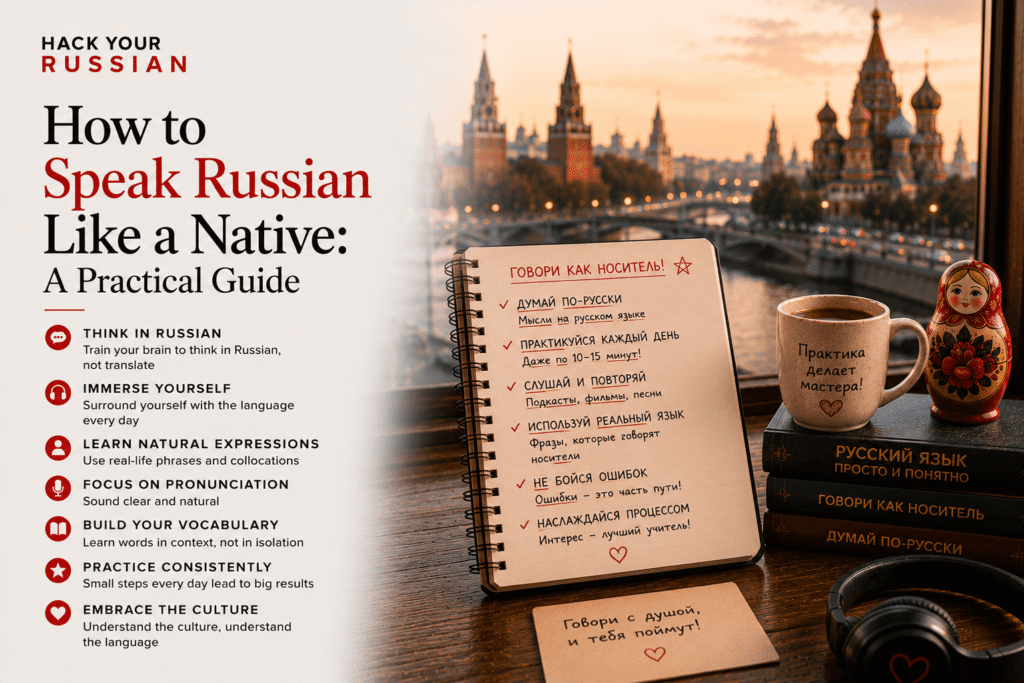
Many Russian learners know grammar rules, memorize vocabulary, and can build correct sentences — but still feel that their Russian sounds too “textbook”. Native speakers do not always speak in perfect, complete sentences. They use short reactions, filler words, natural intonation, informal expressions, emotional particles, and phrases that often do not translate word for word into English.
That is why speaking Russian like a native is not only about having a perfect accent. It is about sounding more natural, confident, and comfortable in real conversations. You need to understand how Russians actually speak when they agree, hesitate, joke, interrupt politely, express surprise, refuse something, or simply react to what someone says.
In this guide, you will learn practical tips to make your Russian sound more native-like: how to improve pronunciation and intonation, use natural filler words, avoid direct translations from English, understand slang and informal speech, and build phrases that native speakers really use every day.
Table of Contents
What Does “Speaking Russian Like a Native” Really Mean?
Speaking Russian like a native does not mean that you must have a perfect accent or never make grammar mistakes. Even advanced learners make mistakes, and that is normal. The real goal is to sound more natural, confident, and easy to understand.
Native-like Russian is not only about pronunciation. It is also about rhythm, intonation, word choice, short reactions, filler words, and the way you connect ideas in conversation.
For example, a textbook answer may sound like this:
Да, я согласна.
Yes, I agree.
But in real conversation, a native speaker may say:
Да, конечно.
Yes, of course.
Ну да, согласна.
Well yes, I agree.
В принципе, да.
Basically, yes.
Да, наверное.
Yes, probably.
All these phrases mean something close to “yes”, but they have different tones. Some sound confident, some softer, some hesitant, and some more conversational.
So, if you want to speak Russian more naturally, do not only memorize vocabulary. Learn how Russians actually react, hesitate, agree, disagree, ask questions, interrupt politely, and express emotion.
If you want to sound more natural when saying yes or no, read my guide on how to accept and refuse in Russian.
1. Improve Your Russian Pronunciation First
If you want to sound more natural in Russian, pronunciation is the first thing to work on. You do not need to sound exactly like a native speaker, but your pronunciation should be clear enough so that native speakers understand you easily.
Russian pronunciation is especially important because Russian words are not always pronounced exactly as they are written. Stress, vowel reduction, hard and soft consonants, and final devoicing can change the way words sound in real speech.
For example:
хорошо́ is written with three о, but it sounds closer to харашо́.
молоко́ sounds closer to малако́.
друг is written with г, but at the end of the word it sounds closer to друк.
These small details make a big difference. If you pronounce every Russian letter exactly as it is written, your Russian may sound unnatural and harder to understand.
The best way to improve pronunciation is to learn every new word with stress, repeat full phrases aloud, record yourself, and compare your speech with native examples.
To understand these patterns better, read my guide to the most important Russian pronunciation rules.
2. Use Russian Filler Words Naturally
Native speakers rarely speak in perfect textbook sentences. They pause, think, hesitate, soften their opinions, and use filler words. Russian has many small words that help speech sound more natural.
Here are some useful Russian filler words and phrases:
| Russian | Meaning | How it feels |
|---|---|---|
| ну | well | very common, conversational |
| вот | so / here / well | used to continue or finish a thought |
| ти́па | like / kind of | very informal |
| как бы | kind of / sort of | softens an idea |
| зна́чит | so / that means | used when explaining |
| коро́че | long story short | informal |
| в о́бщем | basically / in general | useful for summaries |
| слу́шай | listen | used to start a thought |
| че́стно говоря́ | honestly | adds personal tone |
| на са́мом де́ле | actually / in fact | introduces clarification |
Examples:
Ну, я не зна́ю.
Well, I don’t know.
Слу́шай, а дава́й встре́тимся за́втра?
Listen, shall we meet tomorrow?
В о́бщем, мне понра́вилось.
Basically, I liked it.
Че́стно говоря́, я не поняла́.
Honestly, I didn’t understand.
Do not overuse filler words. If every sentence starts with ну, типа, or короче, your Russian may sound messy. But a few natural fillers can make your speech sound much more alive. For more informal words used in real conversations, check my guide to Russian slang words.
3. Learn Short Native-Like Reactions
One reason learners sound unnatural is that they often answer with long, correct, but heavy sentences. Native speakers use many short reactions.
Instead of always saying:
Я понимаю.
I understand.
You can say:
Ага.
Uh-huh.
Поня́тно.
I see.
Ясно.
Clear / I see.
Да, поняла́.
Yes, I got it. — said by a woman
Да, по́нял.
Yes, I got it. — said by a man
Instead of always saying:
Это хорошо.
That is good.
You can say:
Класс!
Cool!
Здо́рово!
Great!
Круто́!
Cool!
Отли́чно!
Excellent!
Instead of always saying:
Я не понимаю.
I don’t understand.
You can say:
Не поняла́.
I didn’t get it. — said by a woman
Не по́нял.
I didn’t get it. — said by a man
Что ты име́ешь в виду́?
What do you mean?
Мо́жешь повтори́ть?
Can you repeat?
Short reactions help you participate in conversations even when you do not want to give a long answer. If you often freeze in conversations, learn these natural ways to say “I don’t understand” in Russian.
4. Pay Attention to Russian Particles
Russian native speakers use many small words that are difficult to translate directly. These words are called particles, and they add emotion, attitude, softness, surprise, or emphasis.
Some useful Russian particles are:
| Particle | Approximate meaning | Example |
|---|---|---|
| же | emphasis / “after all” | Я же сказа́ла! |
| ли | question particle | Зна́ешь ли ты? |
| бы | would / softens | Я бы хоте́ла. |
| то | emphasis / contrast | А мне-то что? |
| ведь | after all / you know | Ты ведь зна́ешь. |
| вот | here / so / emphasis | Вот э́то да! |
Examples:
Я же сказа́ла!
I told you already!
Ты ведь зна́ешь, пра́вда?
You know, right?
А мне-то что?
Why should I care?
Вот э́то да!
Wow! / Now that’s something!
Particles are one of the reasons Russian sounds emotional and expressive. You do not need to master all of them immediately, but you should start noticing them in movies, podcasts, songs and real conversations.
5. Understand Russian Reductions in Real Speech
Native speakers often pronounce common phrases faster than learners expect. Words connect, sounds become weaker, and some expressions sound different from their written form.
Video Lesson “How to better understand real spoken Russian?”
The most common Russian reductions
1) Что [shto] VS Чё [cho]
The question word ‘Что’ (what) is very often shorten to just ‘Чё’ in a fast spoken Russian speech. One can perfectly use this reduction in conversations with family members, friends, some colleagues. This word reduction is often used not only by young people but also by elderly people. However, it’s better not to use this reduction in formal situations: public events, at work with your boss, etc.
Example: Что ты делаешь? (What are you doing?) can be pronounced with Чё – Чё ты делаешь?
This Russian word reduction ‘Чё’ can be used either as a part of the question or separately – when you ask a person what he/she said in Russian or when you are surprised to hear some news.
Ex.: – Маша выходит замуж (Masha is getting married)
– Чё? (What?! – surprise)
2) Сейчас [seechas] VS Щас [shchas]
Another word that we like to shorten in Russian language is a word ‘сейчас’ (now / one moment). The reduction of this word is quite strange but we do really use it a lot in spoken speech. Sometimes we can even shorten it to just ‘ща’. Note that this word has 2 possible meanings in Russian: now and one moment. The latter is mostly used in a spoken speech. Again, it’s better to only use it in informal conversations with your friends, family members and good acquaintances.
Ex.: – Ты готова? (Are you ready?)
– Щас, подожди ещё 5 минут! (One moment, wait 5 more minutes).
3) Сегодня [seevodn’a] VS Сёдня [s’odn’a]
Next is a word ‘сегодня’ (today) that we often reduce to just ‘сёдня’. This word can be shorten both in a sentence and separately. As all the other reductions, one should use it only in informal situations.
Ex.: – Чё ты будешь делать сёдня? = Что ты будешь делать сегодня? (What are you going to do today?)
– Сёдня? (сегодня) Да, ничего особенного (Well, nothing special)
4) Ничего [neecheevo] VS Ничё [neecho]
The word ‘ничего’ (nothing) is very often reduced to ‘ничё’ in a fast spoken Russian. Make sure that you don’t use this reductions in a formal speech.
Ex.: – Как дела? (How are you?)
– Да ничё, пойдёт (Well it’s going fine)
– Что нового? (What’s new?)
– Ничего (Nothing)
5) Тебя / тебе / себя / себе VS тя / те / ся / се
In a fast spoken Russian we also shorten some Russian pronouns: тебя (you), тебе (to you), себя (oneself), себе (to oneself) as follows:
Тебя = тя
Тебе = те
Себя = ся
Себе = се
In can only be done in a sentence but not separately.
Ex.: Я те (=тебе) не верю – I don’t believe you
Ничёсе! (= ничего себе) – No way!
6) Вообще [vabshcheh] VS Ваще [vashcheh]
The word ‘вообще’ (in general / completely) is often reduced in a fast spoken Russian to ‘ваще’. Make sure that you use it only in informal conversations.
Ex.: Я ваще (= вообще) ничё (ничего) не поняла – I completely didn’t understan anything.
7) Слышишь [slyshysh] VS Слышь [slysh]
The verb ‘слышишь’ (you hear / hey) exactly in this form with a pronoun ‘ты’ is often reduced to just ‘слышь’. This form can sound a bit rude but it’s fine to use it with friends and family members in cases when you want to attract their attention.
– Слышь (= слышишь), давай сходим в кино! – Hey, let’s go to the cinema!
8) Нормально [narmal’na] VS Норм [norm]
The word ‘нормально’ (normal / fine) is sometimes reduced to ‘норм’.
Ex.: – Как дела? (How are you?)
– Норм (fine)
9) Может [mozhet] VS Мож [mozh]
The Russian word ‘может’ (may) is sometimes reduced to ‘мож’, especially in questions. As all previous reductions, it only can be used in an informal spoken speech.
Ex.: Мож (= может) сходим в кино? – May be we can go to the cinema? (What about going to the cinema?)
10) нибудь [neebut’] VS нить [neet’]
In a fast spoken Russian we also like to pronounce a particle ‘нибудь’ just as ‘нить’ in words like:
Что-нибудь (something) – как-нить
Кто-нибудь (someone) – кто-нить
Где-нибудь (somewhere) – где-нить
Когда-нибудь (somewhen) – когда-нить
Как-нибудь (somehow) – как-нить
Ex.: Нужно как-нить (= как-нибудь) сходить в кино – We should go to the cinema somewhen.
Some reductions are pronunciation rules, while others are informal speech habits, so it helps to study both Russian pronunciation rules and Russian slang words.
6. Learn from Real Russian Materials
If you want to speak Russian like a native, you need to hear real Russian regularly. Textbooks are useful, but they usually do not show how people actually speak when they are relaxed, emotional, funny, annoyed, or spontaneous.
Use authentic materials such as:
- Russian movies and TV series;
- YouTube videos;
- interviews;
- podcasts;
- songs;
- short clips;
- comments and memes;
- slow Russian stories for learners.
When you listen, do not try to understand every single word. Instead, notice useful patterns:
- How do Russians start a sentence?
- How do they react?
- What words do they repeat often?
- How do they say yes, no, maybe, really, exactly?
- What filler words do they use?
- How do they show surprise, doubt, agreement or disagreement?
You can even create your own “native-like phrase bank” with short expressions you want to use in conversations.
Want more lessons like this? Explore my Russian learning resources.
If you wish to speak Russian, you should absolutely learn how to use Russian cases. Check the most comprehensive guides to Russian cases:

FAQ: How to Speak Russian Like a Native
Can I really speak Russian like a native speaker?
You can learn to sound much more natural in Russian, but you do not need to sound exactly like a native speaker. The goal is clear pronunciation, natural phrases, good intonation, and confidence in real conversations.
What makes Russian speech sound natural?
Natural Russian speech includes correct stress, clear pronunciation, natural intonation, short reactions, filler words, particles, informal phrases, and expressions that native speakers actually use in everyday conversations.
How can I improve my Russian pronunciation?
To improve your Russian pronunciation, learn every word with stress, practice vowel reduction, listen to native speakers, repeat short phrases aloud, and record yourself. For a structured approach, you can also use my Russian Pronunciation Course.
What are common Russian filler words?
Common Russian filler words include ну — “well”, вот — “so / well”, типа — “like”, как бы — “kind of”, короче — “long story short”, в общем — “basically”, and на самом деле — “actually”.
Should I use Russian slang to sound like a native?
You should understand Russian slang because native speakers use it often in movies, songs, YouTube videos and casual conversations. However, do not overuse slang. Some slang words are rude, vulgar, or inappropriate in formal situations.
How can I stop translating from English into Russian?
The best way is to learn Russian phrases as ready-made chunks. Instead of translating word by word, memorize natural expressions such as я не против, как тебе удобно, в принципе да, может быть, не поняла, and что ты имеешь в виду?
Why is Russian intonation important?
Russian intonation can change the meaning, emotion and attitude of a phrase. The same words can sound friendly, bored, surprised, annoyed or sarcastic depending on intonation. Listening and repeating short native phrases is one of the best ways to improve it.
What is the best way to practice speaking Russian naturally?
The best way is to combine listening, shadowing, and active speaking. Listen to short native phrases, repeat them aloud, record yourself, and try to use useful expressions in real conversations.
Do I need to learn Russian grammar to speak naturally?
Yes, you do need to understand some Russian grammar if you want to speak naturally. Russian endings, cases, verb forms, word order, and agreement all affect meaning. For example, Russian cases show who is doing the action, who receives it, where something happens, where someone is going, and who or what something belongs to.
However, you do not need to learn grammar only through dry rules. The best approach is to study grammar through clear explanations, useful examples, dialogues, and real phrases that you can actually use in conversation.
If Russian cases are the most confusing part for you, my Russian cases books can help you learn them step by step. They explain each case with simple rules, practical examples, tables, exercises, and visual explanations, so you can understand how cases work in real speech instead of memorizing endings without context.
A good goal is not “perfect grammar before speaking”, but enough grammar to express yourself clearly and understand native speakers better. Grammar should support your speaking, not stop you from speaking.
How long does it take to speak Russian naturally?
It depends on your level, practice routine and exposure to real Russian. You can start sounding more natural very quickly by learning short reactions, filler words, polite phrases and pronunciation rules. Speaking like a native takes longer, but sounding clear and natural is a realistic goal.