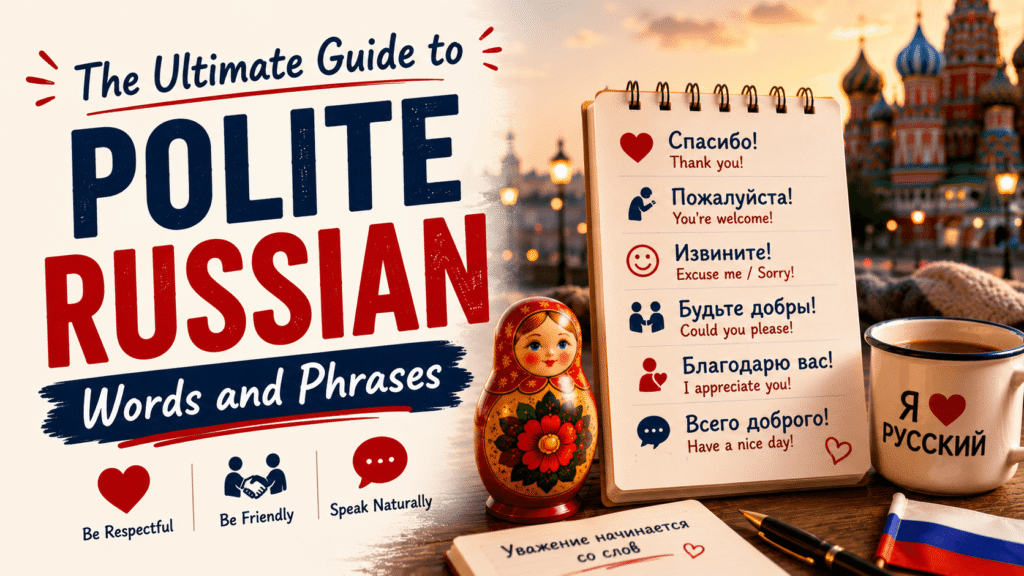
Being polite in Russian is not only about saying спаси́бо and пожа́луйста. Russian politeness depends on the situation, your relationship with the person, and the level of formality. The same phrase can sound friendly in one situation and too informal in another.
For example, you can say спаси́бо to almost anyone, but when you speak to a stranger, a teacher, an older person, or a client, it is usually better to use the polite form вы instead of ты. This is why learning polite Russian phrases together with formal and informal forms is so important.
In this free Russian video lesson, you will learn different polite words and phrases in Russian. In particular, you will learn how to thank someone in Russian, how to say you are welcome in Russian, how to say bless you, and other polite Russian words and phrases.
While there is a stereotype that Russian people are rude, it is very important to use some basic Russian polite words and phrases everyday. And no, Russian people are not rude, but rather straightforward. And being polite in Russian is not that difficult. You don’t need to use some long and super polite phrases like in English or French. On the contrary, if you use such sophisticated phrases, it would sound weird to Russian people and they would think that you make fun of them.
I recommend you to watch this free video lesson first. You can find a summary of this video just below. The test to check your knowledge on polite Russian phrases is at the bottow of this page. Have fun learning!
Table of Contents
Free Russian Video Lesson – How to be polite in Russian
How to Say Thank You in Russian
Спаси́бо – Thank you
It is the most common way to thank someone in Russian (both formal/informal). To make it more personal, you can add a pronoun. Ex.: Спасибо тебе / вам (Thank you).

Спаси́бо (spasiba) – Thank you
The word СПАСИБО comes from the saying “Спаси (тебя) Бог” which means “God save you”. You can also add an adjective БОЛЬШОЕ (bal’shóye) big to say that you are really grateful to someone.
Any variations of word order are possible: Большо́е спаси́бо / спаси́бо большо́е / спаси́бо тебе́ большо́е / спаси́бо вам большо́е
Another variation is ОГРОМНОЕ (agrómnaye) huge.
Огро́мное спаси́бо = thank you so much
Any variations of word order are possible: Огро́мное спаси́бо, спаси́бо огро́мное / спаси́бо тебе́ огро́мное / спаси́бо вам огро́мное
If you want to specify for what exactly you want to thank a person you need to use this construction: Спаси́бо за + noun (Accusative case)
Ex.: Спаси́бо за пода́рок (Thanks for a gift)
There are many informal variations of the word СПАСИБО:
Спаси́бочки, спаси́бки (cute, colloquial);
Спаси́б, паси́б (conversational);
Спс – a short written form (not really polite).
There is an interesting Russian expression with a word спасибо:
ПОТОМ ЕЩЁ СПАСИБО СКАЖЕШЬ (patóm yeshyó spasiba skázhesh’) – You will thank me later.
You can use this expression when someone doubts the importance / value of your actions or believes that you / they waste time on smth.
For example, Russian mothers like to say this expression to their children when they force them to study hard.
Ex.: – Дава́й, учи́сь! Пото́м ещё спаси́бо ска́жешь (Come on, study! You will thank me later).
Благодарю́ – Thank you / I am grateful
It is a very formal way to say “thank you”
Благодарю тебя (blagadaryú tibyá) / благодарю вас (blagadaryú vas)
благо + дарю – I give you goodness

Благодарю́ (blagadaryú) – Thank you / I am grateful
Normally you should better use the word БЛАГОДАРЮ only for some official meetings, performances and with customers (for some jobs). Though there is nothing wrong to use this word in everyday situations. Just don’t use it with your friends, family and children.
If you want to specify for what exatly you want to thank a person you need to use this construction: Благодарю за + Noun (Accusative case)
Ex.: Благодарю за приглашение (I am grateful for an invitation).
How to Respond to Thank You in Russian
When someone says спаси́бо, you can answer in several ways.
Не за что – Not at all! / It’s nothing

Не за что (nyézashta) – Not at all! / It’s nothing
It is a common but controversial way to respond to СПАСИБО. Literal meaning: there is nothing to thank me for. Use it only when you think that you have done smth really insignificant for another person or that you didn’t make any efforts to do it
Пожа́луйста – You are welcome
It is the most common and polite way to respond to СПАСИБО. You don’t need to respond anything after someone said to you a word ПОЖАЛУЙСТА (You are welcome).

Пожа́луйста (pazhálsta) You are welcome
The word ПОЖАЛУЙСТА has several meanings and serves different roles in speech:
1) A way to respond to СПАСИБО. Equivalent to “You’re welcome”
2) A way to politely ask for smth. Equivalent to an English “Please”.
It is important to add a word ПОЖАЛУЙСТА whenever you ask somebody for something (at shops, cafes, other public places, with your friends, colleagues, family and any other groups of people).
3) A polite way to give a permission. Equivalent to “Go ahead if you want”, “Sure, go ahead”
Ex.: – Мо́жно взять твою́ ру́чку? (Could I borrow your pen?)
– Да, пожа́луйста (Sure, go ahead)
4) A polite way to pass something. Equivalent to “Here you are”,”Here you go”.
A long version – Возьми́(те), пожа́луйста (Take it, please).
There is an interesting expression with a word “пожалуйста” – НУ И ПОЖАЛУЙСТА (nu i pazhálsta) Whatever / I don’t care
You can use it when you are angry at smb for not accepting your idea, not wishing to do smth with you / show / share with you. This way you let smb know that after all you don’t care.
Some other nice replies:
Всегда́ пожа́луйста.
Anytime.
Обраща́йся.
Feel free to ask. — informal
Обраща́йтесь.
Feel free to ask. — formal or plural
Polite Russian Phrases for Shops, Cafés, and Restaurants
Polite phrases are very useful in shops, cafés, restaurants, hotels, and other everyday situations.
Useful phrases:
Извини́те, ско́лько э́то сто́ит?
Excuse me, how much does it cost?
Да́йте, пожа́луйста, во́ду.
Please give me water.
Мо́жно мне ко́фе, пожа́луйста?
Can I have a coffee, please?
У вас есть меню́ на англи́йском?
Do you have a menu in English?
Мо́жно счёт, пожа́луйста?
Can I have the bill, please?
Спаси́бо большо́е.
Thank you very much.
Всего́ до́брого.
All the best / Have a nice day.
What to Say When Someone Sneezes in Russian
While in some cultures it is polite to pretend that you don’t hear when someone sneezes or it is not obligatory to say anything, for Russian people, it is very important to wish a good health to a person who sneezed.
Бу́дьте здорóвы (búd’te zdaróvy) – Bless you (formal / plural)
Будь здорóв (bud’ zdaróv) – Bless you (informal / singular / masculine)
Будь здорóва (bud’ zdaróv) – Bless you (informal / singular / feminine)
Literally, these phrases mean “be healthy.” They are very common in everyday speech.
Examples:
— Апчхи́!
— Будь здоро́ва!
— Спаси́бо!
If you are speaking to a stranger or someone formally, use бу́дьте здоро́вы.
How to Apologize in Russian
Russian has several words for “sorry” and “excuse me.” The most important ones are извини́, извини́те, прости́, and прости́те.
Informal:
Извини́.
Sorry / excuse me.
Прости́.
Sorry / forgive me.
Formal or plural:
Извини́те.
Sorry / excuse me.
Прости́те.
Sorry / forgive me / I beg your pardon.
Извини́те is very common when you want to get someone’s attention or apologize politely.
How to Say “Excuse Me” in Russian
If you want to get someone’s attention politely, say:
Извини́те.
Excuse me.
Прости́те.
Excuse me / I beg your pardon.
These phrases are useful in the street, in shops, in public transport, or when you need help.
Examples:
Извини́те, мо́жно вас спроси́ть?
Excuse me, can I ask you a question?
Извини́те, вы не зна́ете, где вокза́л?
Excuse me, do you know where the train station is?
Прости́те, вы выхо́дите?
Excuse me, are you getting off? — in public transport
You should also learn other ways to get someone’s attention in Russian.
You can find most common Russian words and phrases in my free guide ‘Essential Russian Words and Expressions to Understand Spoken Russian’. This guide also contains audio files so that you can listen to these phrases on the go: while driving, walking, doing sport or brushing your teeth. Make sure that you repeat these phrases yourself and try to imitate my accent.

Polite Requests in Russian
To make a request polite in Russian, you can use мо́жно, мо́г бы / могла́ бы, мо́жете, and пожа́луйста.
Simple polite requests:
Мо́жно воды́?
Can I have some water?
Мо́жно мне ко́фе?
Can I have a coffee?
Мо́жно вас спроси́ть?
Can I ask you a question?
More polite requests:
Мо́жете помо́чь мне, пожа́луйста?
Can you help me, please?
Не могли́ бы вы мне помо́чь?
Could you help me?
Не могли́ бы вы повтори́ть?
Could you repeat?
The phrase Не могли́ бы вы… is very polite and useful in formal situations.
How to Express Sympathy Politely in Russian
Sometimes politeness means showing care or sympathy. Russian has several phrases for sad or difficult situations.
Мне жаль.
I am sorry.
Мне о́чень жаль.
I am very sorry.
Я сожале́ю.
I regret it / I am sorry.
Я вам сочу́вствую.
You have my sympathy. — formal
Сочу́вствую.
My sympathies.
It’s also very important to know how to pronounce Russian words correctly as not every Russian letter is pronounced the same way as it’s written. There are certain Russian pronunciation rules that are really easy to learn.
If you wish to speak Russian, you should absolutely learn how to use Russian cases. Check the most comprehensive guides to Russian cases:
Common Mistakes with Polite Russian Phrases
1. Using ты with strangers
This can sound too direct or rude. With people you do not know, use вы.
Correct:
Извини́те, вы не подска́жете?
Excuse me, could you tell me?
Not:
Извини́, ты не подска́жешь? — to a stranger
2. Saying привет in formal situations
Приве́т means “hi” and is informal. With strangers, older people, teachers, or in professional situations, use здра́вствуйте.
3. Forgetting пожалуйста in requests
Russian requests can sound too direct without пожа́луйста, especially in shops, cafés, or formal situations.
Better:
Да́йте, пожа́луйста, во́ду.
Please give me water.
4. Overusing я извиняюсь
Я извиня́юсь exists, but many speakers prefer извини́те or прости́те in simple everyday situations. Use я извиня́юсь carefully, especially if you are a beginner.
5. Translating English phrases word for word
Not every English polite phrase has a direct Russian equivalent. Learn common Russian patterns instead of translating each word separately.