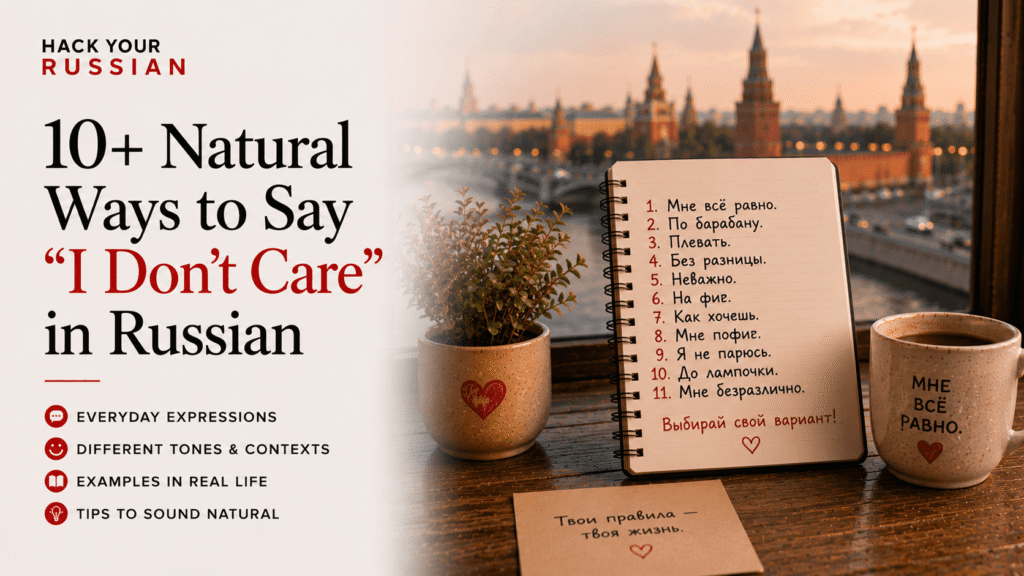
‘I don’t care’ – believe it or not but there are so many different ways to say it in Russian: formal, informal, idiomatic, slang and if you hear them you won’t be able to understand what they mean…unless you watch the video lesson below. And I assure you that you will hear these phrases a lot.
Table of Contents
Why “I Don’t Care” Is Tricky in Russian
The phrase “I don’t care” can sound very different depending on the situation. Sometimes it simply means “it doesn’t matter to me”. Sometimes it sounds cold, rude, aggressive, or even offensive.
Russian is exactly the same. There are neutral phrases like мне всё равно́ or мне нева́жно, but there are also very informal, rude, and vulgar expressions that you should understand but not necessarily use yourself.
For example:
Мне всё равно́.
I don’t care / It doesn’t matter to me. — neutral
Мне без ра́зницы.
It makes no difference to me. — casual / neutral
Мне по́фиг.
I don’t give a damn. — slang / informal
Мне плева́ть.
I don’t give a damn. — rude
Мне по́хуй.
I don’t give a f***. — vulgar
As you can see, these phrases are not interchangeable. Some of them are fine in everyday conversation, while others can sound harsh or disrespectful. That is why it is important to learn not only the translation, but also the tone. If you want to understand more informal expressions like this, check my guide to Russian slang words.
Different ways to say ‘I don’t care’ in Russian
1) So, the first phrase is the most common one – Мне всё равно́ = It’s all equal to me.
You can also ask a person – Тебе́ всё равно́? (You don’t care?) /
Вам всё равно́? (You don’t care – formal/plural)
Or you can use other pronouns in a Dative case – Ей всё равно́? Ему всё равно́? Нам всё равно́. Им всё равно́.
It is somewhat a universal way to say I don’t care in Russian – both formal and informal. There is even a famous Russian song with this phrase – А нам всё равно́ (No, we don’t care).
Example:
— Ты бу́дешь чай или ко́фе?
Will you have tea or coffee?
— Мне всё равно́.
I don’t mind. / Either is fine.
This phrase is useful because it is not vulgar or aggressive. However, depending on your intonation, it can still sound cold. If you say it with a flat or annoyed voice, it may sound like you are emotionally distant or irritated.
A softer version would be:
Мне всё равно́, как тебе́ удо́бно.
I don’t mind, whatever is convenient for you.
Мне всё равно́, выбира́й ты.
I don’t mind, you choose.
These versions sound more polite because they show that you are flexible, not indifferent in a negative way.
2) The second phrase which is really quite formal and rather dramatic is Мне безразли́чно – It makes no difference to me. Again you can change a pronoun in Dative case.
3) Or you can also say “Мне нева́жно”. It’s not important to me.
Важно (It’s important) – неважно (It’s not important)
Мне нева́жно отку́да ты (I don’t care where you are from).
You can also just skip a pronoun мне.
– Ты бу́дешь ко́фе или чай? (Would you like tea or coffee?)
– Нева́жно (It doesn’t matter / I don’t care)
Уже́ нева́жно – it doesn’t matter anymore.
– Прости́, что не рассказа́л тебе́ обо всём (Sorry that I didn’t tell you about everything)
– Уже́ нева́жно (It doesn’t matter anymore)
This word also has a meaning ‘плохо’ = badly, not well
Я нева́жно себя́ чу́вствую (I am not feeling well).
Она нева́жно игра́ет на гита́ре (She is bad at playing the guitar).
4) Another similar expression – Мне без ра́зницы! – There is no difference to me
– На како́й фильм пойдём? (What movie are we going to watch?)
– Мне без ра́зницы (There is no difference to me)
5) Or you can also say ‘Меня́ не волну́ет’ or ‘Меня́ это не волну́ет’ – I couldn’t care less
Меня не волну́ет твоя́ жизнь (I don’t care about your life). You can change a pronoun, or use a name or a noun in Accusative case.
На́шего дире́ктора не волну́ют на́ши пробле́мы (Our director doesn’t care about our problems)
6) Another way to show your indifference is to say ‘И что?’ – So what?
– У нас пробле́мы! Ско́ро коне́ц све́та! (We have problems! The end of the world is coming soon)
– И что? (So what?)
Note that it’s important to add this little conjunction if you really want to show your indifference.
7) Or one can say – А мне-то что? – Why should I care?
But it’s quite rude as well.
Let’s now look at some idiomatic expressions to say ‘I don’t care’ in Russian.
8) Мне по бараба́ну – I couldn’t care less.
Барабан is a drum. It’s like, it makes no drum to me…Well, it may sound a little rude, so don’t use it with strangers, only with people you know well.
9) Мне фиоле́тово – I don’t care at all.
Фиолетовый is a violet color. So the direct translation is ‘It’s all violet to me’
10) Мне паралле́льно – I couldn’t care less
Direct translation – It’s parallel to me
11) Мне до ла́мпочки – I don’t care at all
Literal translation: to me to lightbulb
Well, I believe that this expression is rather outdated, but is still used by older generation.
12) Another interesting expression is ‘Мне от э́того ни жа́рко, ни хо́лодно’ – It’s all the same to me.
You can change the order.
– У Игоря появи́лась но́вая де́вушка (Igor has a new girlfriend)
– Мне от э́того ни жа́рко, ни хо́лодно (I don’t care about that)
13) Next expression is very rude – Мне плева́ть – I don’t give a f*** (плевать means to spit)
It’s often used with a preposition НА + Accusative case
Мне плева́ть на неё (her), на него (him), на эту пробле́му (this problem),
на эту ситуа́цию (this situation).
Тебе плева́ть на меня? (You don’t give a f*** about me?)
Тебе плева́ть на твоих друзей? (You don’t give a f*** about your friends?)
14) Another expression of indifference is Меня не колы́шет – I don’t give a damn.
It’s also very rude and rather outdated (in my opinion) because it comes from the verb колыха́ть (to flap / to flicker), which is not used itself in speech nowadays. But you can still hear this expression from people
And some slang expressions to say ‘I don’t care’ in Russian. You will probably hear them more often than you expect.
15) Мне по́фиг – I don’t give a damn.
Фиг which is also called кукиш, дуля or шиш is the finger sign which means “you are not getting anything” or “zero”. And there are lots of crazy words and expressions derived from this фиг – Пофиг, нафиг, зафиг, нифига, дофига, and so on.
It’s often used without a pronoun to express the feeling of despair mixed with indifference (similar to whatever).
– Чему ты ра́дуешься? Ты потеря́л рабо́ту!
– Да, по́фиг! (Well, whatever!)
Please, note the по́фиг is not a swear word, it’s a euphemism unlike the next word.
16) Мне по́хуй – I don’t give a f***
It’s very rude and I am showing it to you only because it is a part of Russian language and you might hear it somewhere anyway. Even on TV. Some people, especially young people, use a reduction of this word, which is – ‘пох’
Мне пох – It’s funny because it’s like the same as saying ‘I don’t give a f’ and you stop. You didn’t swear but you made your point. But of course, it’s not a good idea to use this expression…no matter whether you are Russian or not.
If you are a beginner or intermediate learner, it is better to actively use the neutral phrases first:
мне всё равно́
мне нева́жно
мне без ра́зницы
You should understand the rude and vulgar phrases because you may hear them in movies, songs, YouTube videos or real conversations, but you do not need to use them yourself.
For a deeper explanation of rude and vulgar expressions, read my guide to Russian swear words and mat.
If you want to sound softer when accepting or refusing something, read my guide on how to accept and refuse in Russian.
You can find the audio files with pronunciation of these Russian phrases in my free guide ‘Essential Russian Words and Expressions to Understand Spoken Russian’.
This guide also contains audio files so that you can listen to these phrases on the go: while driving, walking, doing sport or brushing your teeth. Make sure that you repeat these phrases yourself and try to imitate my accent.
It’s also very important to know how to pronounce Russian words correctly as not every Russian letter is pronounced the same way as it’s written. There are certain Russian pronunciation rules that are really easy to learn.
If you wish to speak Russian, you should absolutely learn how to use Russian cases. Check the most comprehensive guides to Russian cases:

FAQ: How to Say “I Don’t Care” in Russian
How do you say “I don’t care” in Russian?
The most common way to say “I don’t care” in Russian is мне всё равно́. It literally means “it is all equal to me” and can also mean “it doesn’t matter to me.”
Is “мне всё равно” rude?
Мне всё равно́ is not rude by itself, but it can sound cold depending on the context and intonation. If you are choosing between tea and coffee, it is neutral. If someone is talking about their feelings, it can sound hurtful.
How do you say “I don’t mind” in Russian?
A softer way to say “I don’t mind” is я не про́тив. You can also say как тебе́ удо́бно — “whatever is convenient for you” or мне подойдёт любо́й вариа́нт — “any option works for me.”
What does “мне пофиг” mean?
Мне по́фиг means “I don’t give a damn” or “whatever.” It is slang and informal. It is not a strong swear word, but it can still sound rude in polite situations.
What is the most vulgar way to say “I don’t care” in Russian?
Мне по́хуй is one of the most vulgar ways to say “I don’t care” in Russian. It means “I don’t give a f***.” You may hear it in movies, songs, or informal speech, but it is not appropriate in polite conversation.
What is a polite way to say “it doesn’t matter” in Russian?
You can say мне нева́жно — “it is not important to me” or мне без ра́зницы — “it makes no difference to me.” In some situations, как тебе́ удо́бно — “whatever is convenient for you” sounds even more polite.
Can I use “мне фиолетово” in Russian?
Yes, but мне фиоле́тово is informal and a bit humorous. It literally means “it is violet to me,” but the real meaning is “I don’t care.” It is better for casual conversations, not formal situations.