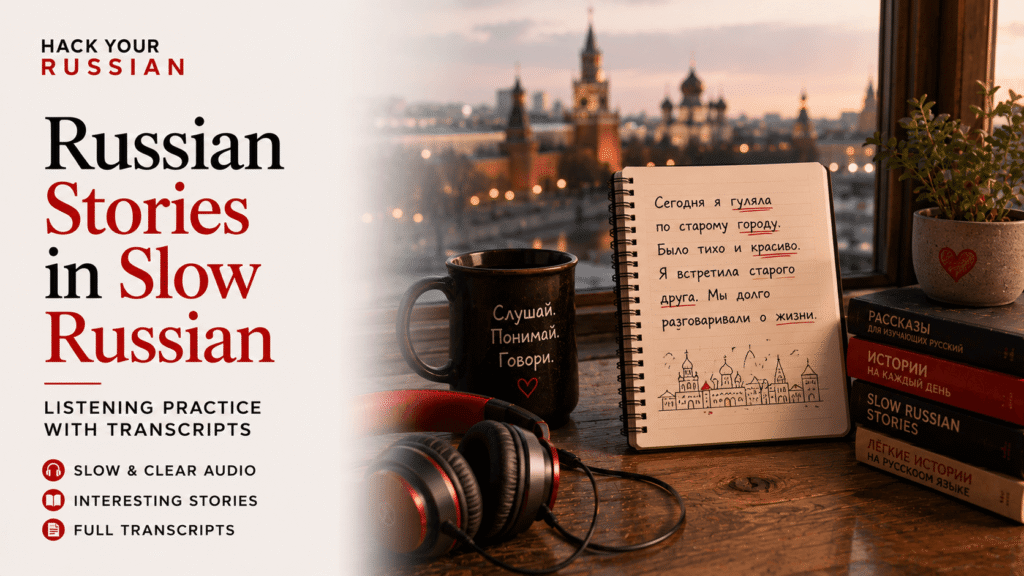
Listening to Russian can feel overwhelming at first. Native speakers talk fast, reduce sounds, connect words together, and use grammar forms that beginners do not always recognize immediately.
That is why stories in slow Russian are one of the best ways to improve your listening skills. They allow you to hear real Russian pronunciation, learn vocabulary in context, and get used to Russian grammar naturally — without memorizing endless tables.
Slow Russian stories are a great way to improve listening, pronunciation, and vocabulary at the same time. If you are still new to the language, start with the Russian alphabet guide and basic Russian phrases for beginners. Then use these stories together with my free Russian video lessons, Russian pronunciation rules, and Russian podcast to hear more Russian in context.
On this page, you will find easy Russian stories with subtitles. These stories are designed for beginner and elementary learners who want to understand spoken Russian better, expand their vocabulary, and discover interesting facts about Russian culture, history, and everyday life.
You can watch the videos, listen carefully, read the subtitles, repeat useful phrases, and come back to the stories again later. The more often you listen, the more natural Russian will start to feel.
Table of Contents
Why Slow Russian Stories Are So Useful
Slow Russian stories are helpful because they give you language in context. Instead of learning isolated words, you hear vocabulary inside a real sentence. This makes it much easier to remember new words and understand how Russian grammar works in practice. Stories are one of the easiest ways to learn Russian words in context.
For example, when you listen to a story about someone’s daily routine, you naturally hear verbs in the present tense. When you listen to a story about a historical person, you hear the past tense again and again. This kind of repeated exposure helps your brain notice patterns.
Slow stories are especially useful if you are tired of traditional grammar exercises. You still learn grammar, but in a softer and more natural way.
With slow Russian stories, you can improve:
- listening comprehension;
- pronunciation;
- vocabulary;
- grammar intuition;
- sentence structure;
- understanding of Russian culture;
- confidence with real spoken Russian.
The goal is not to understand every single word from the first try. The goal is to understand more each time you listen. To build everyday vocabulary, learn these essential Russian words and expressions.
Stories in slow Russian
Below you will find a collection of easy Russian stories with subtitles. Each story focuses on a different topic, so you can choose the one that interests you most.
Some stories are about famous people. Others are about Russian culture, history, daily life, or simple fictional situations. This variety will help you learn different types of vocabulary naturally.
Easy Russian story about Putin
Find out how Vladimir Putin spends his day in this easy Russian story. You will learn useful vocabulary related to daily routine, work, habits, time, movement, and everyday actions.
This story is useful because it is mostly in the present tense, which makes it easier for beginners to follow. You can listen for common verbs like “gets up”, “goes”, “works”, “meets”, “eats”, and “does”.
Use this story if you want to practice:
- daily routine vocabulary;
- present tense verbs;
- listening to simple Russian sentences;
- understanding short biographical texts.
Try watching the story once with subtitles and then again without subtitles.
You can get the transcript for this story from the page Russian podcasts.
Easy Russian story about Joseph Brodsky and his cats
Joseph Brodsky was a Russian and American poet and essayist. In this easy Russian story, you will learn about his special love for cats and discover a more personal side of this famous literary figure.
This story is especially useful if you want to practice the past tense in Russian. You will hear how Russian speakers describe events, habits, and biographical facts from the past.
Use this story to learn:
- past tense forms;
- vocabulary about animals and personality;
- simple biographical phrases;
- cultural vocabulary connected to literature.
If Russian verb forms confuse you, my Russian grammar books can help you review grammar in context.
It is a good story for learners who want to combine Russian listening practice with cultural knowledge.
You can get the transcript for this story from the page Russian podcasts.
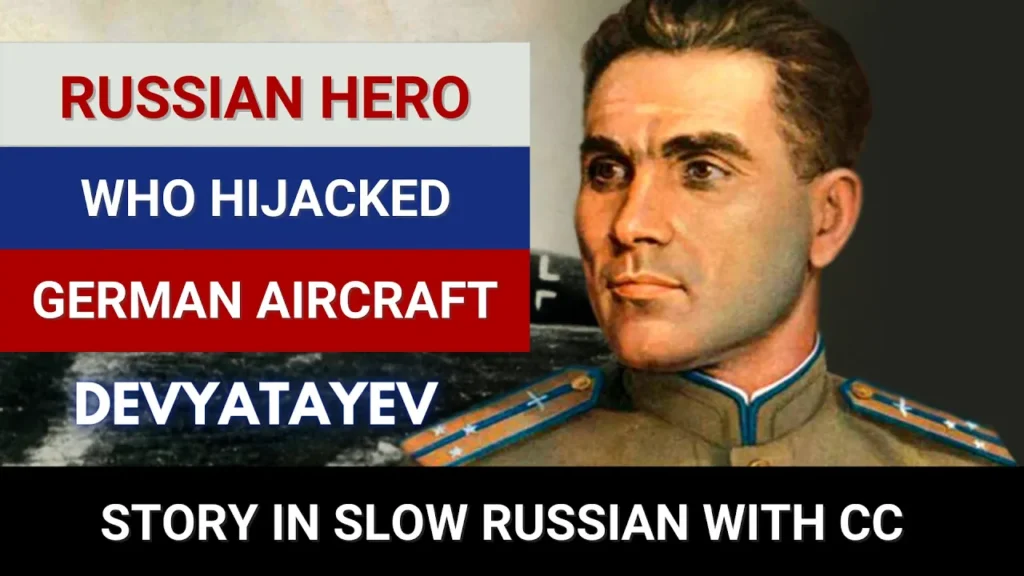
Slow Russian story about a Soviet war hero Devyatayev
This story is about Soviet fighter pilot Mikhail Devyatayev and his incredible escape from a Nazi concentration camp on the island of Usedom in the Baltic Sea.
Because this story is historical, it may contain more serious vocabulary than simple everyday stories. You may hear words connected to war, courage, danger, escape, and survival.
Use this story if you want to practice:
- historical vocabulary;
- past tense narration;
- listening to longer Russian sentences;
- understanding real historical events in simple Russian.
Do not worry if this story feels more difficult. Historical topics often include words that are less common in everyday conversations, so it is normal to listen more than once.
Russian Story in Slow Russian | Interlinear Text in Russian
This story was created to show how the interlinear method of reading works. The story is about a bear who ate too much snow and got sick.
Interlinear text is useful because it helps you understand Russian sentence structure without translating everything separately. You can see how Russian words work together and compare them with the English meaning.
This type of story is especially helpful for learners who want to:
- read Russian more confidently;
- understand sentence structure;
- learn vocabulary in context;
- stop translating word by word;
- get used to Russian grammar naturally.
The story itself is simple and memorable, which makes it a good choice for beginners.
Get the PDF file and cartoon with Russian and English subtitles here – Russian cartoon “Зимняя сказка”.
How do Russians celebrate New Year | Story in slow Russian
New Year is one of the most important holidays in Russian-speaking culture. In this slow Russian story, you will hear about how Russian people celebrate New Year and learn useful holiday vocabulary.
This story is great for learning words and phrases connected to:
- holidays;
- family traditions;
- food;
- decorations;
- celebrations;
- winter;
- Russian culture.
You can use this story not only for listening practice, but also to understand Russian traditions better. If you are interested in culture, this is a good story to start with.
For more cultural lessons, explore Russian culture articles on the blog.
If you want more free listening practice, explore my free Russian video lessons with other stories in slow Russian.
How to Study with Slow Russian Stories
To get the best results, do not just watch the video once. Use each story as a small listening lesson.
Here is a simple method:
1. Listen without stopping
First, listen to the story from beginning to end. Do not pause after every word. Try to understand the general idea.
2. Watch again with subtitles
Then watch the story with Russian or English subtitles. Notice words you already know and write down the most useful new vocabulary.
3. Repeat short phrases aloud
Choose several short phrases and repeat them after the speaker. This will help you improve Russian pronunciation and rhythm.
4. Listen again without subtitles
After working with the text, listen one more time without subtitles. You will probably understand much more than before.
5. Come back later
Do not worry if you forget words quickly. Repetition is normal. Come back to the same story after a few days and listen again.
This method is simple, but very effective for beginners.
Who Are These Russian Stories For?
These stories are best for learners who already know the Russian alphabet and can read simple words in Cyrillic. You do not need to understand advanced grammar, but it helps if you know basic Russian phrases and common verbs.
These slow Russian stories are especially useful for:
| Level | How to use the stories |
|---|---|
| Complete beginner | Listen for familiar words and pronunciation |
| A1 learner | Read subtitles and learn basic vocabulary |
| A2 learner | Focus on grammar patterns and sentence structure |
| Intermediate learner | Use the stories for shadowing and fluency practice |
If you are a complete beginner, start slowly. Even understanding a few words is already progress.
Try Shadowing with Slow Russian Stories
Shadowing means listening to a phrase and repeating it aloud as closely as possible. It is one of the best ways to improve pronunciation, rhythm, and confidence.
You can use slow Russian stories for shadowing like this:
- Choose one short sentence.
- Listen to it carefully.
- Pause the video.
- Repeat the sentence aloud.
- Try to imitate the pronunciation, stress, and intonation.
- Repeat the same sentence several times.
Do not choose long sentences at first. Start with short phrases and repeat them until they feel natural.
Shadowing helps you move from passive understanding to active speaking.
Shadowing is especially useful if you want to speak Russian like a native.
Practice: How Much Did You Understand?
After watching one story, ask yourself these questions:
- Who is the story about?
- Where does the story happen?
- Is the story in the present tense or past tense?
- What five new words did you learn?
- Can you retell the story in one or two simple Russian sentences?
- Which phrase would you like to remember?
- Can you listen again without subtitles?
You can also write a very short summary in Russian. For example:
Э́та исто́рия о…
This story is about…
Гла́вный геро́й…
The main character…
Мне понра́вилась э́та исто́рия, потому́ что…
I liked this story because…
This will help you turn listening practice into active Russian practice.
Want more lessons like this? Explore my Russian learning resources.
If you have recently started to learn Russian language, you should absolutely get my free guide ‘Essential Russian Words and Expressions to Understand Spoken Russian’.
This guide also contains audio files so that you can listen to these phrases on the go: while driving, walking, doing sport or brushing your teeth. Make sure that you repeat these phrases yourself and try to imitate my accent.
It’s also very important to know how to pronounce Russian words correctly as not every Russian letter is pronounced the same way as it’s written. There are certain Russian pronunciation rules that are really easy to learn.
If you wish to speak Russian, you should absolutely learn how to use Russian cases. Check the most comprehensive guides to Russian cases:

FAQ
Are slow Russian stories good for beginners?
Yes. Slow Russian stories are excellent for beginners because they help you hear Russian vocabulary and grammar in context. They are easier than normal native-speed content and more natural than isolated textbook sentences.
Should I listen with or without subtitles?
At first, subtitles are very useful. Watch the story with subtitles, write down useful words, and then listen again without subtitles. This will help you improve both listening and reading skills.
How many times should I listen to the same story?
Listen as many times as you need. Repeating the same story several times is very effective because you notice more details each time.
Can I learn Russian grammar from stories?
Yes, stories help you notice grammar patterns naturally. For example, stories about daily routine often use the present tense, while biographical or historical stories often use the past tense.
What should I do if I do not understand the story?
Do not panic. Start with the general idea. Watch with subtitles, write down a few important words, and listen again later. Understanding grows with repetition.
Are slow Russian stories better than grammar exercises?
They are not a replacement for grammar, but they are a great complement. Grammar exercises help you understand rules, while stories help you see those rules in real language.
How can I use these stories to improve speaking?
Repeat short sentences aloud, imitate the speaker, and try to retell the story in simple Russian. This will help you move from passive listening to active speaking.