If you want to learn Russian, the alphabet is the best place to start. Russian uses the Cyrillic alphabet, and at first it may look confusing or even intimidating. But once you understand how the letters work, you will be able to read Russian words, recognize familiar vocabulary, pronounce words more accurately, and stop depending on Latin transcription.
Many beginners try to learn Russian with transliteration, but this quickly becomes limiting. Latin letters cannot show Russian sounds correctly, and the same Russian word may be written in different ways in English letters. This can create confusion instead of helping you.
For example, the Russian word Приве́т may be written as privet, privyet, or preevyet in Latin letters. But in Russian, it is always written the same way: Приве́т.
Learning Cyrillic gives you a real foundation. It helps you read signs, menus, maps, textbooks, subtitles, messages, and simple Russian phrases from the beginning.
Table of Contents
Is the Russian Alphabet Difficult to Learn?
The Russian alphabet looks difficult at first, but it is much easier than many beginners expect. There are 33 letters in the Russian alphabet, but you do not need to learn them all randomly. It is much better to learn them in groups.
Some letters look and sound almost the same as in English:
А, К, М, О, Т
Some letters look familiar but sound different:
В, Е, Н, Р, С, У, Х
Some letters look strange but have familiar sounds:
Б, Г, Д, З, И, Л, П, Ф, Э
And some letters represent sounds that do not exist in English or are more difficult for English speakers:
Ы, Ж, Ц, Ч, Ш, Щ, Ю, Я, Ё
When you learn the alphabet this way, Cyrillic becomes much less scary. You are not memorizing 33 random symbols. You are building connections between Russian letters, familiar sounds, and useful words.
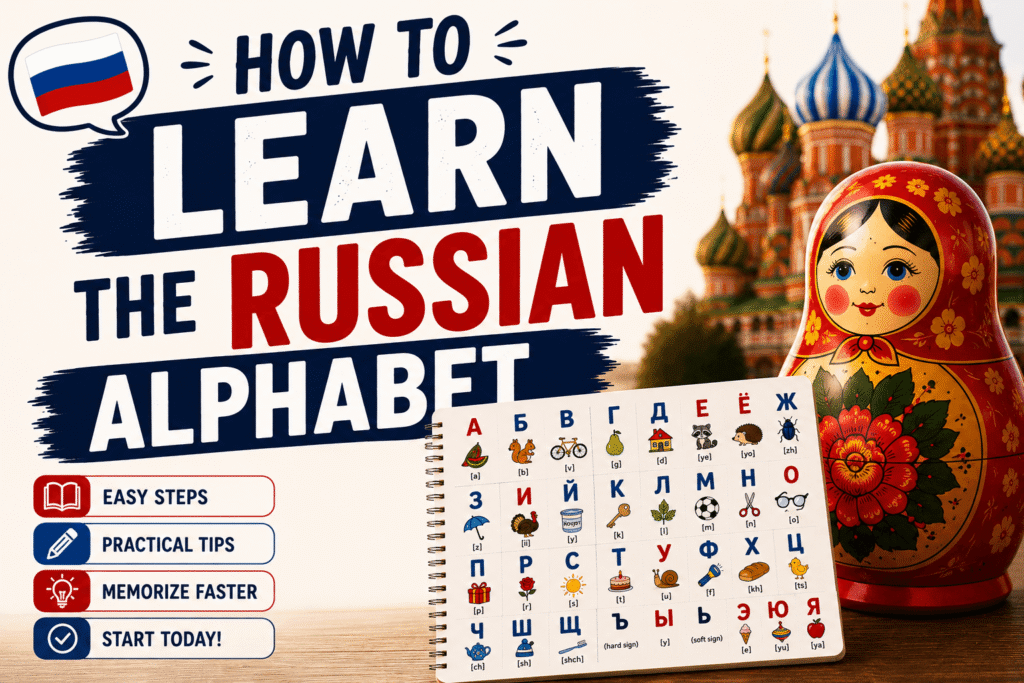
Let’s first look carefully through the whole list of Russian letters. Try to guess how they might sound. By the way, there are 33 letters in a Russian alphabet.

Learn the Russian Alphabet by Letter Groups
The Russian alphabet has 33 letters, but you do not need to memorize them all at once. It is much easier to learn Cyrillic by groups because your brain can compare new letters with letters you already know. Some Russian letters look and sound like English letters, some look familiar but have a different sound, and some are completely new. When you study them in groups, the alphabet becomes less overwhelming, and you start reading real Russian words much faster.
Russian letters that are (almost) the same.
А а – Pronounce it like the English “a” in words like “bar” or “partner”.
К к – Pronounce it like the English “k” in “kit” or “kayak”.
М м – Pronounce it like the English “m” in “mother”.
O o – When it is a stressed vowel, it is pronounced like the “o” in “bog”. If un-stressed should be pronounced more like the letter “a”.
Т т – Pronounce it like the “t” in “table” (Please, note that its hand-written (and italic) form is written this way “т” (Yeah, I know it looks like the English “m”).
To better remember these Russian letters and learn some Russian-English similar words and cognates, let’s watch this video lesson.
Learn Russian letters and sounds. Part 1. Russian letters that are almost the same as in English
Russian letters that look like English letters but sound different.
В в – No, it is not the English “B”. It is rather an equivalent to the English letter “v” and pronounced like the “v” in “vacation”.
Е е – No, it’s not the English “E”. It sounds like the “ye” in “yes”.
Н н – No, it’s not the English “H”. It is rather an equivalent to the English letter “N” and pronounced like the “n” in “nobody”.
Р р – No, it’s not the English “P”. There is a common mistake of people who don’t know Russian alphabet to read a Russian word “Ресторан” as “pectopah”. Have you guessed what this word is? Ресторан = restaurant in English. So, the Russian letter “P” is rather an equivalent to the English letter “R”. It is pronounced like the “r” in “rabbit”, but it is rolled (with a Russian accent).
С с – No, it’s not the English “C”. It is rather an equivalent to the English letter “S”. It is pronounced like the “s” in “stay”.
У у – No, it’s not the English “Y”. This letter should be pronounced like the “oo” in “look” or “moon”.
Х х – No, it’s not the English “X”. It is pronounced like the “h” in “hat”.
To better remember these Russian letters and learn some Russian-English similar words and cognates, let’s watch this video lesson.
Learn Russian letters and sounds. Part 2.
Russian letters that look like English but sound differently
Russian letters that look strange, but have familiar sounds
Б б – Well, this letter looks almost like its English equivalent in its lower case form -“b”. It is pronounced like the “b” in “bar”.
Г г – This one is equivalent to the English letter “g”. It is pronounced like the “g” in “get”.
Д д – Equivalent to the English letter “d”. It is pronounced like the “d” in “day”.
З з – No, it’s not a number 3. This letter is equivalent to the English letter “z”. It is pronounced like the “z” in “zap”.
И и – This letter is sometimes equivalent to the English letter “i”, the short ‘ee’ sound. Pronounced like the “i” in “mix”. Please, note that a hand-written form for “и” looks a little like the English “u”).
Л л – Equivalent to the English letter “L”. It is pronounced like the “l” in “letter”.
П п – Equivalent to the English letter “p”. Pronounced like the “p” in “parrot”.
Ф ф – Equivalent to the English letter “f”. Pronounced like the “f” in “father”.
Э э – Pronounced like the “e” in “Ted”.
To better remember these Russian letters and learn some Russian-English similar words and cognates, let’s watch this video lesson.
Learn Russian letters and sounds. Part 3.
Russian Letters that look Strange but Have Familiar Sounds
Russian letters and sounds that don’t exist in English
Ю ю – This letter is pronounced exactly the same as the English pronoun “You”.
Я я – It is pronounced like a combination”ya” in “yard”.
Ё ё – It is pronounced like “yo” in “your”. (please, note that nowadays this letter is often written simply as Е е. Russian people are lazy)
Ж ж – It is pronounced like “s” in “pleasure”
Ц ц – This one is similar to the “ts” sound in “sits” or “its”.
Ч ч – It is pronounced like the “ch” in “chair”.
Ш ш – It is pronounced like the “sh” in “shout”.
Щ щ – It is pronounced like “sh” in a word “shit”, you should put your tongue on the roof of your mouth. You can find it difficult to differentiate”ш” and “щ”.
Ы ы – It is pronounced like “i” in “sit”. (say it with your tongue slightly back in your mouth.)
Й й – This letter is used to form diphthongs. So “oй” is like the “oy” sound in “toy” or “aй” in “sight”.
To better remember these Russian letters and learn some Russian-English similar words and cognates, let’s watch this video lesson.
Learn Russian letters and sounds. Part 4.
Russian Letters and Sounds that don’t exist in English
Pronunciation Symbols
These signs have no sound on their own, but are still considered letters. There have been some attempts throughout history when these letters were about to be replaced by an apostrophe but it didn’t happen. So, essentially what you need to know is that they basically serve almost the same role as an English apostrophe but with certain peculiarities. Many foreigners find it difficult to understand how to pronounce these two signs since they don’t have any sound. There are some easy tips to help you understand how to pronounce these Russian hard and soft signs.
ъ – The ‘Hard Sign’. It is rarely used in words. It indicates a slight pause between sylables. Examples of words: подъезд, объявление, съёмка (without a slight pause these words would sound completely different and people might not understand what you mean).
ь – The ‘Soft Sign’. It makes the previous letter ‘soft’. Think of the “f” sound in the word “few”.
Note that handwritten Russian letters differ from printed letters and it might be a good idea to learn how to write by hand in Russian as soon as it’s possible. In addition, Russian cursive is really beautiful and fun to learn with the right materials.
It’s also very important to know how to pronounce Russian words correctly as not every Russian letter is pronounced the same way as it’s written. There are certain Russian pronunciation rules that are really easy to learn.
Commonly Confused Russian Letters
Here are some letters beginners often mix up:
В and Б
В sounds like V. Б sounds like B.
Н and И
Н sounds like N. И sounds like EE.
Р and П
Р sounds like R. П sounds like P.
С and К
С sounds like S. К sounds like K.
Ш and Щ
Both sound similar to “sh,” but Щ is softer and longer.
Е and Э
Е often sounds like “ye,” while Э sounds more like “e” in “bed.”
Examples:
банк (bank)
вино́ (wine)
парк (park)
ру́сский (Russian)
школа (school)
ещё (more / still)
Do not worry if you confuse them at first. The key is not to stare at the alphabet table forever. Read real words and your recognition will improve naturally.
Why Russian Letter Stress Matters
Learning the alphabet is only the first step. In Russian, word stress is very important. The same letter can sound different depending on whether it is stressed or unstressed.
For example, the letter О sounds like “o” when it is stressed, but more like “a” when it is unstressed.
Examples:
дом (house)
молоко́ (milk)
хорошо́ (good / well)
This is why it is useful to learn new words with stress marks at the beginning. Stress marks are not normally used in everyday Russian texts, but they are very helpful for learners.
When you learn a new word, try to remember not only the letters, but also the stressed syllable.
What Are the Russian Hard Sign and Soft Sign?
Russian has two special letters that do not have their own sound:
ъ — hard sign
ь — soft sign
The hard sign ъ is rare. It usually creates a small separation between parts of a word.
Examples:
подъе́зд (entrance)
объявле́ние (announcement)
съёмка (filming)
The soft sign ь is much more common. It makes the previous consonant soft.
Examples:
день (day)
мать (mother)
любовь (love)
At the beginning, you do not need to understand every detail of hard and soft signs. Just remember that they affect pronunciation and meaning, even though they do not represent a separate sound. You should learn how to correctly pronounce a hard sign and a soft sign as soon as possible to avoid misunderstanding.
Should You Learn Russian Cursive?
Yes, but not on the first day. First, learn to recognize printed Russian letters. Then, when you feel more confident, start learning handwritten and cursive forms.
Russian cursive can look very different from printed letters. For example, handwritten т may look like English m, and handwritten д may look unusual for beginners. This is why many learners feel shocked when they first see Russian handwriting.
However, learning cursive is useful if you want to:
- write notes by hand
- read handwritten text
- understand real Russian notebooks or forms
- improve your memory of letters
- feel more confident with the writing system
You do not have to master cursive immediately, but it is a great next step after learning the printed alphabet. You can check my Russian handwriting course.
How to Practice Reading Russian Words
Once you know the letters, start reading simple words. Do not wait until you feel “ready.” Reading is what makes the alphabet stick in your memory.
Start with short words:
дом (house)
кот (cat)
мама (mom)
суп (soup)
такси́ (taxi)
Then move to familiar international words:
рестора́н (restaurant)
телефо́н (phone)
му́зыка (music)
аэропо́рт (airport)
компью́тер (computer)
These words are great because they help you practice Cyrillic while recognizing familiar vocabulary.
How to Stop Relying on Transliteration
Transliteration can be useful for the first few minutes, but it should not become your main learning tool. If you always read Russian through English letters, your pronunciation and reading skills will develop more slowly.
Instead of writing: privet
Train yourself to read: приве́т
Instead of writing: spasibo
Read: спаси́бо
Instead of writing: kak dela
Read: как дела́
At first, Cyrillic will slow you down. That is normal. But after some practice, reading Russian letters directly will become much easier and more natural.
Common Mistakes When Learning the Russian Alphabet
1. Learning letters only as names, not sounds
Knowing the name of a letter is useful, but reading depends on sounds. Focus on how the letter is pronounced in real words.
2. Relying too much on Latin transcription
Transliteration can help at the very beginning, but it cannot show Russian pronunciation accurately. Move to Cyrillic as soon as possible.
3. Ignoring word stress
Russian stress affects pronunciation. Learn new words with stress marks when possible.
4. Confusing familiar-looking letters
Letters like В, Н, Р, С, У, and Х look familiar to English speakers but represent different sounds. Review them often.
5. Trying to learn everything in one sitting
It is better to study letters in groups and review them over several days than to memorize the whole alphabet once and forget it.
6. Avoiding handwriting completely
Writing letters by hand helps memory. Even if you mostly type, handwriting is useful for learning the alphabet.
Want more lessons like this? Explore my Russian learning resources.
You can also browse my free Russian video lessons.
If you have recently started to learn Russian language, you should absolutely have my free guide ‘Essential Russian Words and Expressions to Understand Spoken Russian’.
It’s also very important to know how to pronounce Russian words correctly as not every Russian letter is pronounced the same way as it’s written. There are certain Russian pronunciation rules that are really easy to learn.
If you wish to speak Russian, you should absolutely learn how to use Russian cases. Check the most comprehensive guides to Russian cases:
FAQ: Russian Alphabet for Beginners
How many letters are in the Russian alphabet?
There are 33 letters in the Russian alphabet. Some look and sound similar to English letters, some look familiar but sound different, and some represent sounds that do not exist in English.
How long does it take to learn Cyrillic?
You can learn to recognize most Cyrillic letters in a few days or one week. To read Russian words comfortably, you need more practice with real words, stress, and pronunciation.
Should I learn Russian with Latin transcription?
Latin transcription can help for a very short time, but it is better to learn Cyrillic early. Transliteration cannot show Russian pronunciation clearly and may slow down your progress.
What are the hard sign and soft sign in Russian?
The hard sign ъ and soft sign ь do not have their own sound. The hard sign creates a small separation, while the soft sign makes the previous consonant soft.
Do I need to learn Russian cursive?
You do not need to learn cursive on the first day, but it is useful later. Russian cursive helps you write by hand, read handwritten notes, and understand real Russian handwriting.
What should I learn after the Russian alphabet?
After the alphabet, learn basic pronunciation rules, common Russian phrases, greetings, simple questions, and beginner vocabulary. This will help you start reading and speaking Russian faster.