
If you have been learning Russian for some time, you already know how to say ‘yes’ and ‘no’ in Russian. Yes is ‘да’ and no is ‘нет’. But the problem is that Russian natives can use many other ways to accept and refuse something in Russian, including slang and idiomatic Russian expressions. Therefore, you should absolutely know them because they are not often easy to understand. In this post, I have collected the most common ways to say ‘yes’ and ‘no’ in Russian that you absolutely need to feel confident speaking Russian with natives. You can first watch a video lesson ‘How to Accept and Refuse in Russian | Different Ways to Say ‘Yes’ and ‘No’ in Russian’ and find a summary just below.
Table of Contents
Why You Need More Than Да and Нет in Russian
In Russian, saying да and нет is not always enough. Of course, these two words are essential, but real conversations are usually more emotional, polite, indirect, or expressive. Native speakers rarely answer every question with a simple yes or no. Instead, they use different phrases depending on the situation, their mood, and the relationship with the person they are talking to.
For example, if a friend invites you for coffee, you can say да, but it may sound a little too plain. A more natural answer would be с удово́льствием — “with pleasure”, почему́ бы и нет? — “why not?”, or отли́чная иде́я — “great idea”.
The same thing happens when you refuse something. A direct нет can sometimes sound cold, especially if someone offers help, invites you somewhere, or suggests an idea. In many situations, it is better to soften your answer with phrases like я не уве́рен / я не уве́рена — “I’m not sure”, сего́дня не получи́тся — “it won’t work today”, or может быть, в друго́й раз — “maybe another time”.
That is why learning different ways to accept and refuse in Russian will help you sound more natural, polite, and confident in real conversations. If you want to sound more polite in everyday Russian, you may also like my guide to polite Russian words and phrases.
Video lesson: How to Accept and Refuse in Russian
Different ways to say ‘yes’ in Russian
The simplest way to say yes in Russian is да. It is short, neutral, and easy to remember. However, native speakers often use other expressions because they want to show enthusiasm, agreement, politeness, hesitation, or emotion.
Compare these answers:
- Ла́дно [лАдна] – Fine
- Хорошо́ [харашО] – Good
- Коне́чно [кан’Эшна] – Of course
- Идёт [ид’От] – alright, deal
- Отли́чная иде́я [атлИчнай’а ид’Эй’а] – Excellent idea
- Я согла́сен [й’а саглАсин] – I agree (for a man)
- Я согла́сна [й’а саглАсна] – I agree (for a woman)
- Договори́лись [дагаварИлис’] – It’s a deal, we agreed
- С удово́льствием [судавОл’ствий’эм] – With pleasure
- Почему́ бы и нет? [пачимУбы ин’Эт] – Why not?
All of these phrases can mean “yes”, but they do not feel exactly the same. Some are neutral, some are warm and friendly, and some are better for making plans.
For example, с удово́льствием sounds very positive and polite. You can use it when someone offers you tea, invites you somewhere, or asks if you would like to do something pleasant.
– Ты хо́чешь ча́ю? (Would you like some tea?)
– С удово́льствием! (With pleasure!)
On the other hand, договори́лись is very useful when you agree on a plan, time, meeting, or arrangement.
– Встре́тимся в семь? (Shall we meet at seven?)
– Договори́лись! (Deal!)
Here are some short situations in Russian that illustrate these expressions to accept something in Russian:


– Would you like one more cup of coffee?
– Why not?

– Would you like (do you desire) hot tea?
– With pleasure!

– Do you agree to marry me?
– I agree!
Different ways to say ‘no’ in Russian
Saying no can be difficult in any language. In Russian, a simple нет is correct, but it can sometimes sound too direct if you do not add anything else.
For example, imagine someone invites you somewhere:
– Пойдём в кино́? (Shall we go to the cinema?)
If you simply answer:
– Нет (No).
It is grammatically correct, but it may sound cold.
Here are some good alternatives:
- Мо́жет быть, в друго́й раз – Maybe another time.
- Сего́дня не получи́тся – It won’t work today.
- Меня́ э́то не интересу́ет [минА Эта ниинтирисУйит] – I am not into this stuff
- Ни за что́ [низаштО] – Not in a million years.
- Ни в ко́ем слу́чае [нифкОйим слУчии] – By no means
- Не́тушки [нЭтушки] – No way!
- Плоха́я иде́я [плахАйа ид’Эй’а] – Bad idea
- Я не уве́рен [й’а ниувЭрин] – I am not sure (for a man)
- Я не уве́рена [й’а ниувЭрина] – I am not sure (for a woman)
- Нет жела́ния [нэт жылАнийа] – I have no desire
- Я не хочу́ [йа нихачУ] – I don’t want to
- Неохо́та [ниахОта] – I don’t feel like
These phrases are very useful because they allow you to refuse something without sounding too harsh. They are especially important if you want to keep the conversation friendly.
In Russian, tone matters a lot. You can refuse directly with нет, but in many social situations it is better to give a small explanation or use a softer phrase.
If you want to refuse politely, use soft phrases such as я не уве́рен / я не уве́рена, сего́дня не получи́тся, or мо́жет быть, в друго́й раз.
If you want to sound emotional or very firm, you can use stronger phrases like ни за что́ or ни в ко́ем слу́чае. But be careful: these expressions are not suitable for every situation.
Here are some short situations in Russian that illustrate these expressions to accept something in Russian:

– What about going to the bar after work?
– I have no desire today!
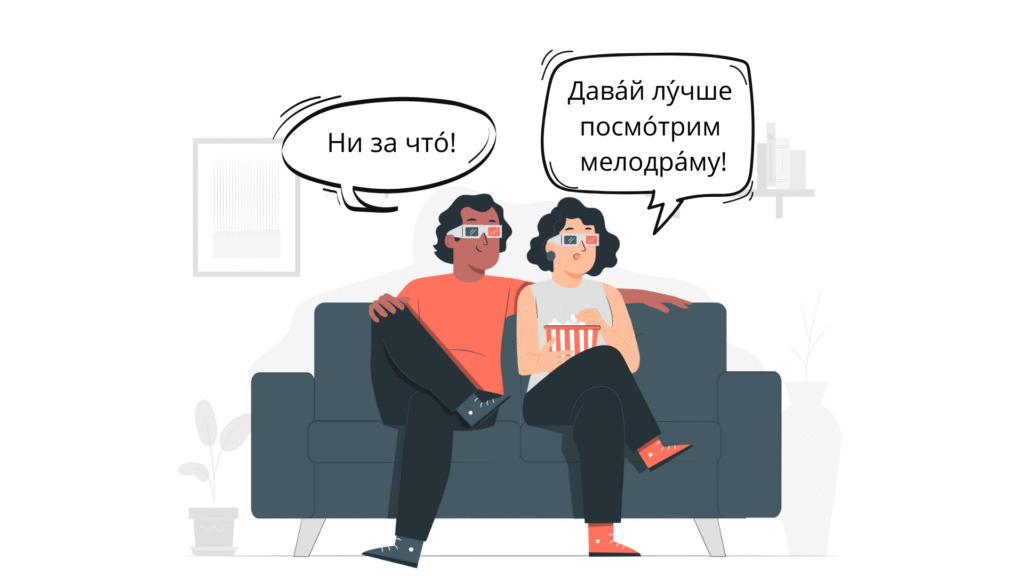
– Let’s better watch a soap opera!
– No way!
Learnin different way to accept and refuse in Russian is very useful, but depending on the situation, you may also need other important phrases: learn how to praise someone in Russian, how to encourage someone in Russian, and how to wish luck in Russian. These phrases will help you react naturally when someone does something well, feels nervous, or needs support.
Want more lessons like this? Explore my Russian learning resources.
You can also browse my free Russian video lessons.
If you have recently started to learn Russian language, you should absolutely have my free guide ‘Essential Russian Words and Expressions to Understand Spoken Russian’.
It’s also very important to know how to pronounce Russian words correctly as not every Russian letter is pronounced the same way as it’s written. There are certain Russian pronunciation rules that are really easy to learn.
If you wish to speak Russian, you should absolutely learn how to use Russian cases. Check the most comprehensive guides to Russian cases:

FAQ: How to Accept and Refuse in Russian
How do you say yes in Russian?
The basic way to say yes in Russian is да. However, native speakers also use phrases like коне́чно — “of course”, хорошо́ — “okay / good”, с удово́льствием — “with pleasure”, and почему́ бы и нет? — “why not?”
How do you say no in Russian?
The basic way to say no in Russian is нет. You can also say я не хочу́ — “I don’t want to”, я не уве́рен / я не уве́рена — “I’m not sure”, неохо́та — “I don’t feel like it”, or ни за что́ — “no way”.
How do you politely refuse in Russian?
To refuse politely in Russian, avoid using only нет. Softer phrases include сего́дня не получи́тся — “it won’t work today”, мо́жет быть, в друго́й раз — “maybe another time”, or я не уве́рен / я не уве́рена — “I’m not sure”.
What is the most polite way to accept something in Russian?
One of the most polite ways to accept something in Russian is с удово́льствием, which means “with pleasure”. You can use it when someone offers you food, tea, help, or invites you somewhere.
Example:
— Хо́чешь ча́ю?
Would you like some tea?
— С удово́льствием!
With pleasure!
What does “договорились” mean in Russian?
Договори́лись means “agreed”, “deal”, or “it’s settled”. It is often used when people agree on a plan, meeting, time, or arrangement.
Example:
— Встре́тимся в семь?
Shall we meet at seven?
— Договори́лись!
Deal!
What does “почему бы и нет” mean?
Почему́ бы и нет? means “Why not?” It is a casual and friendly way to accept an offer or suggestion when you are open to the idea.
Example:
— Пойдём в кино́?
Shall we go to the cinema?
— Почему́ бы и нет?
Why not?
Can I use “ладно” instead of “да”?
Sometimes, yes. Ла́дно means “okay” or “fine”. It can be used to accept something, but it sounds more informal than да, хорошо́, or коне́чно.
What is the strongest way to say no in Russian?
Strong ways to say no in Russian include ни за что́ — “not in a million years / no way” and ни в ко́ем слу́чае — “by no means”. These expressions are very firm, so use them carefully.