Russian grammar can be really confusing, and many learners are convinced that the only way to master the language is to fully embrace its grammar rules — which might actually be their biggest mistake. Do you want to know why every Russian teacher insists that you must study grammar? To be honest, it’s simply easier for teachers to teach that way — with clear rules and structured exercises. Creating materials that help you absorb grammar effortlessly is much more challenging.
Did I say effortlessly? Yes, EFFORTLESSLY! You can learn Russian grammar naturally — through songs, movies, and special podcasts where key structures are repeated so many times that you end up remembering them without even trying.
For example, there is a sentence: “Путин любит играть в хоккей” (Putin likes playing hockey). You heard this sentence and now I ask you: “Путин любит играть в футбол?” (Does Putin like playing football?). Imagine that you cannot see a previous sentence and can only remember what was said. Try to respond to my question. It will be “Нет, Путин не любит играть в футбол. Он любит играть в хоккей” (No, Putin doesn’t like playing football. He likes playing hockey). I am still not convinced and I ask you: “Это Трамп любит играть в хоккей?” (Is it Trump who likes playing hockey?), you should reply: “Нет, это не Трамп, а Путин любит играть в хоккей” (No, it’s not Trump but Putin who likes playing hockey). I continue: “Ну а кто тогда любит играть в футбол?” (But who then likes playing football?). You can reply: “Я люблю играть в футбол” (I like playing football). That is a very good technique to learn Russian language. You can discover my Hack Your Russian Elementary Podcast for more examples like this one.
So, why is it not a good idea to focus on Russian grammar at the very beginning? Because it prevents you from learning real Russian and will slow down your progress toward speaking fluently. Of course, you still need to learn some basics: word order, pronouns, a general understanding of how the Russian language works, why we use cases, and how to conjugate verbs. But don’t get too caught up in grammar.
The biggest mistake many Russian learners make is buying countless grammar books, enrolling in language courses (a huge mistake!), and believing that this will help them start speaking Russian soon. Well, it depends on your expectations. If you are patient and extremely disciplined, you might start speaking Russian in about three years — if you focus mainly on grammar. But if your goal is to start speaking within five or six months, forget about grammar for now and focus on building your vocabulary instead.
However, it’s also important to know how to learn vocabulary effectively. Flashcards? Duolingo? Other language apps? It all depends on your preferences. Personally, I don’t like either flashcards or Duolingo — and here’s why: you don’t learn words in real context. A much better option is to use interlinear texts and watch authentic Russian materials with Russian or dual subtitles.
It’s also important to see the big picture when you learn Russian grammar. So, instead of just learning the endings for each Russian case, learn all situations when a particular case is needed. The reason why you should dedicate time to each separate case is because you will learn both grammar and useful conversational constructions at the same time. For example, while discovering the Russian Genitive case, you will learn:
– how to speak about things you have and you don’t have (in present, past and future tenses);
– the ways to ask people how to get to a particular place;
– the ways to describe your location;
– how to say the date or respond to some questions that require the date;
– how to wish something good (or bad) to people;
– and so much more!
So, instead of focusing on the grammar part, you should see the opportunities to use certain new constructions in your speech straight away.
Table of Contents
How to learn Russian cases effectively
A good example of a person who managed to learn Russian language without focusing on Russian grammar is Benjamin Rich from Bald and Bankrupt. Yes, his Russian language skills are not perfect: he makes some grammar mistakes, his pronunciation is not perfect, and he can sometimes misunderstand Russian natives. Nevertheless, he can perfectly travel in Russian and some other post-Soviet countries where people speak Russian language. He can easily interact with people in Russian language and his comprehension of Russian is really impressive. However, it doesn’t mean that he should stop improving his Russian language. But here is the point – you first need to start speaking Russian language and improve, polish your grammar throughout the way. You don’t need to be perfect in the beginning.
The Problem with Learning Russian Grammar First
Many learners begin Russian by opening a grammar book and trying to memorize tables. They learn the nominative case, genitive endings, accusative rules, verb conjugations, and long lists of exceptions. This can feel productive, but it often creates a problem: learners understand rules on paper, but cannot use them in real conversation.
For example, a student may know that the genitive case is used after нет, but still freeze when they need to say:
У меня́ нет вре́мени (I don’t have time).
У меня́ нет де́нег (I don’t have money).
У меня́ нет вопро́сов (I have no questions).
Why does this happen? Because knowing a rule is not the same as being able to use it automatically. Speaking requires quick access to patterns, not only theoretical knowledge.
That is why beginners should learn Russian grammar through useful phrases and repeated structures. Instead of memorizing grammar first and speaking later, you can learn phrases that already contain grammar.
For example:
Я хочу́ пить (I want to drink).
Мне ну́жно идти́ (I need to go).
У меня́ есть вопро́с (I have a question).
У меня́ нет вре́мени (I don’t have time).
These sentences teach grammar, but they also teach communication. This is much more useful than memorizing endings without knowing when you will actually use them.
Better Alternatives to Traditional Grammar Study
If you do not want to start with heavy grammar, you still need a smart learning system. “No grammar” should not mean “no structure”. It means learning grammar through context, repetition, and real use.
Here are better alternatives:
1) Try to learn Russian grammar a natural way with interlinear texts (texts with translation of each word in English). This is really a great way to understand how Russian language works. These texts will seem weird in the beginning because it’s not a translation of the sentence as a whole but only of separate words which makes it difficult to understand the meaning of a sentence at first. But here is a point – by trying to connect each word you can notice how the language works and see a word order in Russian language.
2) Listen to Russian songs and learn some interesting patterns. You can simply learn several phrases you like. Try to analyze them and transform by using other words you know. You can learn a great amount of Russian grammar patterns this way.
3) Watch Russian cartoons with dual subtitles. It is known that in the majority of cartoons they use a simple language because they are mainly created for kids. Therefore, you should find some intersting Russian cartoons, preferably with dual subtitles so that you will be able to follow the original text and see its translation straight away. I have created several Russian cartoons with dual subtitles.
4) Learn Russian with slow Russian stories. It’s better to find some specialized podcasts to learn Russian language through slow Russian. You can check out my Hack Your Russian Elementary Podcast that I created to help Russian language learners to learn Russian grammar easily. The concept of this podcast is to listen to an interesting story from a life of a famous Russian or a Russian-speaking person and then reply to questions that I ask during the episode. The key is to learn some patterns of Russian grammar in the context through a repetition with fun questions.
5) Just start speaking! I am serious. Of course, you first need to learn Russian alphabet, know how to read Russian words correctly, learn some basic Russian words. You will be surprised but you already know at least 800 Russian words. So, you are ready start speaking with Russian natives! What are you waiting for? Find some Russian natives who are ready to speak to you, open Google Translate or Open Russian to find some words you don’t know and start practicing.
You can watch my video where I assess Russian language skills of Benjamin Rich from Bald and Bankrupt. Benjamin Rich has made a video where he explains how he managed to learn Russian language. In the beginning he went to a language school and was trying to learn Russian language a traditional way but it didn’t work. He was frustrated because of Russian grammar that is really challenging for any Russian language learners in the beginning. So, before creating his channel ‘Bald and Bankrupt’, Benjamin Rich decided to use a different approach of learning Russian language – to focus on Russian vocabulary and practice speaking. As he said, he managed to make a great progress when he decided to stop learning Russian grammar. In this video, I will give my honest opinion on this topic:”To learn or not to learn Russian grammar”. Please, note that Benjamin’s approach cannot suit all types of learners. I admit that there are certain groups of learners who won’t be able to start speaking Russian language without knowing every piece of grammar and that is fine. However, I still recommend you to find the most interesting authentic materials for you in the beginning.
Learning Grammar Through Patterns
One of the best ways to learn Russian naturally is to repeat useful patterns with small changes. This trains your brain to recognize grammar without forcing you to analyze every ending.
Look at this pattern:
Я люблю́ пить чай (I like drinking tea).
Now you can change one part:
Я люблю́ пить ко́фе (I like drinking coffee).
Она́ лю́бит пить чай (She likes drinking tea).
Мы лю́бим пить чай (We like drinking tea).
Ты лю́бишь пить ко́фе? (Do you like drinking coffee?)
This is grammar, but it does not feel like grammar. You are learning verb forms, sentence structure, word order, and questions through repetition.
You can do the same with cases:
У меня́ есть кни́га (I have a book).
У меня́ нет кни́ги (I don’t have a book).
Я чита́ю кни́гу (I am reading a book).
Я говорю́ о кни́ге (I am talking about a book).
Instead of memorizing case endings separately, you start noticing how words change in real phrases. Later, when you study the rules, they will make much more sense.
This is also the approach I use in my Russian cases books: grammar is explained through real situations, examples, tables, exercises, and useful phrases.
To learn or not to learn Russian grammar
Can You Completely Ignore Russian Grammar?
No, you should not completely ignore Russian grammar. That would create problems later.
Russian is a highly inflected language. This means that word endings change depending on meaning, role in the sentence, direction, possession, quantity, negation, and many other factors. If you ignore grammar forever, your Russian may become difficult to understand, especially when you want to speak about more complex topics.
However, there is a big difference between:
Learning grammar as your main goal
and
Using grammar as a tool to speak better
In the beginning, your priority should be communication. You need to understand simple speech, build vocabulary, pronounce words clearly, and start speaking with basic phrases. Grammar should support this process.
For beginners, it is enough to understand the big picture:
- Russian words change endings;
- cases show the role of nouns and pronouns;
- verbs change depending on person and tense;
- word order is flexible but not random;
- pronunciation and stress matter;
- many useful phrases can be learned as ready-made patterns.
Later, when you already have enough vocabulary and listening experience, grammar becomes easier. You will not be learning abstract rules anymore. You will finally understand why those rules matter. If cases are your biggest difficulty, my Russian cases books can help you understand them step by step without drowning in dry theory.
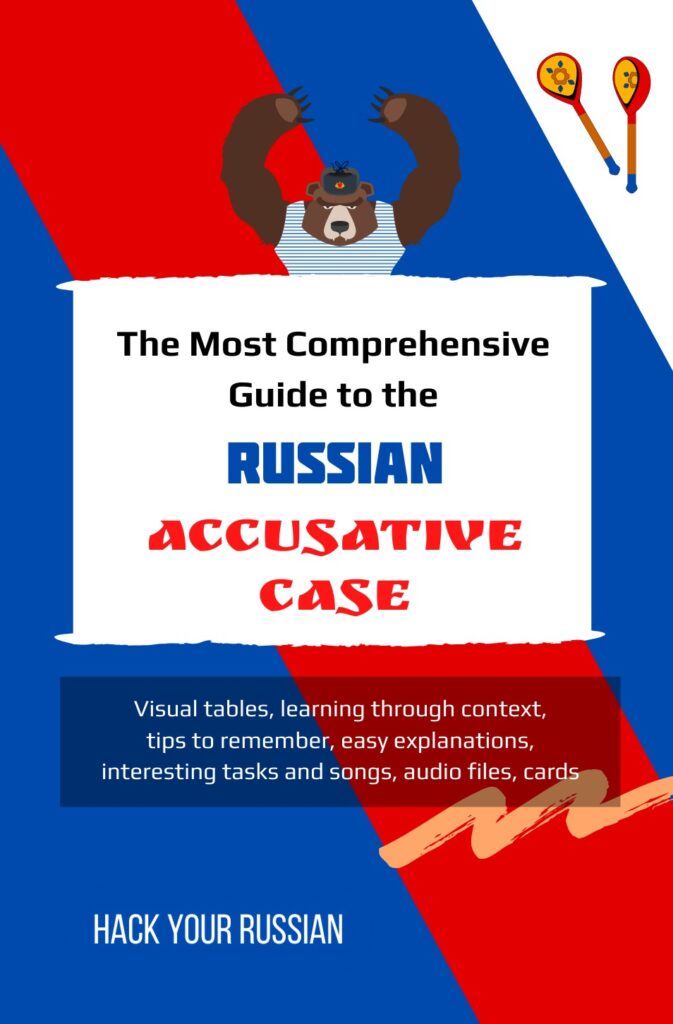
If you wish to speak Russian, you should absolutely learn how to use Russian cases. Check the most comprehensive guides to Russian cases:

Why Vocabulary Should Come Before Heavy Grammar
If you want to start speaking Russian, vocabulary is your fuel. Grammar helps you organize your thoughts, but without words, you have nothing to organize.
A beginner who knows 500 useful words and 50 basic patterns can communicate much more than a beginner who knows all case names but cannot remember everyday vocabulary.
The best vocabulary to learn first is not random word lists. Learn words and phrases connected to real situations: introducing yourself, ordering food, asking for help, talking about your day, explaining what you like, and asking simple questions.
If you have recently started to learn Russian language, you should absolutely have my free guide ‘Essential Russian Words and Expressions to Understand Spoken Russian’.
It’s also very important to know how to pronounce Russian words correctly as not every Russian letter is pronounced the same way as it’s written. There are certain Russian pronunciation rules that are really easy to learn.
When Should You Start Studying Grammar Seriously?
You do not need to study advanced grammar from day one. But you should not postpone grammar forever either.
A good approach is:
Beginner level
Focus on:
alphabet and pronunciation;
basic words and phrases;
simple sentence patterns;
listening to slow Russian;
speaking from the beginning;
understanding the idea of cases, but not memorizing everything.
Elementary level
Start learning:
basic verb conjugation;
present, past and future tense;
common case patterns;
basic prepositions;
polite phrases;
question-answer structures.
Intermediate level
Go deeper into:
all six cases;
verbs of motion;
aspect;
more complex sentence structures;
natural speech patterns;
idioms, slang and real-life expressions.
This way, grammar appears at the right moment. You do not avoid it, but you also do not let it block your speaking.
You can use my Russian learning resources to choose materials depending on your level and goals.
Common Mistakes Russian Learners Make
Mistake 1: Thinking grammar is the whole language
Grammar is important, but it is not the whole language. You also need pronunciation, listening, vocabulary, phrases, confidence, and real communication.
Mistake 2: Waiting too long before speaking
Many learners wait until they “know enough grammar” before speaking. But speaking is a skill. You improve it by speaking, not only by studying.
Mistake 3: Learning words without context
Random vocabulary lists are hard to remember. Learn words in phrases, stories, dialogues, songs, and real situations.
Mistake 4: Avoiding grammar completely
Some learners go too far in the opposite direction and ignore grammar completely. This may work for basic communication, but later you will need grammar to speak more clearly and understand complex Russian.
Mistake 5: Memorizing case endings without knowing when to use them
Do not learn endings first and meaning later. Learn real situations first, then endings will become easier to remember.
Mistake 6: Using only apps
Apps can be useful, but they are usually not enough. You need real listening, speaking, repetition, and longer context.
FAQ: Learning Russian Without Grammar
Can I learn Russian without studying grammar?
You can start learning Russian without focusing heavily on grammar, especially at the beginner level. You can build vocabulary, learn useful phrases, listen to slow Russian, and practice speaking. However, if you want to speak clearly and understand more complex Russian, you will eventually need grammar.
Is Russian grammar necessary?
Yes, Russian grammar is necessary, but it should not stop you from speaking. Cases, verb forms, endings, and word order all affect meaning. The best approach is to learn grammar through real phrases, stories, examples, and conversation instead of memorizing rules only.
Should beginners learn Russian grammar first?
Beginners should not focus only on grammar first. It is better to start with the alphabet, pronunciation, basic vocabulary, simple phrases, listening practice, and speaking. Grammar should be introduced gradually through useful patterns.
What should I learn before Russian grammar?
Before studying grammar deeply, learn the Russian alphabet, pronunciation rules, basic Russian words, common phrases, and simple sentence patterns. You should also listen to slow Russian and repeat phrases aloud.
How can I learn Russian grammar naturally?
You can learn Russian grammar naturally through stories, songs, cartoons, podcasts, interlinear texts, and question-answer practice. The key is repetition in context. When you hear the same structure many times, grammar starts to feel more natural.
What is the best way to learn Russian cases?
The best way to learn Russian cases is to study them through real situations. For example, learn how the Genitive case is used to say you do not have something, where you are from, dates, locations, and wishes. My Russian cases books explain each case step by step with examples, tables, exercises, and practical phrases.
What is better: learning grammar or speaking practice?
You need both, but not in the same amount at every stage. Beginners should focus more on vocabulary, listening, and speaking. Grammar should support communication. At higher levels, grammar becomes more important for accuracy and fluency.