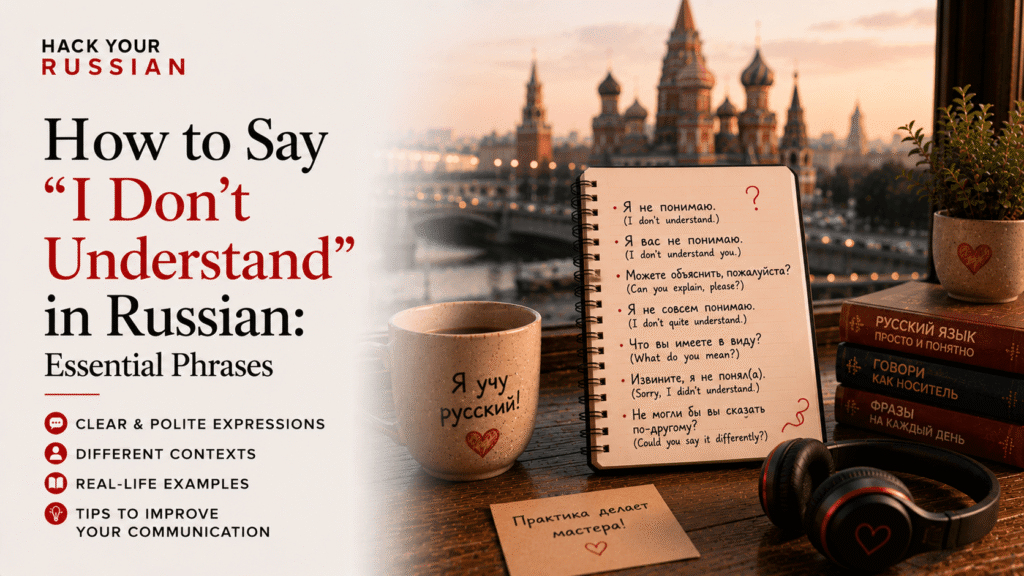
There are many different ways to say that you didn’t understand something in Russian: formal, informal and slang. And it’s better to know all of them if you want to be able to let a person know what exactly is not clear. You can watch my video lesson on this topic and read a brief overview of the lesson below. The PDF file with all these Russian phrases is attached below the video.
Table of Contents
Why “I Don’t Understand” Is One of the Most Useful Russian Phrases
When you learn Russian, it is completely normal not to understand everything. Russian pronunciation, word order, grammar cases, fast speech and informal reductions can make even simple conversations difficult at first.
That is why phrases like я не понима́ю, я не по́нял / я не поняла́, and вы мо́жете повтори́ть? are not just “emergency phrases”. They are essential conversation tools. If you are just starting Russian, you may also like my list of basic Russian phrases for beginners.
If you can politely say that you did not understand something, you can keep the conversation going instead of freezing or switching to English immediately. Native speakers usually do not mind repeating, explaining, or speaking more slowly — especially when they see that you are trying to speak Russian.
Instead of only saying:
Я не понима́ю.
I don’t understand.
You can sound more natural and polite by saying:
Извини́те, я не по́няла. Вы мо́жете повтори́ть?
Sorry, I didn’t understand. Could you repeat?
Я не о́чень хорошо́ понима́ю по-ру́сски. Вы мо́жете говори́ть поме́дленнее?
I don’t understand Russian very well. Could you speak more slowly?
These phrases are especially useful for beginners, travelers, language exchange, online lessons, and real conversations with Russian speakers.
Video lesson How to say “I don’t understand in Russian”
Common ways to say “I don’t understand” in Russian
The most common way to tell someone that you don’t understand something in Russian is «Я не понима́ю» [й’а нипанимАй’у] – I don’t understand. Can be used in any situations.
You can also clarify what exactly you don’t understand because otherwise it would sound a bit weird.
In informal situations (with friends and people you know well):
Я тебя́ не понима́ю, ты говори́шь о́чень бы́стро [й’а тиб’А нипанимАй’у ты гаварИш Очин’ бЫстра] – I don’t understand you, you speak very fast
In formal situations (with strangers, elderly people, etc.) / or to address to several people:
Я вас не понима́ю, вы говори́те о́чень бы́стро [й’а вас нипанимАй’у
вы гаварИт’э Очин’ бЫстра] – I don’t understand you, you speak very fast
Informal:
Я ничего́ не понима́ю. Ты мо́жешь говори́ть поме́дленнее? [й’а ничивО нипанимАй’у
ты мОжыш гаварит’ пам’Эдлин’эй’э] – I don’t understand anything. Can you speak more slowly?
Formal:
Я ничего́ не понима́ю. Вы мо́жете говори́ть поме́дленнее? [й’а ничивО нипанимАй’у
вы мОжыт’э гаварит’ пам’Эдлин’эй’э] – I don’t understand anything. Can you speak more slowly?
However, it will be more natural to use this phrase in the past tense:
«Я не понял» (for a man) and «Я не поняла» (for a woman) = I didn’t get it
You can add some details of course to sound more polite.
Извини́, я не по́нял (m) / я не поняла́ (f) – Sorry, I didn’t understand (informal)
Извини́те, я не по́нял (m) / я не поняла́ (f) – Sorry, I didn’t understand (formal)
Извини́, я не понял(а) что ты сказа́л – Sorry, I didn’t understand what you said (informal)
Извини́те, что вы сказа́ли? – Sorry, what did you say? (formal)
You can also face some situations when, for example, you understood the whole speech except for several words or phrases you don’t know. In this case, you can use the following phrases:
Что это зна́чит? [штО Эта знАчит] – What does it mean?
Что зна́чит сло́во …? [штО знАчит слОва …] – What does a word … mean?
Как это сло́во бу́дет по-англи́йски? [как Эта слОва бУдит паанглИски] – What is this word in English?
And now let’s imagine that you perfectly understand all the words and phrases being said but you have no idea what a person wants to say by this, you can use the following phrases:
Что ты име́ешь в виду́? [што ты им’Эиш в:идУ] – What do you mean? (informal)
Что вы име́ете в виду́? [што вы им’Эит’э в:идУ] – What do you mean? (formal)
If you need more details, just use the next phrases:
А мо́жно поподро́бнее? [амОжна пападрОбний’э] – Can I have more details on that?
Вы не могли́ бы объясни́ть поподро́бнее? [вы нимаглИбы абй’ис’нИт’ пападрОбний’э] – Could you give some details on that? (formal)
This particle НЕ makes such requests sound more polite.
And how about some Russian slang? There are 3 most common ways to say ‘I don’t get it’ in slang Russian.
Slang words to say “I don’t understand” in Russian
Я не догоня́ю [й’а нидаган’Ай’у] – I can’t follow what is said / I am not catching up.
And in the past tense:
Я не догна́л (for a man) [й’а нидагнAл] – I couldn’t follow what was said
Я не догнала́ (for a woman) [й’а нидагналА] – I couldn’t follow what was said
До меня́ не дохо́дит [дамин’А нидахОдит] – I can’t follow what is said
And in the past tense:
До меня́ не дошло́ [дамин’А нидашлО] – I couldn’t follow what was said
Я не вруба́юсь [й’а ниврубАй’ус’] – I am not able to get / understand smth
And in the past tense:
Я не вруби́лся (m) / Я не вруби́лась (f)
[й’а ниврубИлс’а / й’а ниврубилас’]
I couldn’t follow what was said / I haven’t caught.
If you want to understand more informal spoken Russian, check my guide to Russian slang words.
When You Don’t Understand Fast Spoken Russian
Many learners understand slow textbook Russian, but panic when native speakers talk naturally. This is normal. Russian speakers often reduce sounds, connect words, speak quickly, and use informal expressions that are not obvious from textbooks.
For example, я не понима́ю can sound faster and less clear in natural speech. Words may blend together, unstressed vowels may change, and endings may sound weaker.
In this situation, you can say:
Вы о́чень бы́стро говори́те.
You speak very fast.
Я пока́ пло́хо понима́ю бы́струю ру́сскую речь.
I still don’t understand fast Russian speech very well.
Мо́жете говори́ть чуть ме́дленнее?
Could you speak a little more slowly?
Мо́жете сказа́ть э́то други́ми слова́ми?
Could you say it in other words?
Мо́жете приве́сти приме́р?
Could you give an example?
These phrases are extremely useful because they help you stay in Russian instead of giving up.
If fast speech is your biggest problem, read my guide on how to understand and speak Russian more naturally.
You can find the audio files with pronunciation of these Russian phrases in my free guide ‘Essential Russian Words and Expressions to Understand Spoken Russian’.
This guide also contains audio files so that you can listen to these phrases on the go: while driving, walking, doing sport or brushing your teeth. Make sure that you repeat these phrases yourself and try to imitate my accent.
I hope that you found these phrases useful and next time you need to tell a person that you don’t really understand something in Russian, you will be ready. Hovewer, there are lot’s of other things that you need to learn in order to speak Russian language properly:
1) Polite words and phrases in Russian;
2) How to address people in Russian;
3) The difference between using Ты and Вы in Russian.
Want more lessons like this? Explore my Russian learning resources.
You can also browse my free Russian video lessons.
If you have recently started to learn Russian language, you should absolutely have my free guide ‘Essential Russian Words and Expressions to Understand Spoken Russian’.
It’s also very important to know how to pronounce Russian words correctly as not every Russian letter is pronounced the same way as it’s written. There are certain Russian pronunciation rules that are really easy to learn.
If you wish to speak Russian, you should absolutely learn how to use Russian cases. Check the most comprehensive guides to Russian cases:

FAQ: How to Say “I Don’t Understand” in Russian
How do you say “I don’t understand” in Russian?
The most common way to say “I don’t understand” in Russian is я не понима́ю. It is neutral and can be used in most situations.
What is the difference between “я не понимаю” and “я не понял”?
Я не понима́ю means “I don’t understand” and can describe a general situation or ongoing lack of understanding. Я не по́нял / я не поняла́ means “I didn’t understand” and usually refers to one specific thing that was just said or explained.
How do you politely say “I don’t understand” in Russian?
You can say извини́те, я не по́нял if you are a man, or извини́те, я не поняла́ if you are a woman. To be even clearer, add вы мо́жете повтори́ть? — “Could you repeat?”
How do you ask someone to repeat in Russian?
Informally, say повтори́, пожа́луйста or ты мо́жешь повтори́ть? Formally, say повтори́те, пожа́луйста or вы мо́жете повтори́ть?
How do you ask someone to speak more slowly in Russian?
Informally, say ты мо́жешь говори́ть поме́дленнее? Formally, say вы мо́жете говори́ть поме́дленнее? Both mean “Can / could you speak more slowly?”
What does “я не догоняю” mean?
Я не догоня́ю is an informal slang phrase meaning “I don’t get it” or “I can’t follow.” It is common in casual speech, but it is not suitable for formal situations.
What does “до меня не доходит” mean?
До меня́ не дохо́дит means “I can’t get it” or “it doesn’t click for me.” The past form до меня́ не дошло́ means “I didn’t get it” or “it didn’t click.”
How do you say “I don’t understand this word” in Russian?
You can say я не понима́ю э́то сло́во. You can also ask что э́то зна́чит?, which means “What does this mean?”
What should I say if a Russian speaker talks too fast?
You can say извини́те, вы о́чень бы́стро говори́те. Вы мо́жете говори́ть поме́дленнее? It means “Sorry, you are speaking very fast. Could you speak more slowly?”