Did you know that there are approximately 2000 words that are similar in both Russian and English languages?
Yes, you heard it right! These words are called cognates – they sound almost the same and have the same meaning. As you can see, Russian and English are not completely alien languages as they both come from the same Indo-European language family.
Similar words are especially helpful at the beginning because they reduce the fear of Russian vocabulary. When you first see Cyrillic, everything may look new and strange. But then you realize that many Russian words are actually familiar when you read them aloud.
For example: му́зыка – music, телефо́н – telephone / phone, рестора́н – restaurant, компью́тер – computer, аэропо́рт – airport.
These words may look a little different because Russian uses the Cyrillic alphabet, but once you learn to read Russian letters, you will start recognizing many familiar words.
Cognates are a great shortcut for building your first Russian vocabulary. Instead of starting from zero, you can immediately recognize hundreds of words connected to technology, culture, science, food, sport, music, politics, and everyday life.
Russian and English may look very different, but they have more in common than many beginners expect. Some similar words come from shared Indo-European roots, while others entered Russian through French, German, Latin, Greek, or English.
Ok, let’s begin! You can watch this video first to learn the main word endings of Russian-English cognates and check yourself by playing a game. After watching this video you will find more Russian-English similar words divided by topics down below (after a brief summary).
Table of Contents
Free Russian Video Lesson – Russian words similar to English
Common Russian Word Endings Similar to English
Many Russian-English cognates are easy to recognize because they have common endings. Once you know these patterns, you can guess the meaning of many new words.
Words Ending in -ция
Many English words ending in “-tion” become Russian words ending in -ция.
информа́ция (information)
ситуа́ция (situation)
организа́ция (organization)
тради́ция (tradition)
револю́ция (revolution)
In Russian, words ending in -ция are usually feminine nouns.
Examples:
Э́то важная информа́ция (This is important information).
Интере́сная ситуа́ция (An interesting situation).
Words Ending in -ия
Many international words end in -ия in Russian.
исто́рия (history / story)
энерги́я (energy)
геогра́фия (geography)
биоло́гия (biology)
тео́рия (theory)
These words are usually feminine.
Examples:
Я люблю́ исто́рию (I love history).
Э́то интере́сная тео́рия (This is an interesting theory).
Words Ending in -изм
Many English words ending in “-ism” become Russian words ending in -изм.
тури́зм (tourism)
реали́зм (realism)
оптими́зм (optimism)
социали́зм (socialism)
ка́питализм (capitalism)
These words are masculine.
Example:
Тури́зм — э́то ва́жная инду́стрия (Tourism is an important industry).
Words Ending in -ист
Many words describing people end in -ист.
тури́ст (tourist)
арти́ст (artist / performer)
журнали́ст (journalist)
специали́ст (specialist)
пиани́ст (pianist)
Words Ending in -ор
Many international words end in -ор in Russian.
профе́ссор (professor)
до́ктор (doctor)
дире́ктор (director)
мо́тор (motor)
компью́тер (computer)
These words are usually masculine.
There are tons of Anglicisms (modern words borrowed from English language) which Russian people use everyday without even noticing it. You can even pronounce these words as they are and most Russian people will understand them
But be careful using them as an older generation (especially ‘babushkas’) might not understand you and even tell you some bad words (it’s a joke). Some really interesting examples of modern Anglicisms are the following:
ЮЗЕР = user; a Russian word for this is ‘пользователь’ (pól’zavatel’)
ПАССВОРД = password; a Russian word for this is ‘пароль’ (paról’)
КОУЧИНГ = coaching; a Russian word for this is ‘обучение’ (abuchéniye)
ОКЕЙ = ok; a Russian word for this is ‘хорошо’ (harashó)
ГОУ = let’s go; a Russian word for this is ‘пойдем’ (paidém)
УИКЕНД = weekend; a Russian word for this is ‘выходные’ (vyhadn’ýye) …and so many others that I am not going to give you because you need to learn more real Russian words! (even though many of them are also borrowed from other languages).
- The ending ‘IST’ of Greek origin means “one who does or makes” is equivalent to a suffix ‘ИСТ’ in words like “optimist” (оптимист), egoist (эгоист), journalist (журналист), etc.
- Many adjectives borrowed from English have the ending -НЫЙ: эмоциональный – emotional, интересный – interesting, серьёзный – serious.
Now let’s learn some most frequent Russian-English cognates and similar words.
Russian-English Cognates by Topic
Work and business
Администрация [administrátsiya] – administration
Ассоциация [asatsiátsiya] – association
Бизнес [bíznes] – business
Брифинг [brífink] – briefing
Бюджет [byudzhét] – budget
Вакансия [vakánsiya] – vacancy
Дедлайн [dedláin] – deadline
Дело [délo] – deal, affair
Документ [dakument] – document
Интервью [interv’yú] – interview
Контракт [kantrákt] – contract
Клиент [kliyént] – a client
Компания [kampániya] – company
Коллега [kaléga] – a colleague
Концепция [kantséptsiya] – conception, concept
Корпорация [karparátsiya] -corporation
Education and Science
Академия [akadémiya] – academy
Аббревиатура [abreviatúra] – abbreviation
Анализ [anális] – analysis
Анатомия [anatómiya] – anatomy
Биология [bialógiya] – biology
География [geagráphiya] – geography
Геометрия [geamétriya] – geometry
Диссертация [disertátsiya] – dissertation
Информатика [infarmátika] – informatics
История [istóriya] – history
Колледж [kóledzh] – college
Литература [literatúra] – literature
Математика [matemátika] – mathematics
Педагогика [pedagógika] – pedagogics
Профессор [prafésar] – professor
Психология [psihalógiya] – psychology
Оccupations
Архитектор [arhitéktar] – an architect
Архитектура [arhitektúra] – architecture
Актёр [aktyór] – an actor
Актриса [aktrísa] – an actress
Аниматор [animátor] – an animator
Адвокат [advakát] – an advocate
Ассистент [asistént] – an assistant
Агент [agént] – an agent
Бизнесмен [biznesmén] – a businessman
Бизнесвумен [bizneswúmen] – a businesswoman
Гид [git] – a guide
Дизайнер [dizáiner] – a designer
Дизайн [dizáin] – design
Доктор [dókta] – a doctor
Журналист [zhurnalíst] – a journalist
Журнал [zhurnál] – journal
Media and communication (mainly words borrowed from English)
Аккаунт [akáunt] – account
Батарея [batare ́ya] – battery
Баланс [baláns] – balance
Блог [blok] – blog
Блоггер [blóger] – blogger
Видео [vídeo] – video
Вебсайт [websáit] – website
Браузер [bráuzer] – browser
Гуглить [gúglit’] – to google
Диск [disk] – disc
Девайс [deváis] – device
Дисплей [displéy] – display
Идея [idéya] – idea
Интернет [internét] – internet
Информация [infarmátsiya] – information
Контакт [kantákt] – contact
Кликать [klíkat’] – to click
Камера [kámera] – camera
Коммуникация [kamunikátsiya] – communication
Лайкать [láikat’] – to give likes on social media platforms
House and household supplies
Адрес [ádres] – address
Антенна [anténna] – antenna
Балкон [balkón] – balcony
Блендер [blénder] – blender
Ваза [váza] – vase
Вилла [vílla] – villa
Гараж [garásh] – garage
Комфорт [kamfórt] – comfort
Кондиционер [kanditsionér] – conditioner
Лифт [lift] – lift, elevator
Лампа [lámpa] – lamp
Миксер [míkser] – mixer
Туалет [tualét] – toilet
Тостер [tóster] – toaster
Терраса [terása] – terrace
Телефон [telefón] – telephone
Телевизор [televízor] – television set, TV
Холл [hol] – hall, hallway
Электричество [elektríchestvo] – electricity
City and Places
Автомобиль [avtamabíl’] – automobile
Арка [árka] – arc
Банк [bank] – bank
Барьер [bar’yér] – barrier
Индекс [índeks] – index
Контейнер [kantéiner] – container
Метро [metró] – metro
Павильон [pavil’yón] – pavilion
Парк [park] – park
Почта [póchta] – post
Парковка [parkóvka] – parking
Супермаркет [supermárket] – supermarket
Стадион [stadión] – stadium
Сквер [skver] – square, park
Станция [stántsiya] – station
Статуя [státuya] – statue
Территория [teritóriya] – territory
Трамвай [tramvái] – tramway
Такси [taksí] – taxi
Центр [tsentr] – centre
You can get a full list of 800 words with audio divided by topics in my SUPER guide on Russian-English cognates and similar words
You should get this guide for several reasons:
1) It will boost your confidence in learning Russian, whether you’re a beginner or an intermediate learner;
2) It is well-structured and provides key word categories that you can instantly use in your speech (you won’t find anything like this online — I’ve checked);
3) It is curious to see how languages are flexible and constantly evolving.
Some of these words are cognates of the same Indo-European origin, others have been borrowed from languages, like German, French, English, Greek and Latin.
Click this link to get a SUPER Guide on Russian-English similar words.
If you have recently started to learn Russian language, you should absolutely have my free guide ‘Essential Russian Words and Expressions to Understand Spoken Russian’.
It’s also very important to know how to pronounce Russian words correctly as not every Russian letter is pronounced the same way as it’s written. There are certain Russian pronunciation rules that are really easy to learn.
If you wish to speak Russian, you should absolutely learn how to use Russian cases. Check the most comprehensive guides to Russian cases:
Be Careful: Similar Words Are Not Always Safe
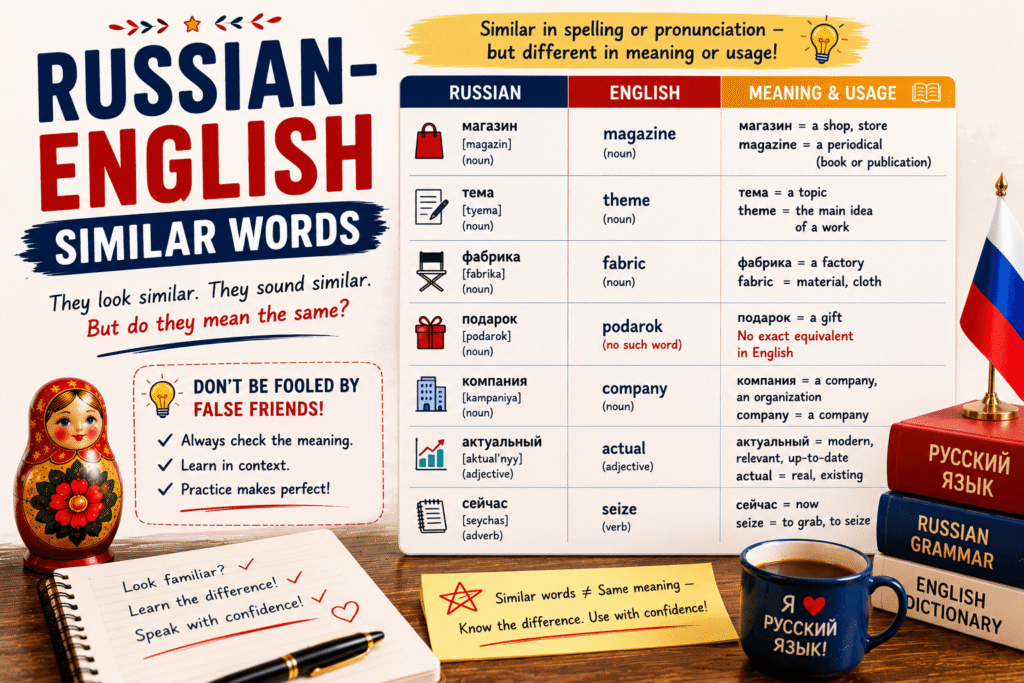
Russian-English similar words can help you learn faster, but you should still be careful. Some words look similar but have different meanings. These are called false friends or false cognates.
For example:
магази́н (shop / store, not magazine)
фами́лия (surname, not family)
лист (sheet of paper or leaf, not list)
аккура́тный (neat / careful, not usually accurate)
This is why it is important to check the meaning of a new word in context. Similar words are a helpful shortcut, but they are not a magic rule.
A good learning strategy is to divide similar-looking words into two groups:
Safe cognates: телефо́н, рестора́н, му́зыка, спорт
False friends: магази́н, фами́лия, лист, аккура́тный
This will help you avoid embarrassing mistakes. Learn more Russian-English False Friends to avoid misunderstanding.
Pronunciation Tips for Russian-English Similar Words
Even when Russian and English words look similar, they are not always pronounced the same way. Russian pronunciation follows its own rules, especially when it comes to stress, vowel reduction, and consonant sounds.
For example:
рестора́н
restaurant — stress on the last syllable
телефо́н
telephone — stress on the last syllable
му́зыка
music — stress on the first syllable
информа́ция
information — stress near the end
Do not rely too much on English pronunciation. Learn Russian cognates with stress marks and repeat them aloud.
Examples:
Не “restaurant” with English pronunciation, but рестора́н.
Not “telephone,” but телефо́н.
Not “music,” but му́зыка.
This small habit will make your Russian sound much more natural.
How to Use Cognates in Real Russian Sentences
The best way to remember similar words is to use them in short and simple sentences. A word becomes much more useful when you know how it behaves in Russian grammar.
Examples:
Это мой телефо́н (This is my phone).
Я люблю́ спорт (I love sport).
Мы идём в рестора́н (We are going to a restaurant).
Она́ рабо́тает в ба́нке (She works in a bank).
У меня́ есть виза (I have a visa).
Я смотрю́ фильм (I am watching a movie).
Notice that even familiar words can change their form in Russian:
рестора́н → в рестора́не
restaurant → in the restaurant
банк → в ба́нке
bank → in the bank
виза → ви́зу
visa → visa as a direct object
So, cognates help you recognize words, but you still need grammar to use them correctly.
Common Mistakes with Russian-English Similar Words
- Assuming every similar word has the same meaning
Some words are true cognates, but others are false friends. Always check the meaning in context.
- Pronouncing Russian words like English
Russian cognates often have different stress and pronunciation. For example, рестора́н and телефо́н are stressed on the last syllable.
- Forgetting gender
Russian nouns have gender. For example, информа́ция is feminine, телефо́н is masculine, and кафе́ is neuter.
- Ignoring case endings
Even familiar words change depending on their role in the sentence.
Example:
Я иду́ в рестора́н.
I am going to a restaurant.
Я в рестора́не.
I am in a restaurant.
- Learning words without phrases
A list of cognates is useful, but real progress starts when you use the words in sentences.
FAQ: Russian-English Similar Words and Cognates
What are Russian-English cognates?
Russian-English cognates are words that look or sound similar in both languages and have the same or very similar meaning. Examples include телефо́н, му́зыка, рестора́н, спорт, and компью́тер.
Are Russian and English related languages?
Yes, Russian and English both belong to the Indo-European language family. They are not closely related in the same way as English and German, but they still share some historical roots and many international words.
How many Russian words are similar to English?
There are many Russian words that are similar to English, especially in fields like technology, science, medicine, politics, sport, and culture. Many learners can recognize hundreds of Russian words once they learn the Cyrillic alphabet.