Learning Russian grammatical cases is often perceived as a formidable challenge by learners of the Russian language. The Russian declension system is notably complex: nouns, all types of pronouns, adjectives, and numerals must be declined according to grammatical number (singular or plural), gender, and case. In total, Russian comprises six grammatical cases: Nominative, Genitive, Dative, Accusative, Instrumental, and Prepositional.
While it may seem discouraging that mastery of all six cases is essential for speaking Russian both fluently and accurately, there is encouraging news: effective methods do exist. The fundamental principle for successfully learning Russian cases is straightforward—they should always be studied in context, through short stories, songs, dialogues, and other meaningful linguistic material.
You’re making great progress in Russian. You can say Это книга (“This is a book”) and Он студент (“He is a student”). Then someone asks “Нет книги?” and your brain short-circuits.
Welcome to the Russian genitive case — the one that trips up almost every English-speaking learner, and for good reason. English doesn’t have cases at all, so wrapping your head around why a word changes its ending based on how it’s used in a sentence feels completely unnatural at first.
But here’s the good news: the genitive case follows logical, learnable rules. Once you see the system behind it, it clicks surprisingly fast. And once it does, your Russian will sound dramatically more natural and fluent.
Table of Contents
⚡ Quick Answer: What Is the Russian Genitive Case?
The Russian genitive case (родительный падеж) is used to express possession, absence, quantity, and relationships between nouns. It answers the questions “Кого?” (of whom?) and “Чего?” (of what?). In English, it roughly corresponds to the word “of” or the possessive apostrophe-s. For example, книга студента means “the student’s book” (literally: “the book of the student”). The genitive is also required after negation, after numbers, after words like много (many) and нет (there is no), and after many prepositions.
The diverse functions of the Genitive case can indeed be difficult to master. To facilitate understanding and retention, it may be helpful to associate the Genitive case with the concept of a “house,” examining the various “rooms” or situations in which it is applied:

Overall, you can see that these situations share many common features and are closely interconnected. The Genitive case is also required with certain prepositions and verbs, which you will encounter throughout this guide. Evidently, there are many contexts in which the Genitive case must be used in Russian. Therefore, it is essential to master it as early as possible in order to speak confidently.
What Is the Russian Genitive Case? (And Why Does It Exist?)
Russian is a synthetic language, meaning it uses word endings (called cases) to show the grammatical role of a word in a sentence — rather than relying on word order like English does.
In English: “The dog bit the man” vs. “The man bit the dog” — the meaning changes based on word order.
In Russian, the endings on the words tell you who’s doing what, so you can rearrange the sentence and still be understood perfectly.
The genitive case (родительный падеж) is arguably the most versatile of all six Russian cases. It shows:
- Possession — whose something is
- Absence — that something doesn’t exist or isn’t there
- Quantity — how much of something there is
- Relationships — how things relate to each other
It’s the English equivalent of:
- “of” → the capital of Russia = столица России
- Possessive ‘s → my friend**’s** phone = телефон друга
- “no / not any” → there is no time = нет времени
How to Form the Genitive Case: Endings Table
The first step in mastering the Genitive case is learning how to modify noun endings when transitioning from the Nominative case. Unfortunately, many available rules on the internet tend to be overly complex, as they often fail to present the broader logic and structure underlying these endings. Moreover, they frequently list endings in isolation, without providing clear illustrative examples.
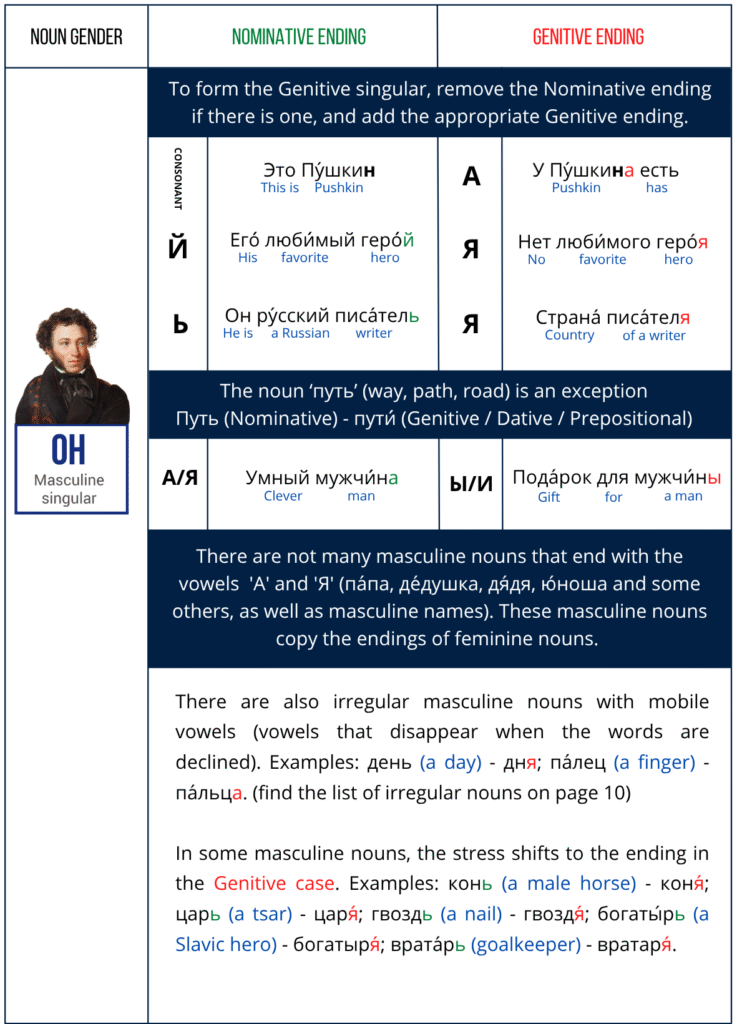
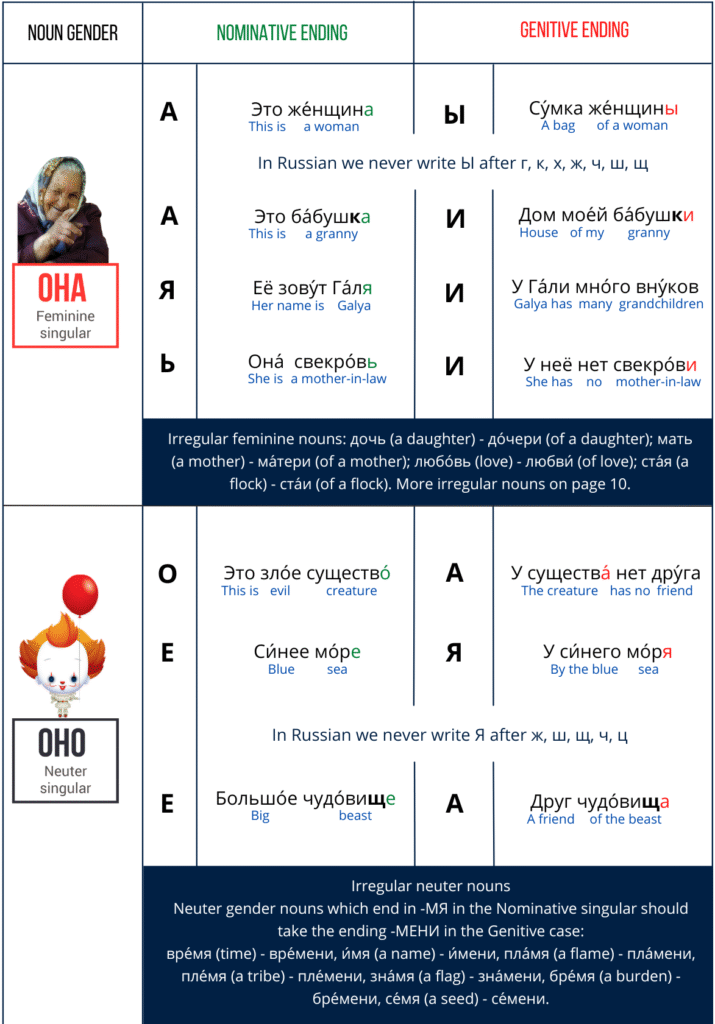
It is important not to memorize the endings mechanically. Instead, they should be learned in context, accompanied by examples. Below is a table showing singular noun endings in the Genitive case. These tables have been specifically designed to make the learning process more accessible. Endings of the Nominative case are highlighted in green, while those of the Genitive case appear in red. Note that the grammatical gender of a noun plays a crucial role in determining the appropriate ending.
Endings for singular nouns in the Genitive case
⚠️ The 7-Letter Spelling Rule
After the letters г, к, х, ж, ш, щ, ч, you cannot write -ы — you must write -и instead. This rule applies throughout Russian grammar, not just the genitive — so it’s worth memorizing early.
✅ книга → книги (NOT книгы)
✅ ручка → ручки (NOT ручкы)
Let’s sum up the Genitive case endings for singular nouns and create a clear system out of it to make it more simple.
Before we begin, let’s review a few key definitions:
- Word stem – the part of a word without its ending.
- Soft consonants – consonants followed by и, е, ё, ю, я, or a soft sign (ь). The letters ч, щ, й are always soft.
- Hard consonants – all other consonants.
To choose the correct ending, you need to identify the final consonant of the word stem. See how simple it is!
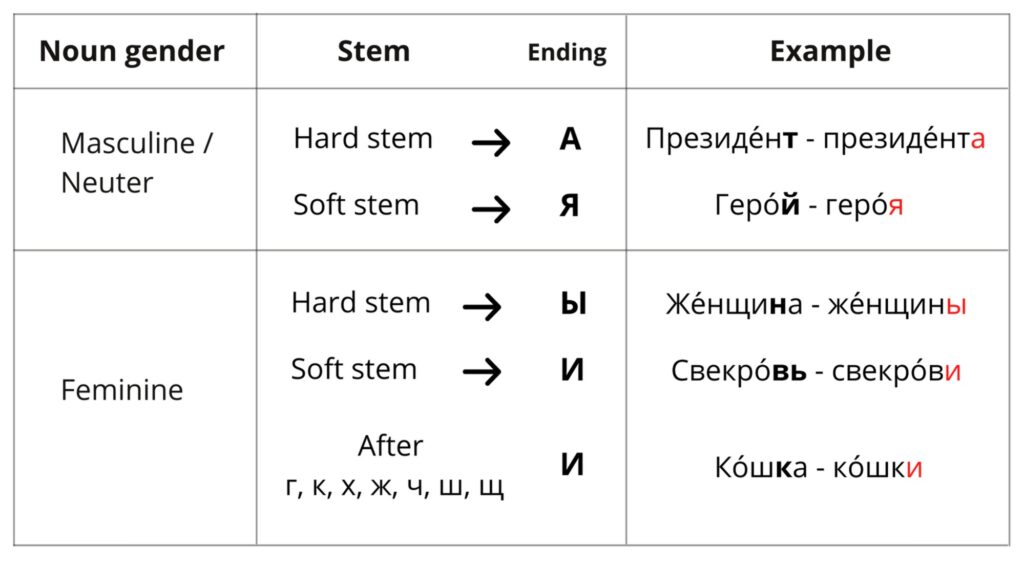
To make it easier for you to remember these endings, memorize them through example sentences. You can create your own or use mine:
У президе́нта нет люби́мого геро́я (The President doesn’t have a favorite character / hero).
У свекро́ви э́той же́нщины две ко́шки (The mother-in-law of this woman has two cats).
So, you already know how to change the endings of singular nouns in the Genitive case. But what happens with plural nouns? Take a look at the table below.
Endings for plural nouns in the Genitive case
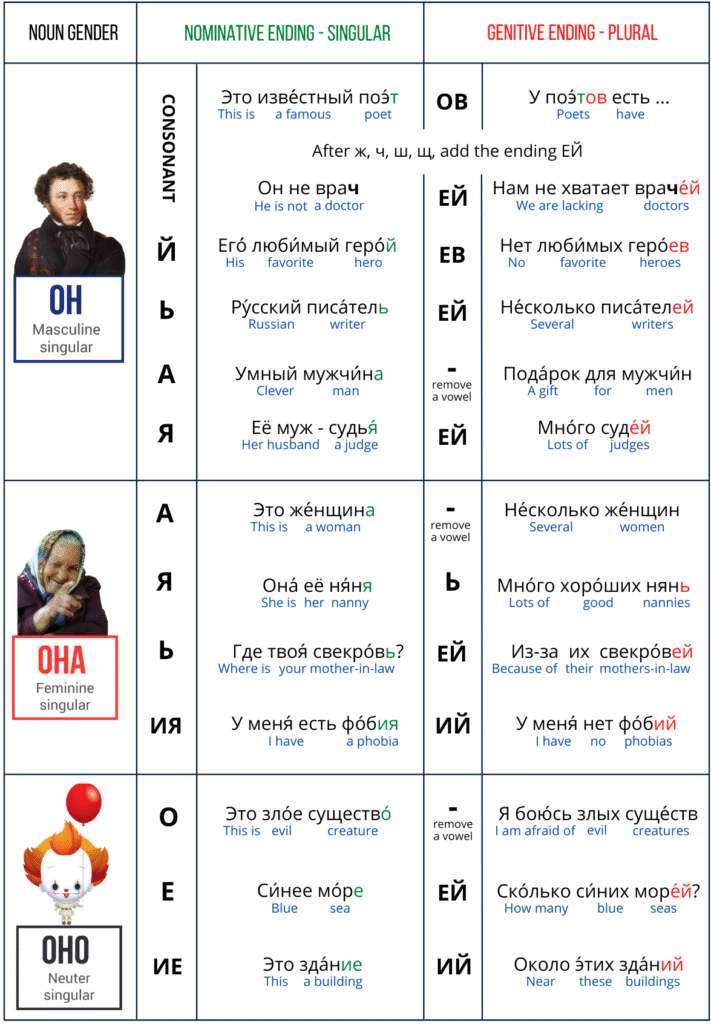
💡 The “zero ending” — some nouns in the genitive plural simply lose their ending. This feels strange at first but becomes natural quickly: книга → книг, окно → окон.
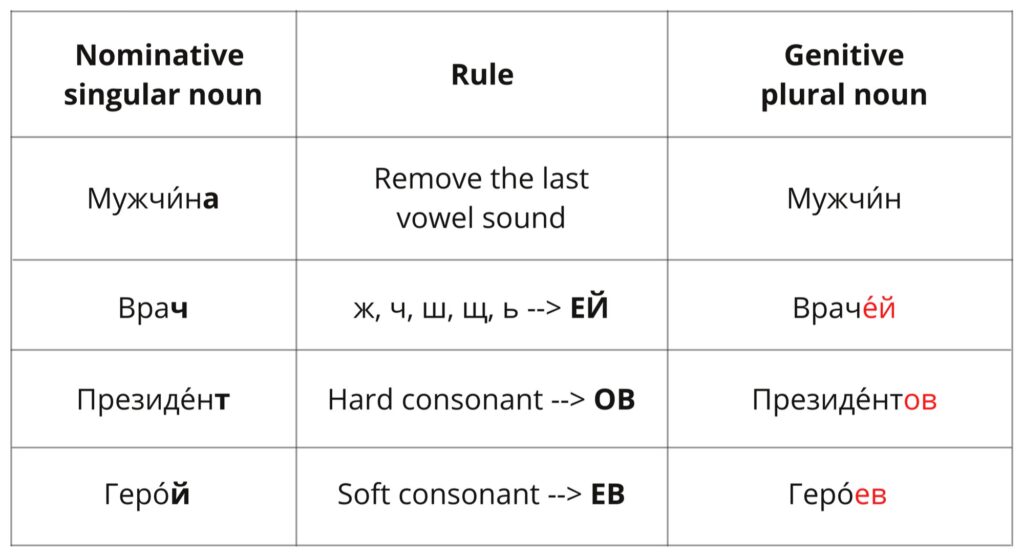
Let’s now summarize the Genitive case endings for plural nouns and organize them into a clear system to make learning easier. However, as you may have noticed, this system is more complex. We can divide the changes into two groups: when a vowel at the end of the word is removed, and when something is added to the end of the word. Let’s examine the rules!
Verdict: Remove it!
We remove the last letter of the word when it ends with a vowel sound. For example, подруга (a female friend) – подруг (female friends in the Genitive case).
It’s very important to know the difference between a sound and a letter here. In Russian, there are 4 vowels that consist of two sounds: Е [й+э], Ё [й+о], Ю [й+у], Я [й+а]. Example word – я́блоко [йАблака] – an apple.
However, when it stands after a consonant it loses its [й] part and softens this consonant. And the softness in Russian is shown with the soft sign (ь) or with an apostrophe in transcription. Therefore, in words like няня [ньАньа or н’Ан’а] – a nanny, we need to remove the last vowel sound А, so we have a soft sign at the end : нянь [ньАнь or н’Ан’].
But what about the endings -ИЕ and -ИЯ? As you could see these endings change into -ИЙ in the Genitive case. So, you are probably thinking now that these are just the exceptions. But no, we also remove the last vowel sound in these endings. Let me prove it to you!
So, we have a word “фо́бия” (a phobia) which is transcribed as [фОбийа]. The last vowel sound is А, so we just remove it [фОбий]. You see, it really is that simple!
Just add it!
Let’s now look at situations when we need to add an ending to plural words in the Genitive case.
We add -ЕЙ when a noun ends with ж, ч, ш, щ, ь. For example: врач – враче́й, прави́тель – прави́телей, свекро́вь – свекро́вей.
If it is a noun of a masculine gender, you need to use the rule of hard and soft stems. When a stem of the word ends with a hard consonant, we add the ending -ОВ: президе́нт – президе́нтов.
When a stem ends with a soft consonant or –Й (which is soft by default), we add –ЕВ: геро́й – геро́ев.
And there is also an ending -ЁВ which is quite rare in words but you need to know it anyway. We use -ЁВ when the stress relocates to the ending of the word: край (an edge)– краёв, бой (a fight) – боёв.
Let’s summarize what we have just learned in a clear table:
Memorization hack
Let’s look at this example sentence that summarizes all the previous rules.

Среди́ мужчи́н мно́го изве́стных президе́нтов, враче́й и геро́ев без фо́бий (Among men there are a lot of famous Presidents, doctors and heroes without phobias).
*Words in bald are the triggers (words / prepositions that trigger us to use the Genitive case)
Again, you can create your own example sentences. They can be simply hilarious. The most important thing is to make them memorable.
So, as you can see, Russian Genitive case endings are not that hard to learn. There is a clear system that you simply need to hack to understand how the language works.
Not all nouns follow the standard Genitive case patterns shown in the tables above. Some nouns are irregular and require special attention. These include nouns with mobile vowels (where a vowel appears or disappears), nouns that gain a vowel in the Genitive form, nouns that have identical forms in the Genitive singular and plural, and others that simply need to be memorised. These nouns are grouped into clear categories to help you learn them more easily in this book – “The Russian Genitive Case Made Easy. A Step-by-Step Self-Study Guide with Audio, Stories, and Real-Life Exercises“.
However, learning noun endings alone is not enough. You also need to learn the case endings for adjectives and pronouns, as they decline together with the noun.
Endings for singular adjectives in the Genitive case
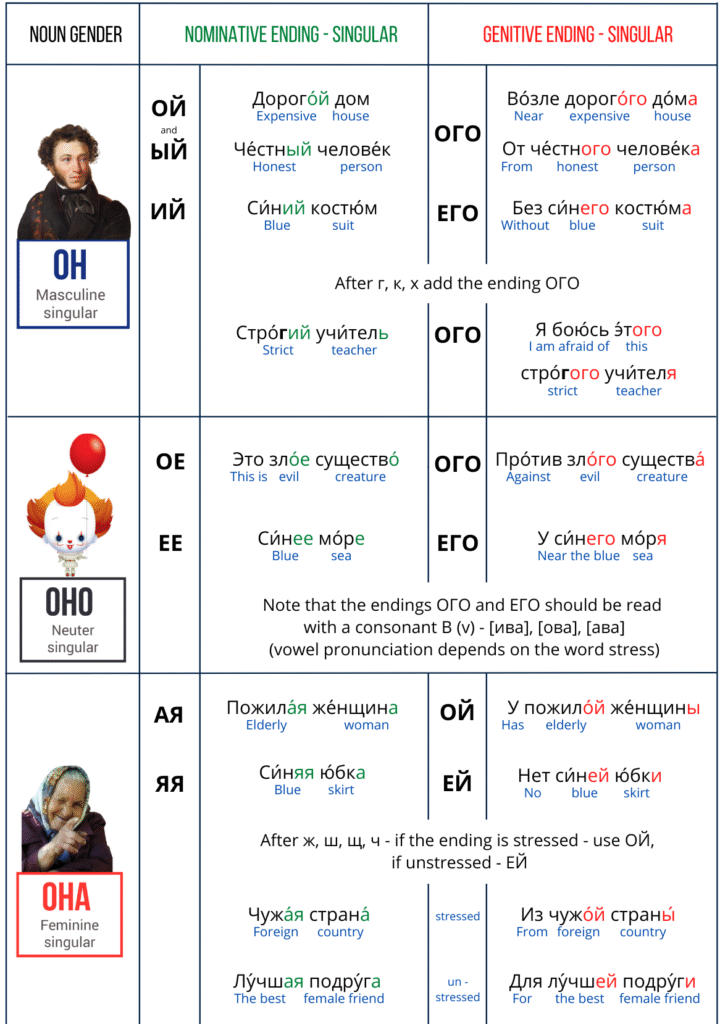
Let’s summarize the Genitive case endings for singular adjectives and create a clear, simpler system.
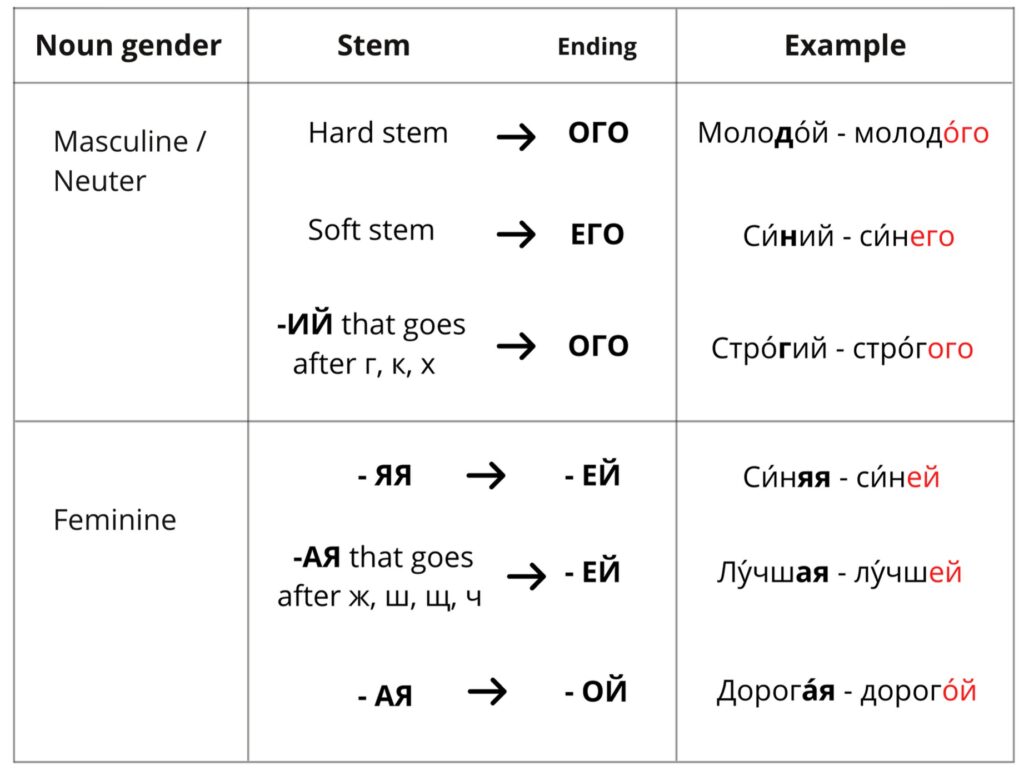
Rules for masculine and neutral adjectives:
If a stem ends in a hard consonant, change the ending to -ОГО. Ex.: отли́чный -> отли́чного (excellent).
When a stem of a word ends in -ИЙ and a stem ends up with one of the special letters (г, к, х) – change the ending to -ОГО. Ex.: ма́ленький -> ма́ленького (small, little).
However, if a word ends in a soft consonant, we should change the ending to -ЕГО. Ex.: ра́нний -> ра́ннего (early).
Rules for feminine adjectives:
If a word ends in -ЯЯ, change this ending to -ЕЙ. Ex.: Ex.: дома́шняя -> дома́шней (homemade).
If an adjective ends in -АЯ that goes after ж, ш, ч, щ change this ending to -ЕЙ. Ex.: хоро́шая -> хоро́шей (good).
If a feminine adjective ends in -АЯ, change this ending to -ОЙ. Ex.: изве́стная -> изве́стной (famous).
Find below two example sentences to remember these rules.
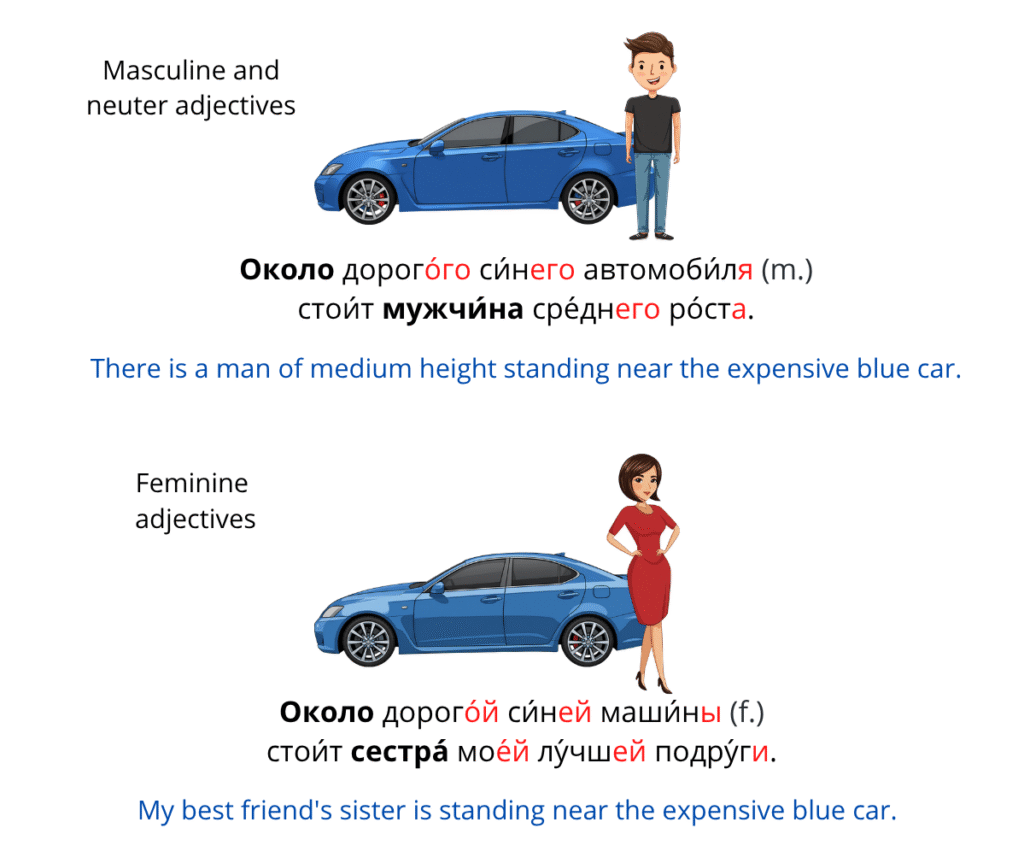
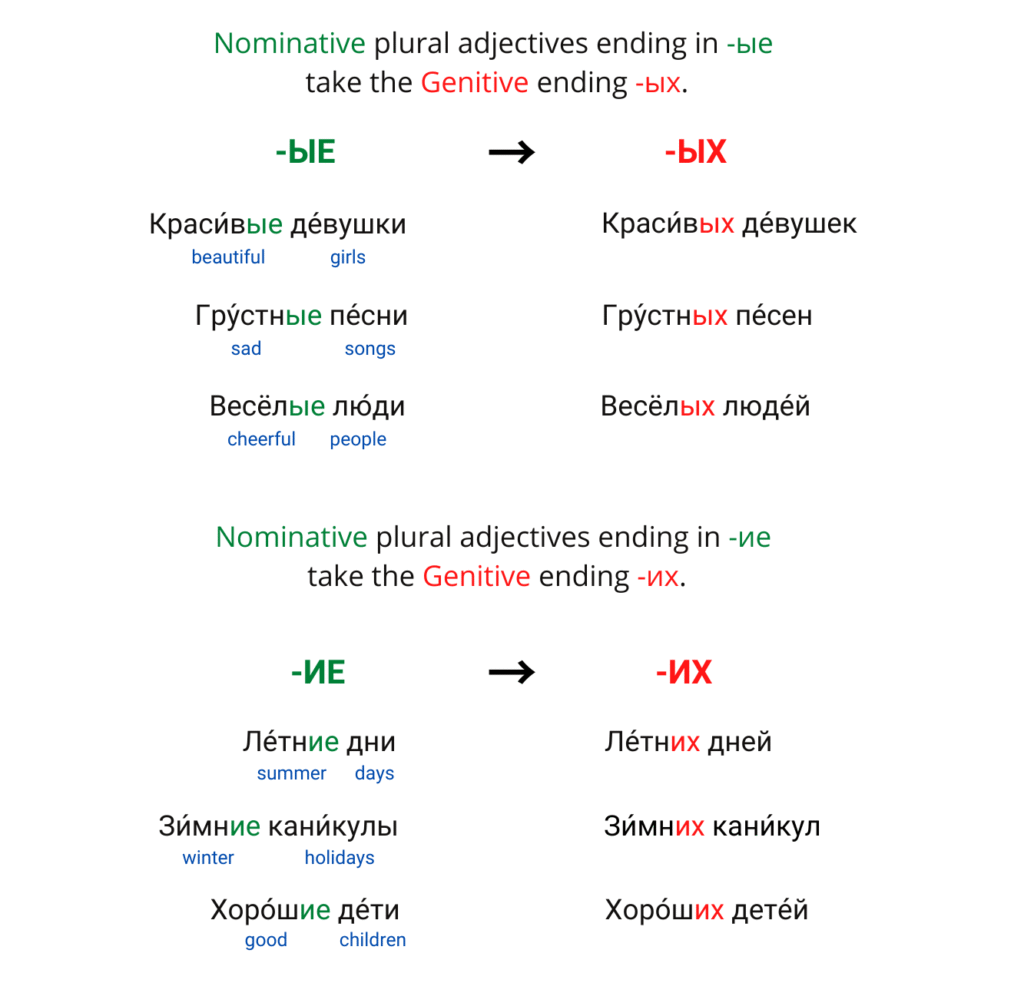
Endings for plural adjectives in the Genitive case
The good news is that in the Genitive plural, all adjectives -masculine, feminine, and neuter- use only two endings: -ых and -их.
Personal Pronouns — Genitive Case
| Nominative | Genitive | Meaning |
|---|---|---|
| я | меня | of me |
| ты | тебя | of you |
| он | его | of him |
| она | её | of her |
| оно | его | of it |
| мы | нас | of us |
| вы | вас | of you (pl.) |
| они | их | of them |
📌 У меня есть собака. — I have a dog. (Literally: at me there is a dog)
📌 Этот подарок для тебя. — This gift is for you.
To master the genitive case, you must also learn the specific forms for possessive, reflexive, and demonstrative pronouns, as well as determinative pronouns. Furthermore, you will need to study the genitive declensions for interrogative, relative, and indefinite pronouns, alongside both cardinal and ordinal numbers. Rather than relying on rote memorization, this clear system makes it significantly easier to understand the underlying logic of how the Russian language works. You will find this comprehensive approach throughout my book, which breaks down the Genitive case into intuitive, functional categories – “The Russian Genitive Case Made Easy. A Step-by-Step Self-Study Guide with Audio, Stories, and Real-Life Exercises“
The 12 Main Uses of the Russian Genitive Case
So, when is the Russian Genitive case used? Let us consider the most common situations:
1. Nouns: Possession and Connection
- Ownership: Indicates to whom an object belongs. Example: Тетра́дь дру́га (the friend’s notebook).
- Kinship: This defines family ties. Ex.: Брат Ива́на (Ivan’s brother).
- Relationship: Professional or hierarchical links. Ex.: Дире́ктор магази́на (the director of the shop).
- Specialization/Content: Indicates the specific subject, product, or profile of a place or activity. Ex.: Магази́н оде́жды (clothing store), уро́к му́зыки (music lesson).
- Genitive of Definition (Specification): Establishes the identity, role, or unique classification. Ex.: Столи́ца страны́ (the capital of the country).
- Designation of Events (Commemoration): Specifies a particular holiday, date, or event by naming what is being celebrated or whom the day is dedicated to. Ex.: День рожде́ния (birthday).
- Experience: Subjective feeling of “belonging” to someone. Example: Ра́дость ма́тери (the mother’s joy).
2. The “Subject vs. Object” Logic
- This is slightly more advanced but critical for fluency. Nouns in the Genitive can act as the actor or the receiver of an action hidden inside a noun.
- The Subject (The Actor): The Genitive noun is the one doing the action. Example: Сове́т до́ктора (doctor’s advice). Logic: The doctor gave the advice. The doctor is the subject.
- The Object (The Receiver): The Genitive noun is the target of the action. Example: Откры́тие Аме́рики (the discovery of America). Logic: America did not discover itself. Someone discovered America.
3. Description and Definition (What is it like?)
Instead of using an adjective, Russian often uses a noun in the Genitive to describe another noun. Attribute: A poetic or emphatic way to describe quality. Example: Де́вушка необыкнове́нной красоты́ (a girl of unusual beauty).
4. Quantity, Aggregation, and Units
- Used to answer the question “How much?” (Quantity and Aggregation).
- Includes the specific Rule of Russian Numerals (use with numbers).
- Includes Units of Quantity (e.g., kilograms, glasses).
- Example: Килогра́мм са́хара (A kilogram of sugar).
5. Possession and Absence (Preposition У)
In Russian, we do not use a verb that means “to have” like in English. Russian uses a special fixed construction with the preposition У. This preposition always puts the “owner / possessor” into the Genitive case. Instead of saying: “I have a book,” Russians say: У меня́ есть кни́га – literally: “At me there is a book.”
We also use the Genitive case to show the absence of something or somebody (both animate and inanimate objects). For this purpose, we use a construction of possession + negation that requires the Genitive case. As a result, the Genitive case is used twice within one construction.
- Example (Possession): У меня́ есть кот (I have a cat).
- Example (Absence): У дру́га нет маши́ны (A friend doesn’t have a car).
6. Absence (Preposition БЕЗ)
- Another way to show absence in Russian is with the preposition ‘без’ (without), which takes the Genitive case. It always answers the idea: something is missing / absent. Think of ‘без’ as a vacuum: it “removes” something → Genitive appears.
- Example: Чай без са́хара (Tea without sugar).
7. Comparative Adjectives
- Used in comparative constructions to show what something is being compared to.
- Example: Он ста́рше бра́та (He is older than his brother).
8. Prepositions of Movement and Origin
The book breaks down several specific movement-related uses for the Genitive case:
- Physical Movement: Using prepositions из (from inside), с (from the surface), and от (away from). Example: I am from Russia = Я из Росси́и; I am going from work = Я иду́ с рабо́ты; I received a gift from Ivan = Я получи́ла пода́рок от Ива́на.
- Movement in space: Using prepositions и́з-за (from behind), и́з-под (from under), пове́рх (on top of / over), вдоль (along), ми́мо (past / by).
- Origin / Source: Using из or от to show where someone or something comes from. Example: Я выхожу́ из до́ма (I am leaving the house). Он уже́ отошёл от до́ма (He has already walked away from the house).
- Material / Composition: Using the preposition из to show what something is made of. Example: кольцо́ из зо́лота (a ring made of gold).
9. Limits
- Spatial Limit: Using до (up to/until a location). Imagine a line drawn on the ground. You move and stop exactly at that line → this is ДО. We can translate it as “up to / as far as / until reaching a place”. Example: Дойти́ до до́ма (To walk up to the house).
- Temporal Limit: Using до (until a certain time). ДО indicates the end point of an action or state: “until”, “till”, “up to”, “by (a deadline)”. The key idea: Everything happens BEFORE this point, but NOT after it. Example: Мне на́до сдать отчёт до пя́тницы (I have to submit the report by Friday).
- Limit of Quantity: Using до to indicate an amount or extent. Think of до as a little hand saying: “Up to this number – not more!” This is the use of ДО + Genitive for amount, size, speed, length, weight, depth, price, age, and everything we can measure. It answers the question: “How far / how much / how many – at most?” Example: Мо́жно взять бага́ж до двадцати́ килогра́ммов (You can take luggage weighing up to twenty kilograms).
10. Time and Dates
- Used for Dates and Time expressions (answering “When?”). Example: Мой день рожде́ния двена́дцатого ма́рта (My birthday is on the 12th of March).
- Used with the preposition после (after). Examples: по́сле рабо́ты (after work); по́сле учёбы (after studying); по́сле уро́ка (after the lesson); по́сле вечери́нки (after the party).
- Used for Telling Time in specific Russian constructions. We use the Genitive case not only in the question asking the time “Ско́лько вре́мени?” (direct translation: how much of time?), but also when we need to tell the actual time. The system of telling time is a mini grammar workout with the Genitive case. Examples: 9:05 → пять мину́т деся́того (ча́са); 5:55 → без пяти́ шесть, 2:00 → два часа́.
11. Other Functional Prepositions
The Genitive case is also required after prepositions that categorize the following:
- Place and Location. Using у (near/at) and other common prepositions: вокру́г (around), напро́тив (in front of / across from), сле́ва от (on the left of), спра́ва от (on the right of), далеко́ / недалеко́ от (far/not far from), о́коло (near), во́зле (right next to), вблизи́ (in the vicinity of), посереди́не / посреди́ / среди́ (in the middle of / among), в це́нтре (in the center of), позади́ (behind).
- Purpose: Using the preposition для (for). Example: крем для рук – a hand cream (cream for hands).
- Cause: Prepositions explaining why something happened. The prepositions “и́з-за” and “по причи́не” are often translated the same way – “because of” or “due to” – and both require the Genitive case. However, they are not interchangeable: и́з-за is alive, emotional, and common in everyday conversations, while по причи́не sounds official, distant, and formal.
- Organizing Information. Prepositions used to structure data or facts: относи́тельно (about), каса́тельно (regarding), насчёт (concerning), кро́ме (except), вме́сто (instead of), etc.
- Using and Opposing. Prepositions related to usage or conflict: с по́мощью / при по́мощи (with the help of / using smb or smth), про́тив (against smb or smth).
12. Verbs Requiring the Genitive Case
The book distinguishes between three types of verbs governing this case:
- Verbs without Prepositions. Example: Она́ бои́тся чёрных ко́шек (She is afraid of black cats).
- Verbs with the Preposition У. Example: Он про́сит де́нег у дру́га (He is asking his friend for money).
- Verbs with the Preposition ОТ. Example: Не отвлека́йся от рабо́ты! (Don’t get distractedfrom your work!)
Common Mistakes English Speakers Make With the Genitive
Let’s be honest — every learner makes these. Here they are, so you can skip the embarrassment.
❌ Mistake 1: Using Nominative After “Нет”
❌ Нет книга.
✅ Нет книги.
After нет, you always use the genitive. No exceptions.
❌ Mistake 2: Forgetting Genitive After Numbers 2–4
❌ Два студент
✅ Два студента
Numbers 2, 3, and 4 require the genitive singular — not nominative, not plural.
❌ Mistake 3: Wrong Adjective Ending
❌ У моего красивый машины
✅ У моей красивой машины
Both the adjective AND the noun must agree in gender and case.
❌ Mistake 4: Skipping the Genitive After Prepositions
Many learners know their prepositions but forget to change the noun’s ending.
❌ без сахар
✅ без сахара
After без, для, из, от, до, после, у, около, кроме — always genitive.
The situations mentioned above are only the tip of the iceberg. To truly master the Russian Genitive case, you need more than just dry grammar rules – you need a roadmap. My guide is designed as a comprehensive course that transforms a notoriously daunting task into a fun, engaging, and manageable journey – “The Russian Genitive Case Made Easy. A Step-by-Step Self-Study Guide with Audio, Stories, and Real-Life Exercises“
I developed this guide to fill a significant gap in Russian language resources: the lack of comprehensive, engaging explanations for the cases. Many learners feel overwhelmed because traditional textbooks provide isolated rules without showing the “big picture” or practical application.
This guide offers a deep dive into the Genitive case, covering both its functional logic and common idiomatic expressions. By prioritizing context over rote memorization, the included exercises will empower you to integrate the Genitive case into your natural speech from day one.
The highlight of this guide is a comprehensive final story featuring a protagonist named Gena (your mnemonic key for the Genitive case). Built on the TPRS method – an industry-leading technique for building fluency through storytelling – the narrative naturally incorporates every essential Genitive construction. To wrap things up, you’ll find an exclusive bonus at the end of the book to help you further elevate your Russian proficiency.

More guides to Russian cases to discover
FAQ: Russian Genitive Case
Here are the most common questions about the Russian Genitive case.
What is the Genitive case in Russian used for?
The Russian Genitive case is one of the most common and useful cases in the language. It is mainly used to show possession (“the book of my friend”), absence (“I don’t have time”), quantity (“a cup of tea”), origin, and relationships between words.
You will also constantly encounter the genitive after numbers, negation, certain prepositions, and many everyday expressions used by native speakers. Because of this, learning the genitive case is essential for understanding real Russian and forming natural sentences from the very beginning.
A practical way to master it is through real examples, stories, and speaking patterns rather than isolated grammar tables. The Russian Genitive Case Made Easy. A Step-by-Step Self-Study Guide with Audio, Stories, and Real-Life Exercises was specifically designed to help learners understand how the genitive actually works in everyday Russian.
How do you form the Genitive case for Russian nouns?
The Russian genitive case is formed by changing the endings of nouns. The exact ending depends on the noun’s gender, number, and spelling pattern.
For example:
- masculine nouns often change to -а or -я
→ стол → стола - feminine nouns ending in -а usually change to -ы or -и
→ книга → книги - neuter nouns often change -о to -а
→ окно → окна
Plural forms follow different patterns and are usually considered the most challenging part of the genitive case for learners.
While the rules may seem overwhelming at first, they become much easier when learned through real examples and repeated exposure instead of memorizing isolated tables. The Russian Genitive Case Made Easy. A Step-by-Step Self-Study Guide with Audio, Stories, and Real-Life Exercises teaches the patterns step by step with stories, dialogues, audio, and practical exercises that help you naturally recognize and use the genitive in real Russian.
What prepositions take the Genitive case in Russian?
Many common Russian prepositions require the genitive case. Some of the most important ones include:
- у — by / at someone’s place / possession
→ у друга (“at a friend’s place” / “my friend has”) - без — without
→ без сахара (“without sugar”) - для — for
→ для семьи (“for the family”) - из — from / out of
→ из России (“from Russia”) - от — from / away from
→ от мамы (“from mom”) - до — until / up to
→ до вечера (“until evening”) - около — near / around
→ около дома (“near the house”) - после — after
→ после работы (“after work”)
These prepositions appear constantly in everyday Russian, which is why the genitive case is one of the first cases learners truly need to master in order to understand native speech and build natural sentences.
The Russian Genitive Case Made Easy. A Step-by-Step Self-Study Guide with Audio, Stories, and Real-Life Exercises explains these prepositions through real-life dialogues, stories, and practical exercises so you learn how they are actually used by native speakers rather than simply memorizing lists.
Why does “нет” always use the Genitive case?
In Russian, нет (“there is no” / “do not have”) requires the genitive case because it expresses absence or non-existence. Historically, the genitive case in Russian became strongly connected with the idea of something being missing, unavailable, or lacking.
For example:
- У меня есть книга.
(“I have a book.”) - У меня нет книги.
(“I do not have a book.”)
Notice how книга changes to книги in the genitive case after нет.
This structure is extremely common in everyday Russian, so learners encounter it very early when talking about possessions, people, time, money, food, or availability of things. At first it may feel unusual for English speakers, but with enough real examples the pattern quickly starts to sound natural.
The Russian Genitive Case Made Easy. A Step-by-Step Self-Study Guide with Audio, Stories, and Real-Life Exercises helps learners understand these patterns through real dialogues, stories, and practical exercises instead of dry grammar memorization.
How is the Russian Genitive different from possessives in English?
In English, possession is usually expressed with ’s or the word of:
- my friend’s book
- the color of the car
In Russian, possession is typically expressed using the genitive case instead of a separate possessive structure. The noun changes its ending to show the relationship:
- книга друга
(“the friend’s book” / “the book of a friend”) - цвет машины
(“the color of the car”)
Because Russian relies heavily on case endings rather than word order, the genitive case helps show how words are connected inside the sentence. But the genitive is not limited to possession — it is also used for absence, quantity, origin, negation, and many common prepositions, making it one of the most important cases in everyday Russian.
The Russian Genitive Case Made Easy. A Step-byStep Self-Study Guide with Audio, Stories, and Real-Life Exercises explains these patterns through clear real-life examples, dialogues, stories, and practical exercises that help learners understand how native Russian actually works.
Is the Russian Genitive case hard to learn?
The Russian genitive case has a reputation for being difficult — mainly because of the plural forms, which can feel unpredictable at first. But the singular genitive actually follows clear patterns that most learners begin to recognize surprisingly quickly with the right guidance.
The key is not memorizing endless rules in isolation, but seeing the genitive used naturally in real Russian sentences, stories, and conversations. With consistent exposure and practice, the logic behind the case starts to feel much more intuitive.
A great resource for mastering it step by step is The Russian Genitive Case Made Easy. A Step-by-Step Self-Study Guide with Audio, Stories, and Real-Life Exercises, which explains the genitive through clear examples, audio, real-life dialogues, and practical exercises designed for self-study.