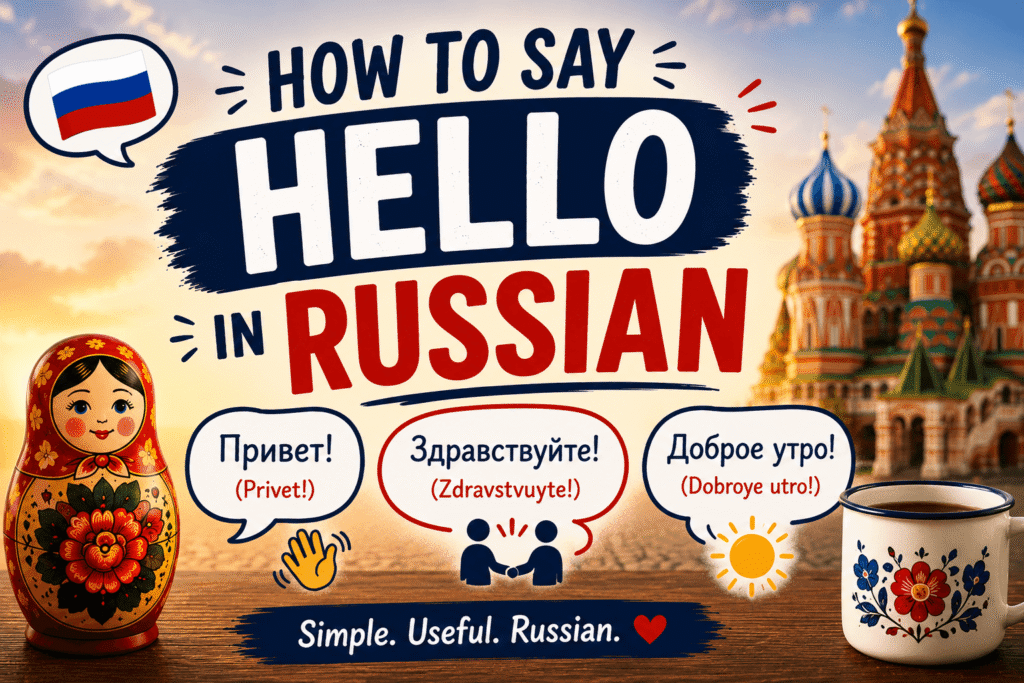

If you are learning Russian language, you must know the following words and expressions for different situations and occasions. I noticed that when it comes to actually using these handy expressions in real situations, people get stuck and cannot remember them or simply don’t know what to say. Therefore, I have collected for you different types of good wishes in Russian that can help you to wish nice things to people in particular situations. You will find all these phrases in my video lesson. Summary of the video with all useful expressions to wish something nice in Russian are given below the video.
Table of Contents
Why Good Wishes Are Important in Russian
Good wishes are a big part of everyday Russian communication. Russians use them not only for birthdays and holidays, but also before exams, trips, interviews, important meetings, performances, medical appointments, and even simple everyday situations.
In English, you can often say “good luck” or “all the best” and it will work in many contexts. In Russian, there are many different phrases depending on the situation. Some wishes sound warm and emotional, some are polite and formal, and some are idiomatic or even superstitious.
For example, уда́чи is a simple and universal way to say “good luck”, but ни пу́ха ни пера́ is a traditional idiom used before exams, performances, competitions, or other important events. Russians often answer к чёрту! to this phrase, which may sound strange if you translate it literally, but it is a normal traditional reply.
Learning these expressions will help you sound more natural, friendly, and culturally aware in Russian. If you want to sound natural and respectful in everyday Russian, you may also like my guide to polite Russian words and phrases.
How to wish something nice in Russian
Here is an overview of all Russian phrases to wish something nice in Russian:
How to say ‘enjoy your meal’ in Russian?

Прия́тного аппети́та! [прийАтнава апитИта] – Enjoy your meal!
Full sentence: Я жела́ю тебе́ прия́тного аппети́та! Direct translation: I wish you to have a pleasant appetite
The verb ‘жела́ть'(to wish) requires nouns in the Genitive case.
Importrant note:
Endings -ЕГО/ -ОГО should be pronounced with a consonant В. This is one of the fixed Russian pronunciation rules that you should know to speak proper Russian.
How to wish a good day in Russian?
There are different ways to wish ‘a good day’ in Russian. You should simply change the adjective and use the one that you like the most.

Хоро́шего дня! [харОшыва дн’А] – Have a good day!
Отли́чного дня! [атлИчнава дн’А] – Have an excellent day!
Прекра́сного дня! [прикрАснава дн’А] – Have a wonderful day!
Замеча́тельного дня! [замичАтил’нава дн’А] – Have an amazing day!
Уда́чного дня! [удАчнава дн’А] – Have a lucky day!
How to wish a good evening in Russian?
There are different ways to wish ‘a good evening’ in Russian. You should simply change the adjective and use the one that you like the most.

Хоро́шего ве́чера! [харОшыва в’Эчира] – Have a good evening!
Отли́чного ве́чера! [атлИчнава в’Эчира] – Have an excellent evening!
Прекра́сного ве́чера! [прикрАснава в’Эчира] – Have a wonderful evening!
Замеча́тельного ве́чера! [замичАтил’нава в’Эчира] – Have an amazing evening!
How to wish a good week in Russian?
There are different ways to wish ‘a good week’ in Russian. You should simply change the adjective and use the one that you like the most.
Хоро́шей неде́ли! [харОшэй нид’Эли] – Have a good week!
Отли́чной неде́ли! [атлИчнай нид’Эли] – Have an excellent week!
Прекра́сной неде́ли! [прикрАснай нид’Эли] – Have a wonderful week!
Замеча́тельной неде́ли! [замичАтил’най нид’Эли] – Have an amazing week!
Уда́чной неде́ли! [удАчнай нид’Эли] – Have a lucky week!
How to wish a good weekend in Russian?
There are different ways to wish ‘a good weekend’ in Russian. You should simply change the adjective and use the one that you like the most.
Хоро́ших выходны́х! [харОшых выхаднЫх] – Have a good weekend!
Отли́чных выходны́х! [атлИчных выхаднЫх] – Have an excellent weekend!
Прекра́сных выходны́х! [прикрАсных выхаднЫх] – Have a wonderful weekend!
Замеча́тельных выходны́х! [замичАтил’ных выхаднЫх] – Have an amazing weekend!
How to wish a good trip in Russian?
There are two ways to wish ‘a good trip’ in Russian. You can also use other adjectives if you want. But these are the most frequent phrases you will hear.

Счастли́вого пути́! [щислИвава путИ] – Have a happy trip!
Счастли́вой доро́ги! [щислИвай дарОги] – Have a happy trip!
How to wish a good flight in Russian?

If you know that a person is going to take a plane, you can use the following expression:
Счастли́вого полёта! [щислИвава пал’Ота] – Have a happy flight!
Pay a special attention to the transcription of the adjective.
How to wish a good vacation in Russian?
There are two most common ways to wish ‘a good vacation’ in Russian. You should simply change the adjective and use the one that you like the most.

Отли́чного о́тпуска! [атлИчнава Отпуска] – Have a great vacation!
Отли́чного о́тдыха! [атлИчнава Отдыха] – Have a great rest!
How to wish a good night in Russian?
There are two most common ways to wish ‘a good night’ in Russian. You can also use other adjectives if you want. But these are the most frequent phrases you will hear.
Споко́йной но́чи! [спакОйнай нОчи] – Good night!
Прия́тных снов! [прийАтных сноф] – Have pleasant dreams!
How to wish a quick recovery in Russian?
There are three most common ways to say ‘get well soon’ in Russian.

Скоре́йшего выздоровле́ния! [скар’Эйшыва выздаравл’Энийа] – Have a quick recovery!
Выздора́вливай быстре́й! [выздарАвливай быстрЭй] – Get well soon!
*Add a particle ‘те’ to the verb if you address it to a stranger, a person in authority or in formal situations – Выздора́вливайте быстре́й!
Поправля́йся скоре́е! [паправл’Айс’А скар’Эй’э] – Get well soon!
*Remove the ending ‘ся’ and add a particle ‘тесь’ to the verb if you address it to a stranger, a person in authority or in formal situations – Поправля́йтесь скоре́е!
When a person has recovered from his / her illness, you can use the following expression in Russian:
Не боле́й! [нибал’Эй] Keep healthy! (don’t get sick)
Не боле́йте! [нибал’Эйт’э] Keep healthy! (don’t get sick) For several people or in formal situations.
How to say ‘take care’ in Russian?
Береги́ себя́! [биригИ сиб’А] – Take care (singular / informal)
Береги́те себя́! [биригИт’Э сиб’А] – Take care (plural / formal)
How to wish good luck in Russian?

Удачи! [удАчи] Good luck!
Full sentence: Я жела́ю тебе́ / вам уда́чи! (I wish you good luck!)
Уда́чи на экза́мене! – Good luck on your exam!
Уда́чи на собесе́довании! – Good luck on your job interview!
Ни пу́ха ни пера́! – I’ll keep my fingers crossed for you! (an old-fashioned idiomatic expression)
К чёрту! – To the devil! (a traditional reply to ‘Ни пуха ни пера’)
If you want to support someone emotionally, you can also learn different ways to say “Don’t worry” in Russian.
How to say ‘Happy birthday!’ in Russian?
С днём рожде́ния! [здн’ом ражд’Эн’йа] – Happy birthday!
In order to wish something nice in Russian, you should use the following construction:
Я жела́ю тебе́ / вам … + Genitive case – I wish you …
кре́пкого здоро́вья [кр’Эпкава здарОв’йа] solid health
успе́хов [усп’Эхаф] success (plural)
любви [л’убвИ] love
мно́го де́нег [мнОга д’Эн’эк] lots of money
Or you can just wish all the good things in Russian. Do you know how to say ‘All the best’ in Russian? Here are the options:
Всего́ хоро́шего! [фсивО харОшыва] All the best!
Всего́ до́брого! [фсивО дОбрава] All the best!
Всего́ наилу́чшего! [фсивО наилУтшыва] All the best!
Holiday Wishes in Russian
For holidays, Russian usually uses the structure:
С + instrumental case (if Russian cases confuse you, check my simple Russian case guides.)
For example:
С Но́вым го́дом! (Happy New Year!)
С Рождество́м! (Merry Christmas!)
С пра́здником! (Happy holiday!)
С 8 Ма́рта! (Happy International Women’s Day!)
С Па́схой! (Happy Easter!)
After the holiday greeting, you can add a wish:
Жела́ю тебе́ сча́стья и здоро́вья! I wish you happiness and health!
Жела́ю вам ми́ра, ра́дости и благополу́чия! I wish you peace, joy and well-being!
If you want to say something even warmer, you can also learn how to make compliments in Russian.
Do you know what you can do now to show of your great knowledge of good wishes in Russian? You can write a postcard to your friend in Russian. And it will be even better if you could write it in a beautiful Russian cursive.

Cultural Note: Why Russians Often Wish Health
In Russian, здоро́вье — health — is one of the most common things to wish. You will hear it in birthday wishes, New Year wishes, wedding wishes, toasts, and everyday conversations.
For example:
Жела́ю тебе́ здоро́вья! I wish you health!
Са́мое гла́вное — здоро́вье. The most important thing is health.
This may sound very serious in English, but in Russian it is completely normal and warm. Wishing someone health shows care, sincerity, and respect.
Russian good wishes can be quite emotional. A native speaker may wish you not only luck, but also happiness, health, love, success, patience, inspiration, peace, and dreams coming true. That is why learning full phrases is better than memorizing only one-word translations.
We have covered the most common good wishes in Russian for different situations and occasions. Your goal now is to learn and practice these Russian words and expressions so that you can use them straight away when needed. You can find the audio files with pronunciation of these Russian phrases in my free guide ‘Essential Russian Words and Expressions to Understand Spoken Russian’.
Want more lessons like this? Explore my Russian learning resources.
You can also browse my free Russian video lessons.
It’s also very important to know how to pronounce Russian words correctly as not every Russian letter is pronounced the same way as it’s written. There are certain Russian pronunciation rules that are really easy to learn.
If you wish to speak Russian, you should absolutely learn how to use Russian cases. Check the most comprehensive guides to Russian cases:


FAQ: Good Wishes in Russian
How do you say “good luck” in Russian?
The most common way to say “good luck” in Russian is Уда́чи! You can also say Жела́ю тебе́ уда́чи to a friend or Жела́ю вам уда́чи in a formal situation.
What does “Ни пуха ни пера” mean?
Ни пу́ха ни пера́ is a traditional Russian expression used to wish someone good luck before an exam, performance, competition, or important event. The traditional answer is К чёрту! This expression is idiomatic and should not be translated literally.
How do you wish someone happy birthday in Russian?
You say С днём рожде́ния! It means “Happy birthday!” You can add: Жела́ю тебе́ сча́стья, здоро́вья и любви́ — “I wish you happiness, health and love.”
How do you say “all the best” in Russian?
You can say Всего́ хоро́шего! or Всего́ до́брого! Both mean “all the best.” Всего́ до́брого sounds a little more formal and polite.
Can I use “Удачи” in formal situations?
Yes, Уда́чи can be used in many situations, but for a more formal tone, you can say Жела́ю вам уда́чи — “I wish you good luck.”
What should I write in a Russian birthday message?
A simple Russian birthday message can be:
С днём рожде́ния! Жела́ю тебе́ сча́стья, здоро́вья, любви́ и исполне́ния жела́ний!
It means: “Happy birthday! I wish you happiness, health, love and that your wishes come true!”