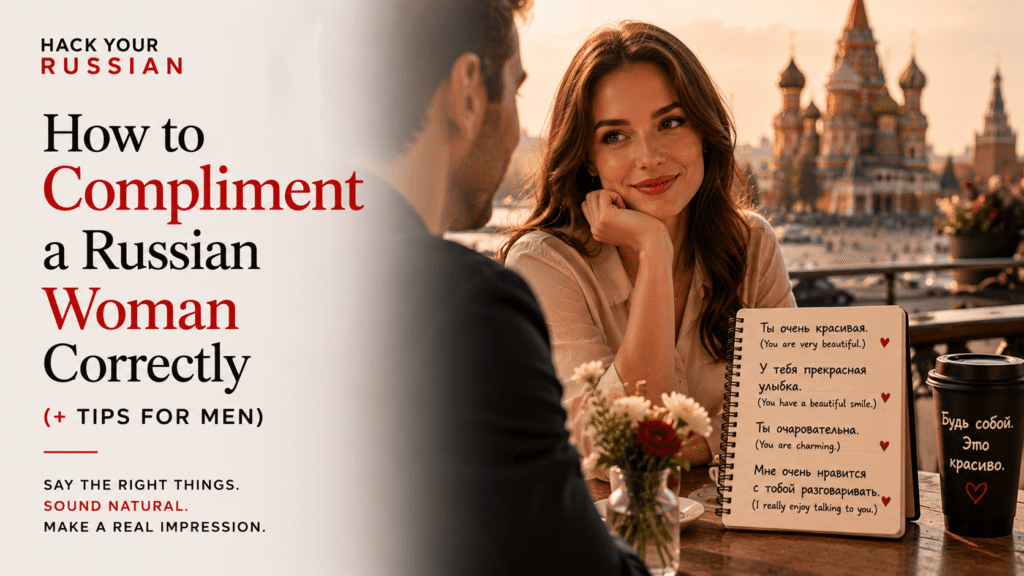
Do you know how to give compliments in Russian without sounding awkward, too direct, or too formal? Compliments are a beautiful part of communication, but in Russian you need to choose the right words depending on the situation.
In this lesson, you will learn how to compliment someone’s appearance, style, personality, clothes, smile, voice, and taste. You will also learn the difference between informal and polite compliments, how to use constructions like Ты выглядишь…, Мне нравится…, У тебя…, and Тебе идёт…, and how to respond when someone compliments you.
Russian compliments can be warm, romantic, friendly, or polite. The most important thing is to understand the context and use phrases that sound natural in real conversation. Compliments are also part of polite communication, so it helps to know common polite Russian words and phrases.
You can watch the free video lesson first and then use the summary below to review the most useful Russian compliments and examples.
Table of Contents
Video Lesson “How to make compliments in Russian”
Compliments on someone’s look in Russian
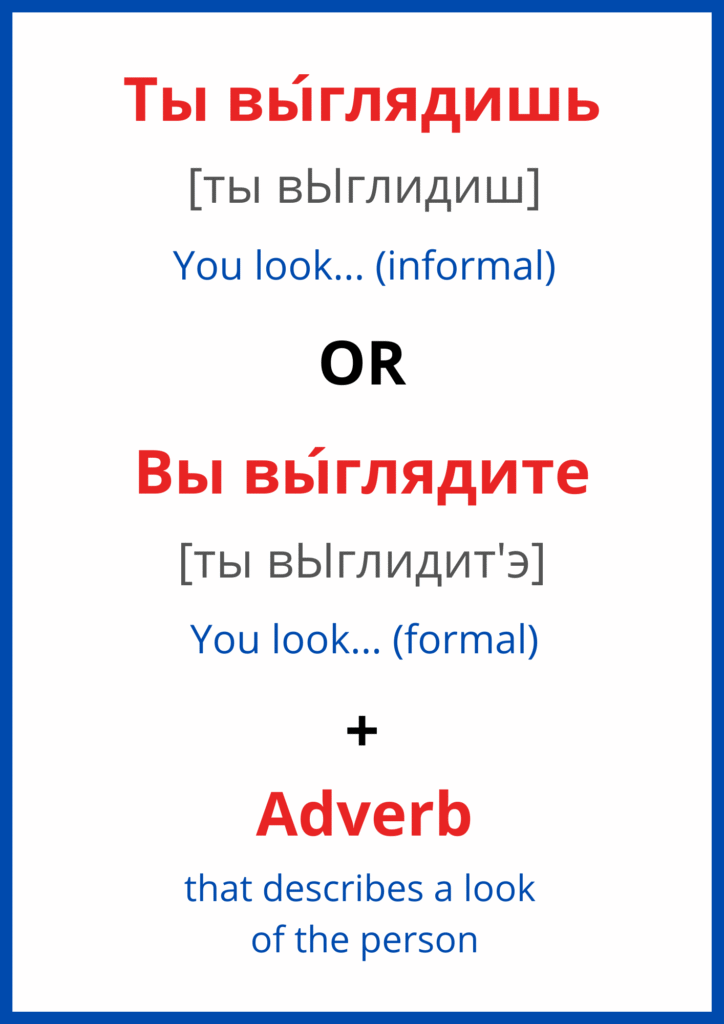
One of the easiest ways to compliment someone’s appearance in Russian is to use the construction:
Ты вы́глядишь… or Вы вы́глядите… (You look …) – and then you need to add an adverb that can describe the look of a person.
After this construction, you need an adverb. This is why we say:
Ты выглядишь прекрасно.
You look wonderful.
But not:
Ты выглядишь прекрасная.
The word after выглядишь / выглядите describes how the person looks, so Russian uses an adverb here: хорошо, прекрасно, отлично, шикарно, замечательно, сногсшибательно.
Use ты выглядишь with friends, family, partners, and people you know well. Use вы выглядите in formal situations, with strangers, older people, or people you want to address respectfully.
Not sure when to use informal or polite ‘you’? Read my guide to Ты and Вы in Russian.
Possible Russian adverbs:
хорошо́ (well), прекра́сно (nice, very well),
отли́чно (perfect), превосхо́дно (superb),
шика́рно (gorgeous), замеча́тельно (excellent),
чуде́сно (wonderful), изуми́тельно (amazing),
великоле́пно (splendid), сногсшиба́тельно (fantastically),
потря́сно (stunning), кла́ссно, кру́то (cool, awesome).
Words like классно and круто are informal, so you may also enjoy learning more Russian slang words.
If you are not sure how strong your compliment should be, start with something simple like Ты хорошо выглядишь or Вы прекрасно выглядите. These phrases are polite, natural, and not too intense.
If you want to compliment a person on something that he or she has (ex.: beautiful eyes, soft hair, etc.), use a construction of the Genitive case without the verb ‘есть’ (to have). This construction is connected to possession, so you may want to review the Russian Genitive case.
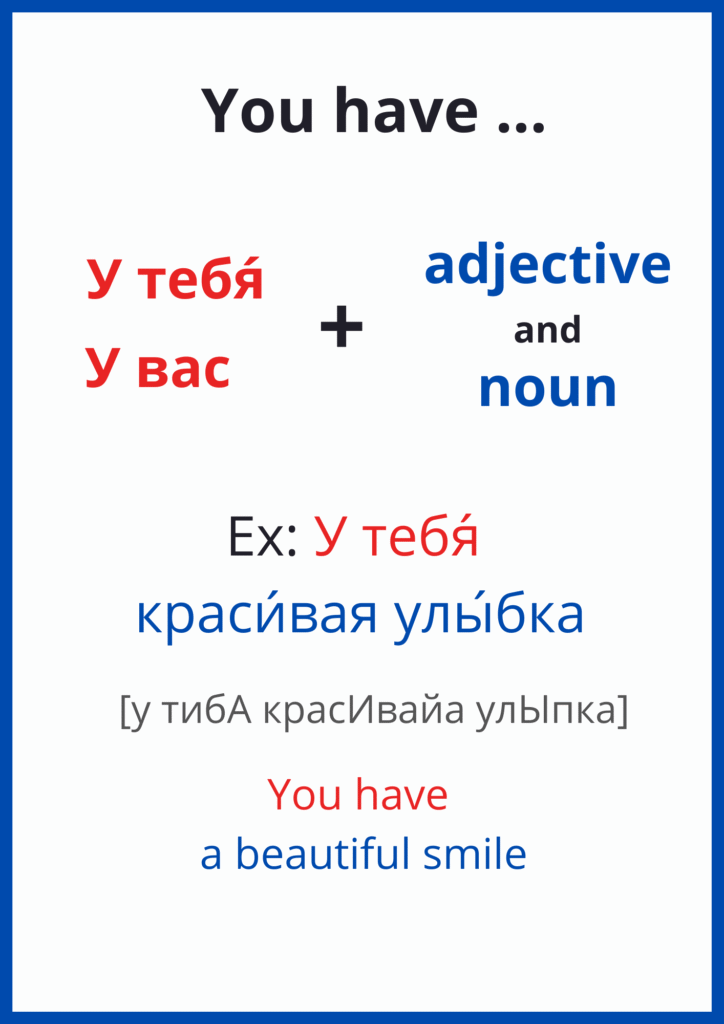
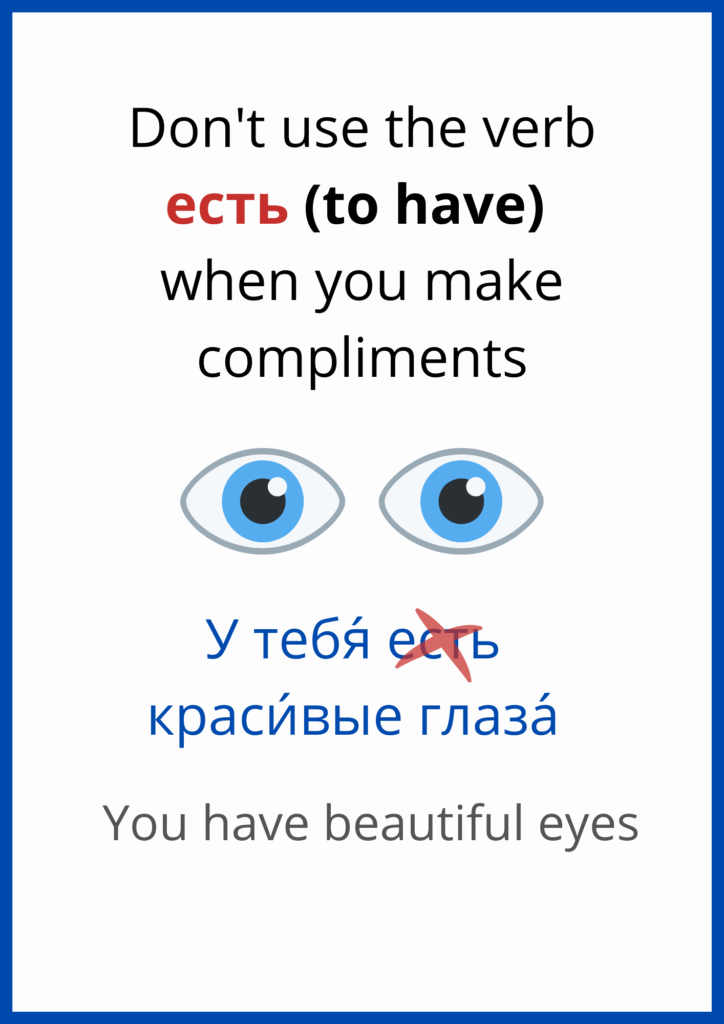
У тебя / у вас + adjective + noun
This structure literally means “at you there is…”, but in English we usually translate it as “you have…”
Use у тебя in informal situations and у вас in formal or polite situations.
Here are some examples of compliments in Russian:
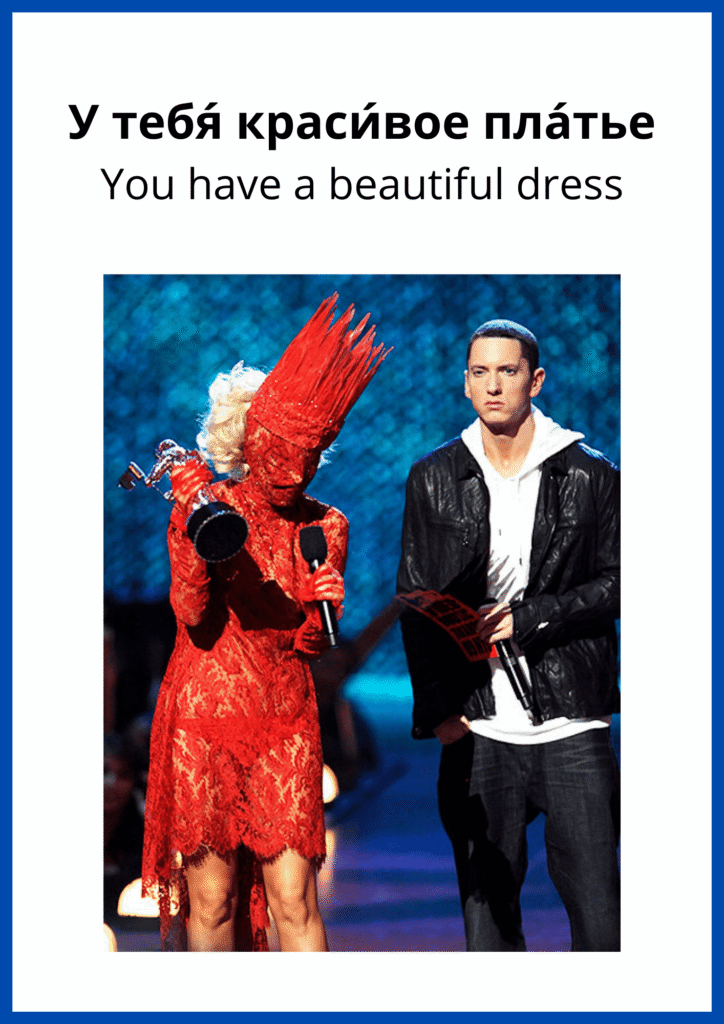
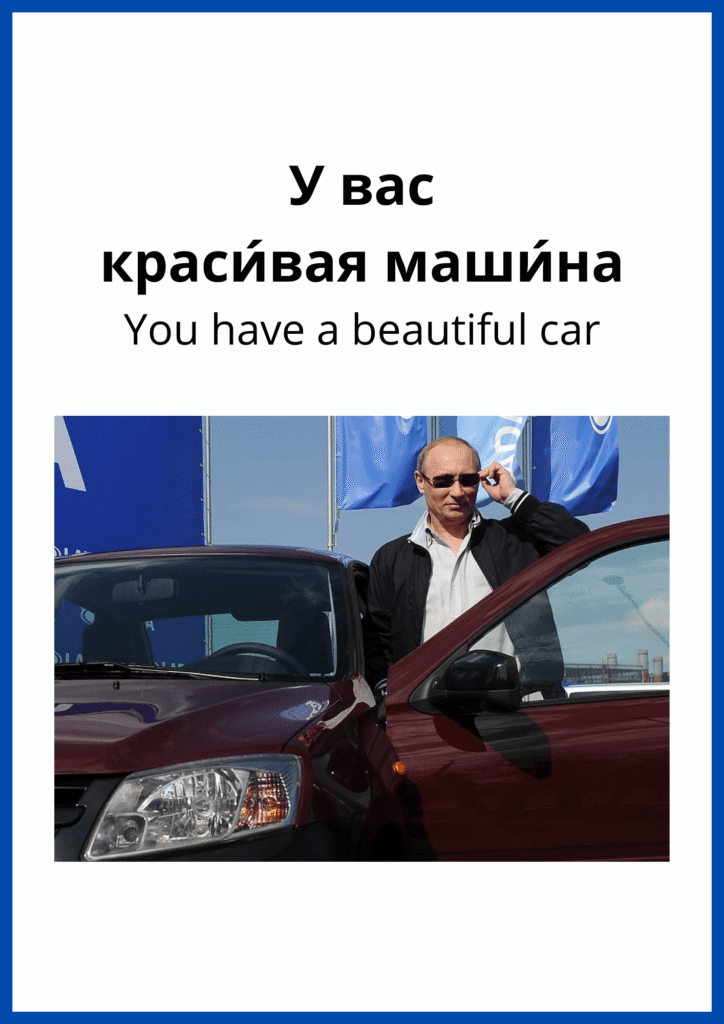
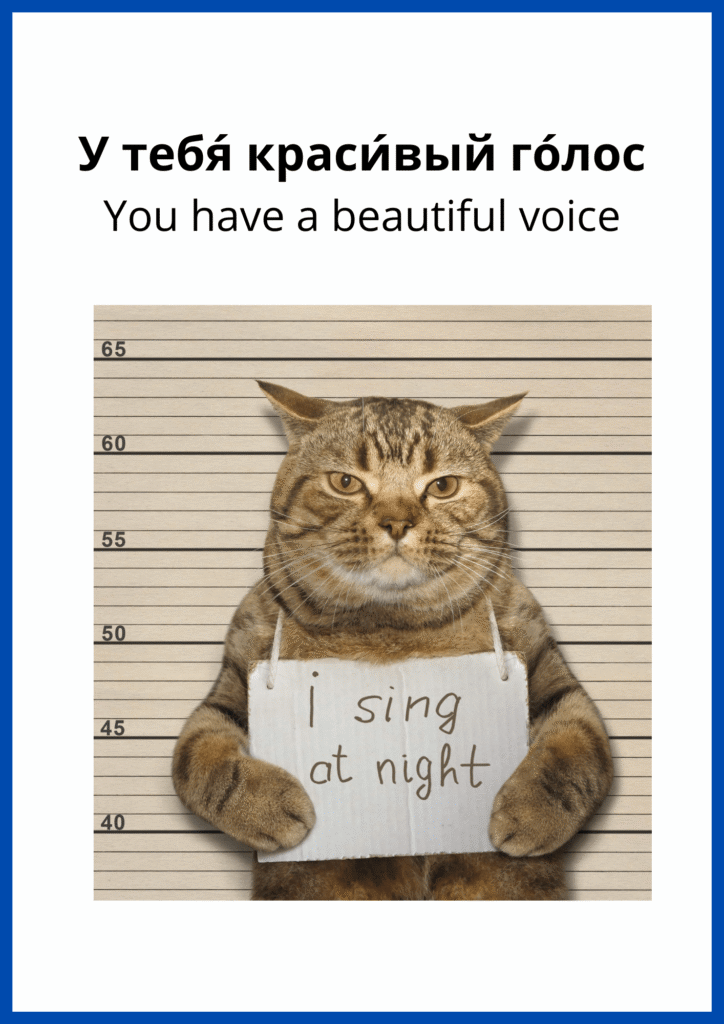
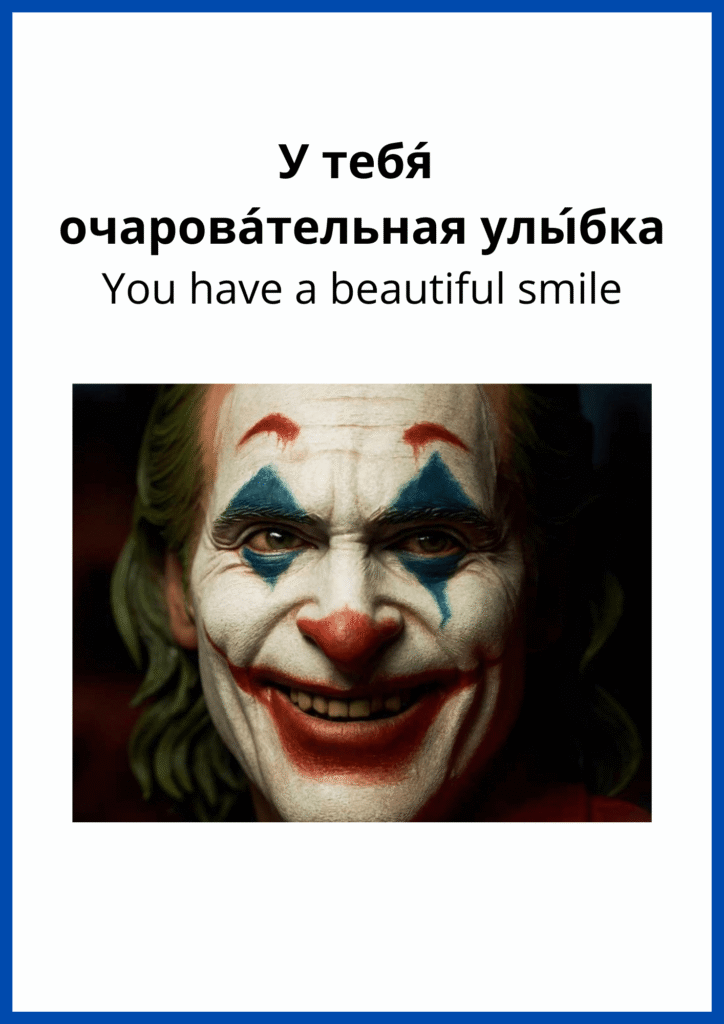
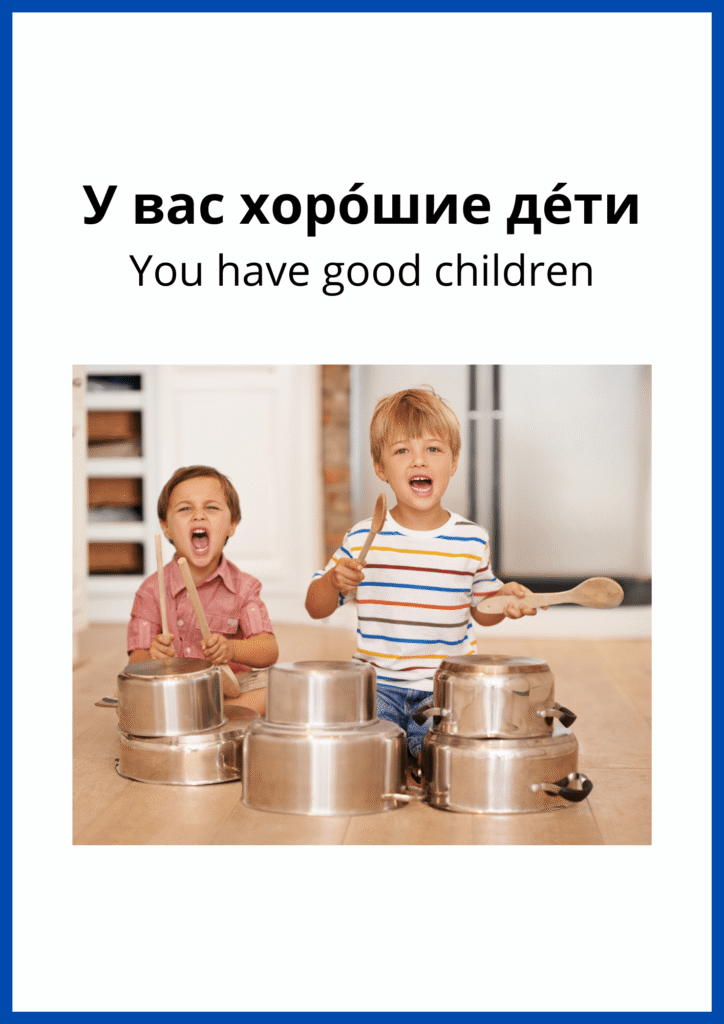
This construction is very useful because you can compliment not only appearance, but also voice, style, taste, energy, personality, and even someone’s home or work.
Compliments on style, fashion and different belongings in Russian
To compliment anything from clothing to looks, use the “I like” (Мне нравится…) construction. The construction Мне нравится… is one of the most useful ways to give compliments in Russian. It means “I like…” but the structure is different from English.
In English, we say:
I like your dress.
In Russian, we say:
Мне нравится твоё платье.
Literally, it is closer to “Your dress is pleasing to me.” This is why the word мне is used.
“Мне нравится” + possessive pronoun + noun that denotes what you like.
Мне нра́вится
Мне нра́вятся (pl.)
Then you should add one of the following possessive pronouns: твой / ваш (m.), твоя́ / ва́ша (f.), твоё / ва́ше (n.), твои́ / ва́ши (pl.).
The word мне is a Dative form, so this is a great example of how the Russian Dative case works in real speech.
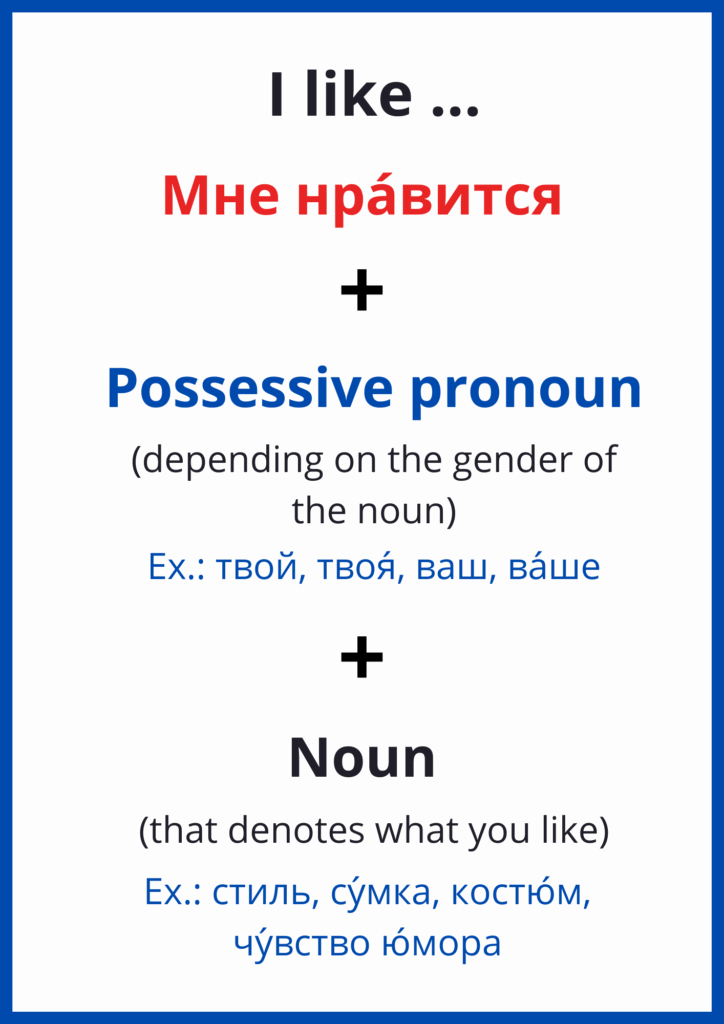
Possible nouns in Russian:
стиль (style), пиджа́к (a jacket), су́мка (a bag), причёска (a hairstyle), и́мя (a name), пла́тье (a dress), ту́фли (shoes), брю́ки (trousers).
*You need to choose the possessive pronoun depending on the gender of a word: m. – masculine, f. – feminine, n. – neuter, pl. – plural.
Твой, твоя, твоё, твои (= your) are for people you know well.
Ваш, ваша, ваше, ваши (= your) are for strangers, authorities and formal situations.
Use нравится with one singular thing:
Мне нравится твоя сумка.
I like your bag.
Мне нравится твой стиль.
I like your style.
Use нравятся with plural things:
Мне нравятся твои туфли.
I like your shoes.
Мне нравятся ваши очки.
I like your glasses.
This construction is very practical because it sounds natural, polite, and not too personal.
Another way to compliment a person on something he/she has is to use the construction:
Тебе / вам идёт + demonstrative pronoun + noun (= that suits you) OR
Demonstrative pronoun + noun + тебе / вам идёт. With plural nouns you should use a verb form ‘иду́т’. Notice the difference between тебе and вам, which depends on whether you speak formally or informally.
The phrase Тебе идёт… / Вам идёт… is extremely useful when you want to compliment someone’s clothes, hairstyle, accessories, or color.
Examples of compliments in Russian:
Тебе́ идёт э́тот шарф (This scarf suits you well)
Вам идёт э́та шля́па (This hat suits you well)
Тебе́ иду́т э́ти джи́нсы (These jeans suit you well)
Вам иду́т э́ти очки́ (These glasses suit you well)
And if you receive a compliment in Russian, here are some common ways to respond.
A Small Cultural Note About Compliments in Russian
Russian compliments can be very sincere, but they are not always used in exactly the same way as in English. Some Russian speakers may feel shy when receiving a compliment, especially if the compliment is very direct.
For example, if you say Ты сногсшибательно выглядишь! to someone you barely know, it may sound too strong. But if you say it to your partner or a close friend before a party, it can sound beautiful and natural.
In many situations, a softer compliment works better:
Тебе очень идёт это платье.
This dress really suits you.
У тебя красивая улыбка.
You have a beautiful smile.
Ты сегодня очень хорошо выглядишь.
You look very good today.
These compliments are warm but not too aggressive.
Compliments About Personality in Russian
Compliments are not only about appearance. In fact, compliments about personality often sound deeper and more meaningful.
Here are some useful Russian phrases:
| Russian | English |
|---|---|
| Ты очень добрый человек. | You are a very kind person. |
| Ты такая внимательная. | You are so thoughtful. |
| Ты такой внимательный. | You are so thoughtful. |
| С тобой очень легко общаться. | It is very easy to talk to you. |
| С тобой всегда интересно. | It is always interesting with you. |
| У тебя отличное чувство юмора. | You have a great sense of humor. |
| Ты очень талантливая. | You are very talented. |
| Ты очень талантливый. | You are very talented. |
| Ты меня вдохновляешь. | You inspire me. |
Pay attention to gender endings:
талантливая — about a woman
талантливый — about a man
внимательная — about a woman
внимательный — about a man
This is one of the reasons Russian compliments can be tricky: adjectives often change depending on the gender of the person you are talking about.
Romantic Compliments in Russian
Some compliments sound more romantic, so use them carefully. They are better for dating, relationships, or very close emotional situations.
| Russian | English |
|---|---|
| Ты очень красивая. | You are very beautiful. |
| Ты невероятная. | You are incredible. |
| У тебя потрясающая улыбка. | You have an amazing smile. |
| Я не могу отвести от тебя глаз. | I can’t take my eyes off you. |
| Ты сводишь меня с ума. | You drive me crazy. |
| Ты особенная. | You are special. |
| Рядом с тобой мне хорошо. | I feel good when I’m with you. |
| Ты мне очень нравишься. | I really like you. |
Be careful with very strong phrases like Ты сводишь меня с ума. They can sound passionate and romantic, but they can also be too intense if you say them too early.
A softer and safer romantic compliment is:
Мне очень нравится твоя улыбка.
I really like your smile.
Can You Use These Compliments for Men Too?
Yes. Many of these Russian compliments can be used for both women and men, but you need to change some adjective endings.
For example:
| To a woman | To a man | English |
|---|---|---|
| Ты красивая. | Ты красивый. | You are beautiful / handsome. |
| Ты милая. | Ты милый. | You are sweet / cute. |
| Ты талантливая. | Ты талантливый. | You are talented. |
| Ты умная. | Ты умный. | You are smart. |
| Ты добрая. | Ты добрый. | You are kind. |
| Ты внимательная. | Ты внимательный. | You are thoughtful. |
For men, красивый can mean “handsome”, but in casual speech you may also hear:
Ты классно выглядишь.
You look great.
Ты очень стильно выглядишь.
You look very stylish.
Тебе идёт эта рубашка.
This shirt suits you.
These phrases sound natural and are usually safer than very dramatic compliments.
Polite Compliments in Formal Situations
In formal situations, it is usually better to avoid very personal compliments about appearance. Instead, compliment someone’s work, style, professionalism, presentation, or taste.
Here are safer formal compliments:
| Russian | English |
|---|---|
| У вас отличный вкус. | You have great taste. |
| Вы очень профессионально всё объяснили. | You explained everything very professionally. |
| Очень хорошая презентация. | A very good presentation. |
| Вы прекрасно выступили. | You spoke / performed wonderfully. |
| У вас очень элегантный стиль. | You have a very elegant style. |
| Мне понравилась ваша идея. | I liked your idea. |
| Вы отлично справились. | You did a great job. |
In Russian, a direct compliment about appearance at work can sometimes feel too personal. If you are not close to the person, it is usually safer to compliment something neutral: their work, taste, idea, presentation, or outfit.
If you want to react to someone’s success or good work, learn how to praise someone in Russian.
You may also need phrases to encourage someone in Russian when they need support.
And if someone has an exam, interview, or important event, learn how to wish luck in Russian.
How to Respond to Compliments in Russian
When someone gives you a compliment in Russian, you can respond in different ways depending on the situation.
The safest answer is: Спасибо! Thank you!
You can also say:
| Russian | English | Tone |
|---|---|---|
| Спасибо, очень приятно. | Thank you, that’s very nice. | polite |
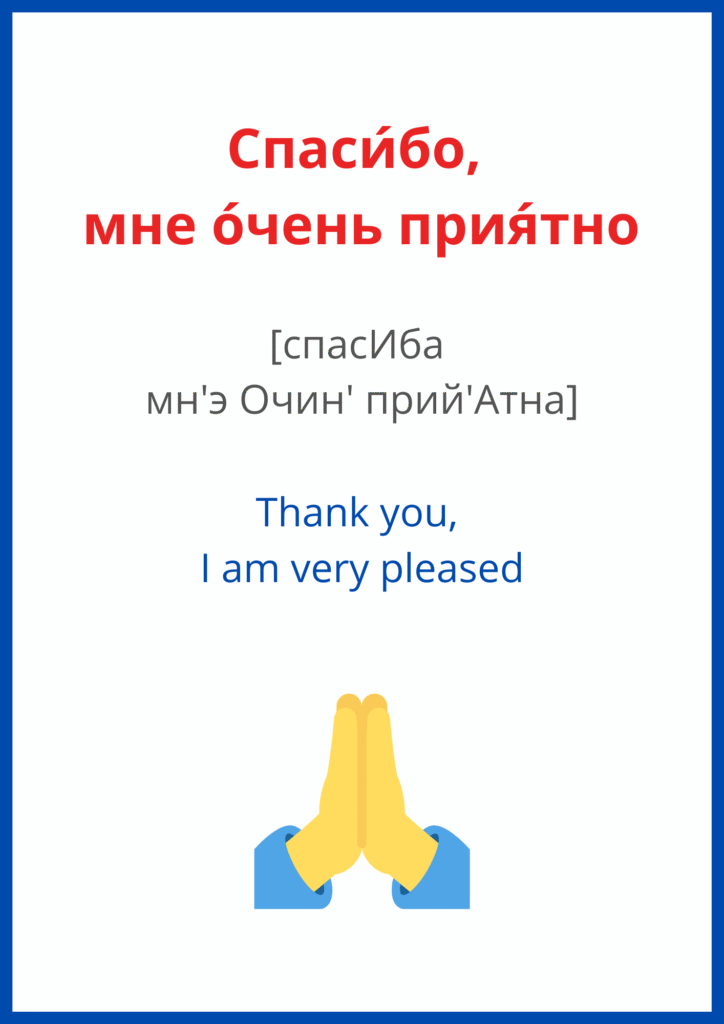
| Спасибо, мне очень приятно. | Thank you, I’m very pleased. | warm |
| Ой, спасибо! | Oh, thank you! | casual |
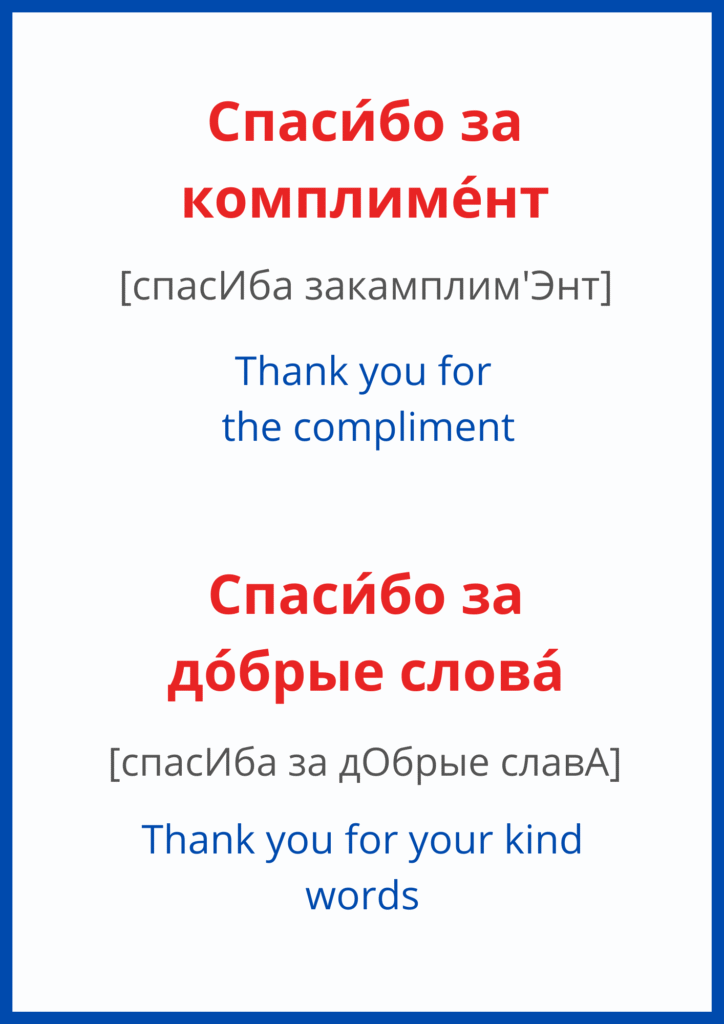
| Спасибо за комплимент. | Thank you for the compliment. | neutral |
| Как приятно это слышать! | How nice to hear that! | warm |
| Ты тоже отлично выглядишь. | You look great too. | friendly |
| Спасибо, я старалась. | Thanks, I tried. | playful / feminine |
| Спасибо, я старался. | Thanks, I tried. | playful / masculine |
The safest answer is usually a simple thank you, but there are many more polite replies in Russian.
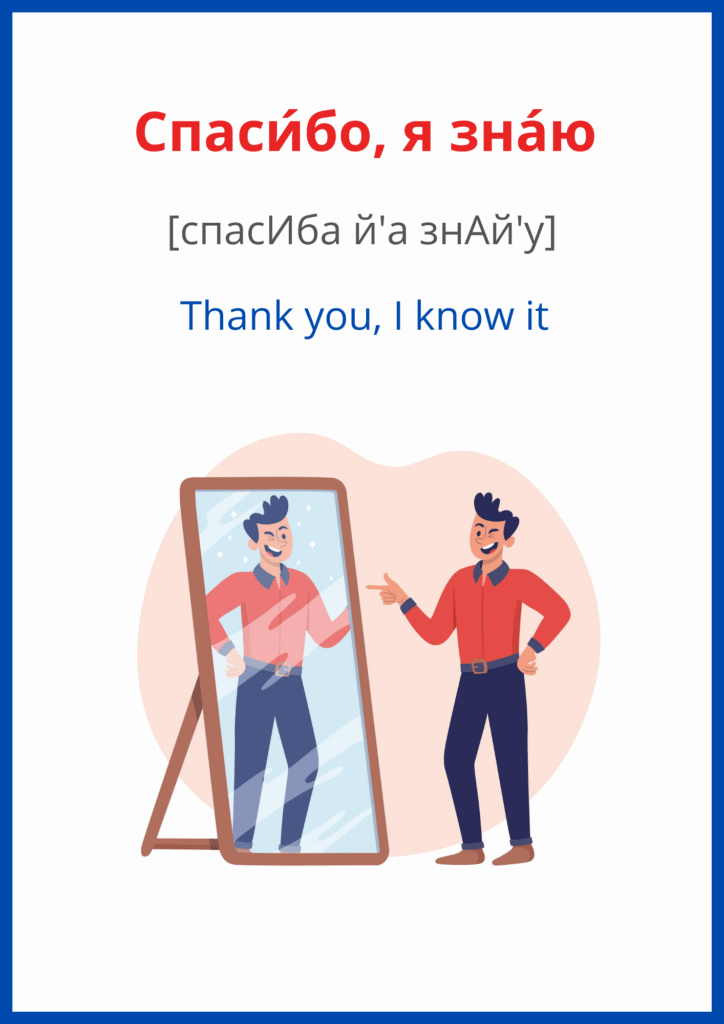
And if you are really confident of yourself, you can say this
In Russian culture, some people may modestly reject a compliment:
Да ладно, ничего особенного. Oh come on, it’s nothing special.
Ой, да брось! Oh, stop it!
This does not always mean they dislike the compliment. Sometimes it is just a modest or slightly embarrassed reaction.
The Best Way to Learn Russian Compliments
The best way to learn Russian compliments is to memorize them as complete phrases, not as isolated words. Russian grammar changes depending on gender, number, formality, and sentence structure, so full phrases are much easier to use correctly.
Start with simple and safe compliments:
Ты хорошо выглядишь.
You look good.
Мне нравится твой стиль.
I like your style.
Тебе идёт этот цвет.
This color suits you.
У тебя красивая улыбка.
You have a beautiful smile.
Then, when you feel more confident, you can learn warmer, more expressive, or romantic compliments.
Also, try to listen to how native speakers use compliments in movies, interviews, YouTube videos, and real conversations. This will help you understand not only the words, but also the tone.
That’s it! You have just learned the most common ways to make compliments in Russian. Watch the video to find out how you SHOULDN’T make compliments in Russian.
Want to continue learning useful Russian phrases? Explore my Russian learning resources.
If you have recently started to learn Russian language, you should absolutely have my free guide ‘Essential Russian Words and Expressions to Understand Spoken Russian’.
It’s also very important to know how to pronounce Russian words correctly as not every Russian letter is pronounced the same way as it’s written. There are certain Russian pronunciation rules that are really easy to learn.
If you wish to speak Russian, you should absolutely learn how to use Russian cases. Check the most comprehensive guides to Russian cases:
FAQ
How do you compliment someone in Russian?
The easiest way to compliment someone in Russian is to use phrases like Ты хорошо выглядишь — “You look good”, Мне нравится твой стиль — “I like your style”, or Тебе идёт этот цвет — “This color suits you”.
How do you compliment a Russian woman?
You can say Ты очень красивая — “You are very beautiful”, У тебя красивая улыбка — “You have a beautiful smile”, or Ты прекрасно выглядишь — “You look wonderful”. If you do not know the woman well, use the polite form: Вы прекрасно выглядите.
How do you say “beautiful” in Russian?
The Russian word for “beautiful” is красивый when speaking about a man or masculine noun, and красивая when speaking about a woman or feminine noun. For example: красивая женщина — a beautiful woman, красивый мужчина — a handsome man.
How do you say “You look good” in Russian?
You can say Ты хорошо выглядишь in an informal situation or Вы хорошо выглядите in a formal or polite situation.
How do you say “I like your style” in Russian?
You can say Мне нравится твой стиль informally or Мне нравится ваш стиль politely.
What is a safe compliment in Russian?
A safe compliment in Russian is one that is polite, simple, and not too personal. For example: Вы прекрасно выглядите, У вас отличный вкус, or Мне нравится ваш стиль.
How do you respond to a compliment in Russian?
The simplest answer is Спасибо! You can also say Спасибо, очень приятно — “Thank you, that’s very nice” or Спасибо за комплимент — “Thank you for the compliment”.