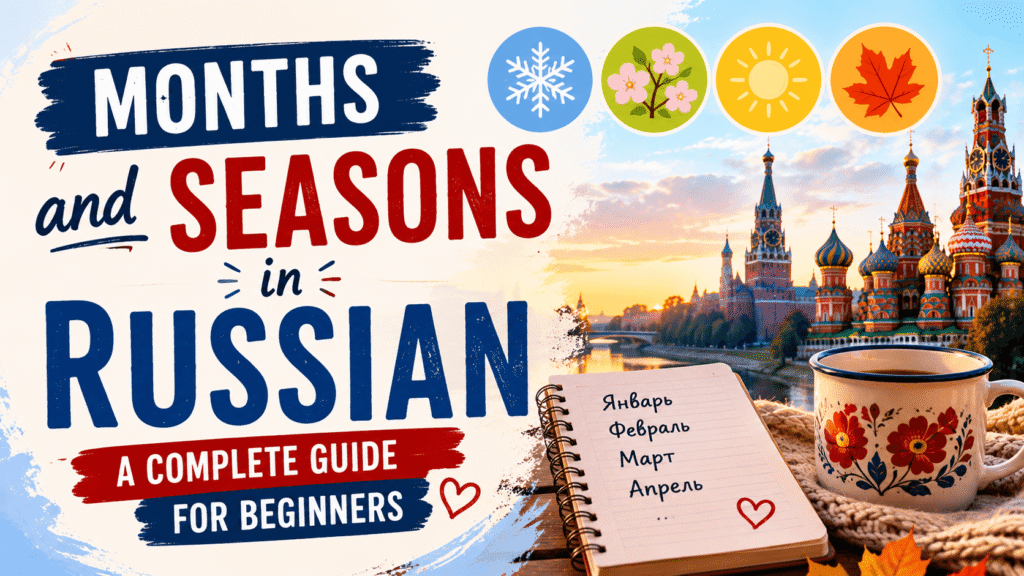
Learning the months and seasons in Russian is useful not only for talking about the calendar. You will need these words when you speak about birthdays, holidays, travel plans, weather, school, work, and past or future events.
For example, you can use months in Russian to say:
Мой день рожде́ния в ма́е (My birthday is in May).
Я е́ду в Росси́ю в декабре́ (I am going to Russia in December).
Мы встре́тимся ле́том (We will meet in summer).
In Russian, months and seasons often change their form depending on the sentence. This is why it is better to learn them not only as isolated words, but also in useful phrases.
Table of Contents
Months of the Year in Russian
- Январь [yahn-VAHR’] – January
- Февраль [fev-RAHL’] – February
- Март [mahrt] – March
- Апрель [ahp-REL’] – April
- Май [my] – May
- Июнь [ee-YOON’] – June
- Июль [ee-YOOL’] – July
- Август [AHV-goost] – August
- Сентябрь [sen-TYAHBR’] – September
- Октябрь [awk-TYAHBR’] – October
- Ноябрь [naw-YAHBR’] – November
- Декабрь [deh-KAHBR’] – December
В каком месяце ваш день рождения? (What month of the year is your birthday?).
In order to answer to this question, you need to use a preposition В and change a form of the month (Prepositional case). Let’s have a look. You will notice that we change an ending and add a letter “e” in the end.
Мой день рождения в … (My birthday is on …)
Январе [yahn-vah-RYE]
Феврале [fev-rah-LYE]
Марте [MAHR-tye]
Апреле [ahp-RE-lye]
Мае [MY-ye]
Июне [ee-YOO-nye]
Июле [ee-YOO-lye]
Августе [AHV-goos-tye]
Сентябре [sen-tyahb-RYE]
Октябре [awk-tyahbr-RYE]
Ноябре [naw-yahb-RYE]
Декабре [deh-kahbr-YE]
Ok, we have learned the names of months in Russian. But what about seasons in Russian?
Names of seasons in Russian
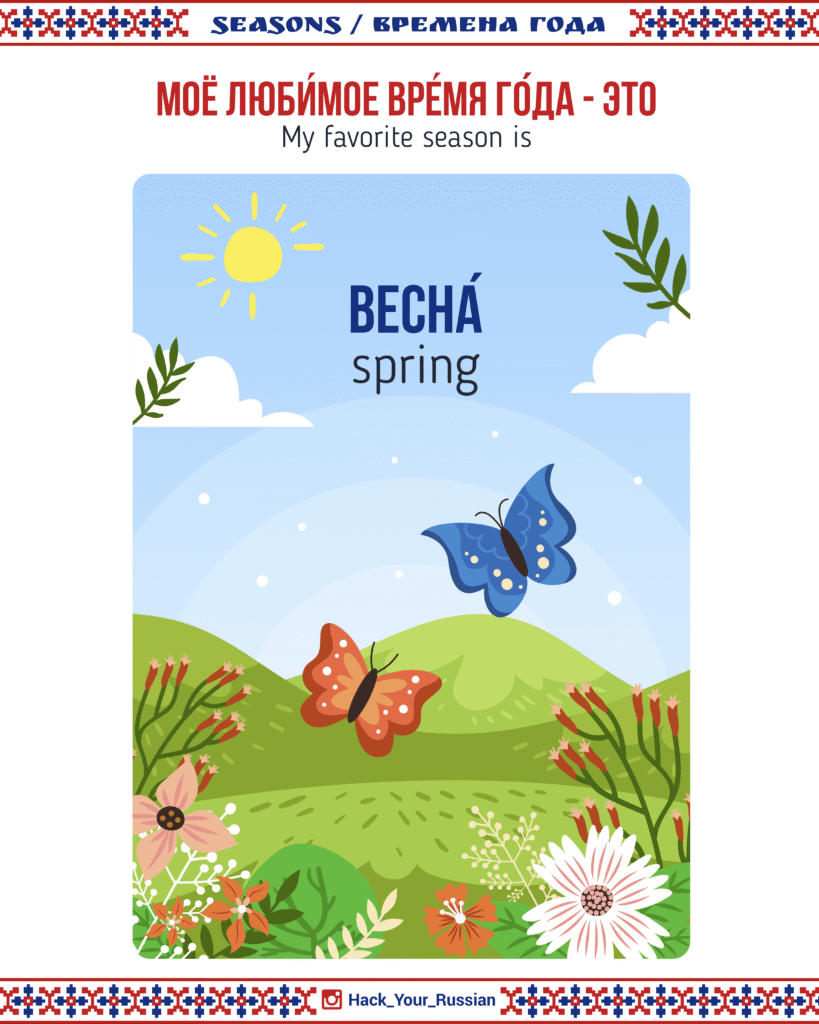
Весна [ves-NAH] – spring
Весе́нние ме́сяцы (spring months)
- Март [mahrt] – March
- Апре́ль [ahp-REL’] – April
- Май [my] – May
Key public holidays in Russia during spring:
8 марта – Междунаро́дный же́нский день (International Women’s Day);
9 мая – День Побе́ды (Victory Day).
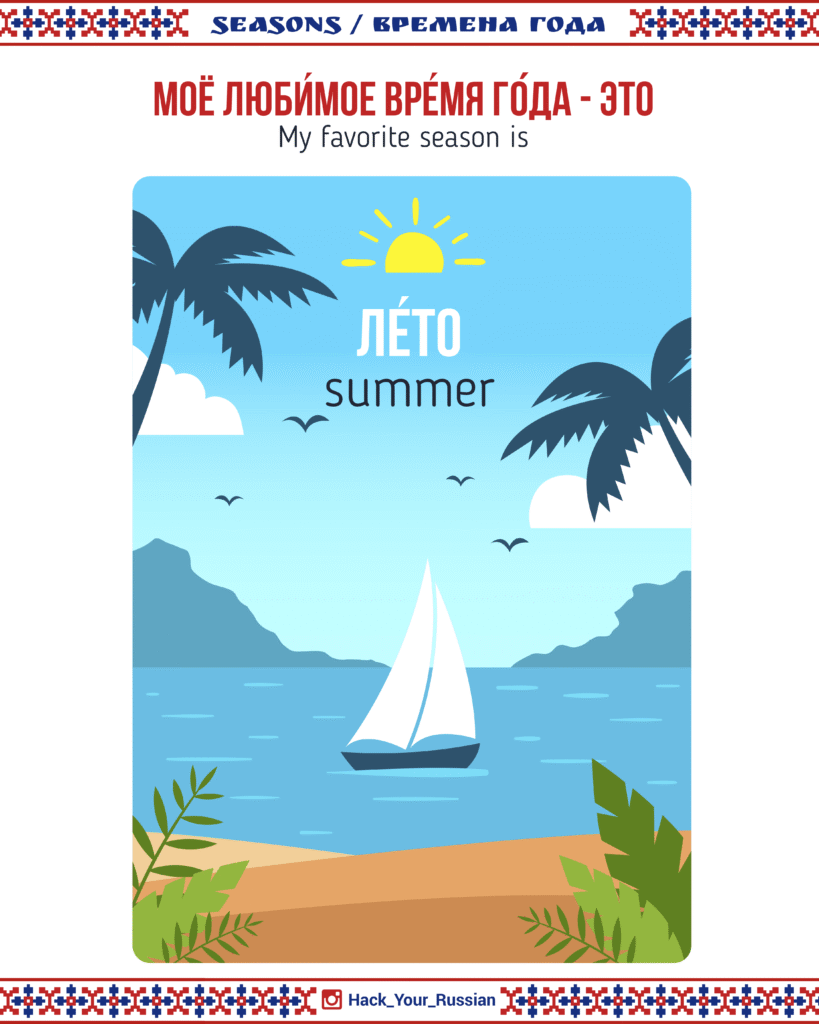
Ле́то [LEH-taw] – summer
Ле́тние ме́сяцы (summer months)
- Июнь [ee-YOON’] – June
- Июль [ee-YOOL’] – July
- Август [AHV-goost] – August
Key public holidays in Russia during spring:
12 июня – День Росси́и (Russia Day);
22 августа – День фла́га Росси́и (Russian Flag Day).
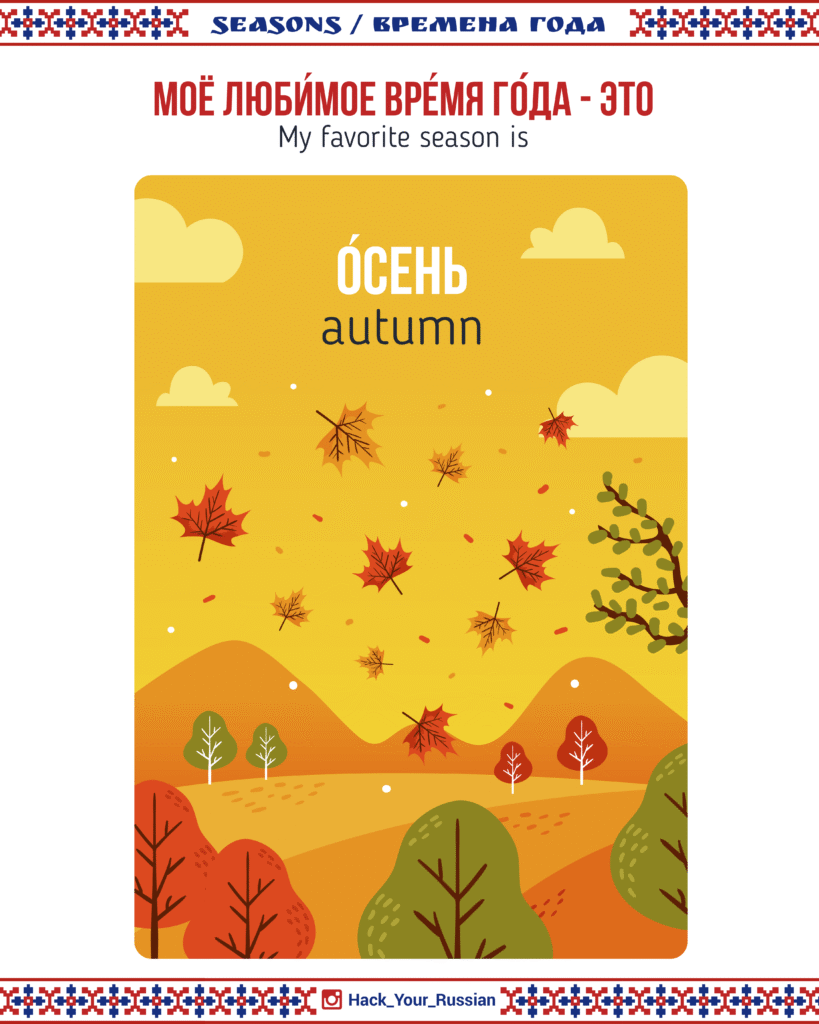
Осень [AW-sen] – autumn
Осе́нние ме́сяцы (autumn months)
- Сентябрь [sen-TYAHBR’] – September
- Октябрь [awk-TYAHBR’] – October
- Ноябрь [naw-YAHBR’] – November
Key public holidays in Russia during spring:
1 сентября – День зна́ний (Knowledge Day);
21 сентября – День ру́сского едине́ния (Russian Unity Day).
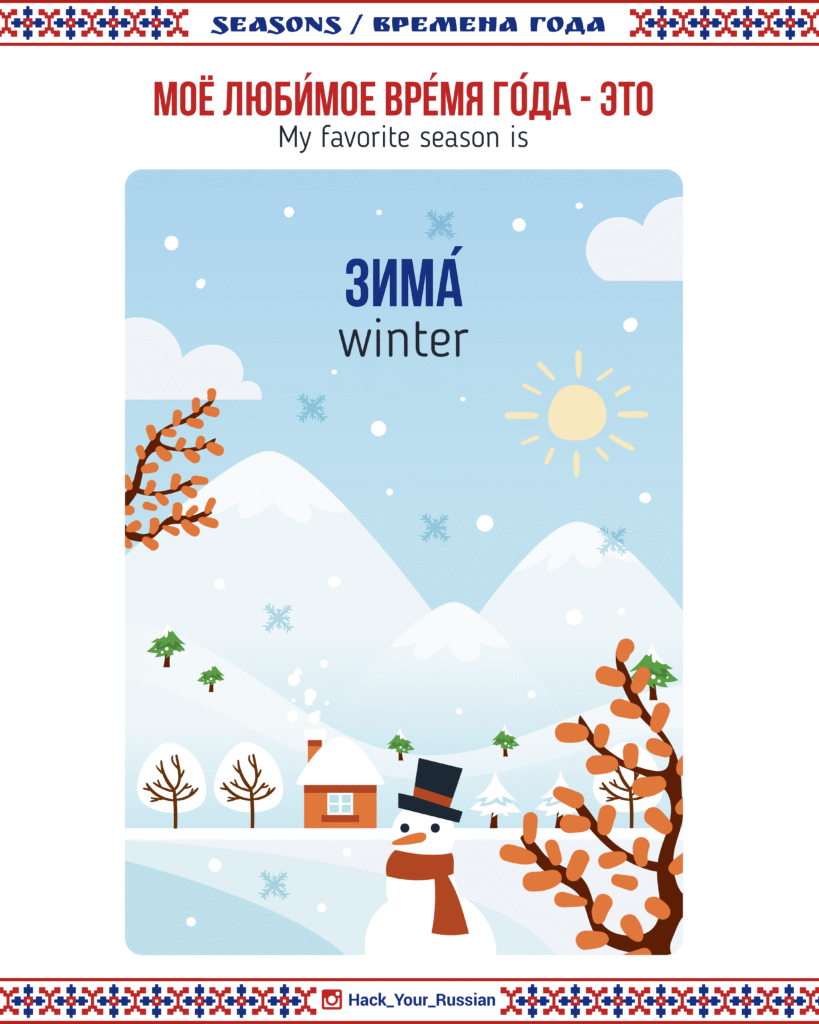
Зима́ [zee-MAH] – winter
Зи́мние ме́сяцы (autumn months)
- Декабрь [deh-KAHBR’] – December
- Январь [yahn-VAHR’] – January
- Февраль [fev-RAHL’] – February
Key public holidays in Russia during spring:
1 января – Но́вый год (New Year);
23 февраля – День защи́тника Оте́чества (Defender of the Fatherland Day).
Great! You have learned the names of months and seasons in Russian.
Useful Questions with Months and Seasons in Russian
Here are some useful questions you can ask using months and seasons in Russian.
В како́м ме́сяце твой день рожде́ния?
What month is your birthday? — informal
В како́м ме́сяце ваш день рожде́ния?
What month is your birthday? — formal
Како́е твоё люби́мое вре́мя го́да?
What is your favorite season? — informal
Како́е ва́ше люби́мое вре́мя го́да?
What is your favorite season? — formal
Когда́ ты е́дешь в о́тпуск?
When are you going on holiday? — informal
Когда́ вы е́дете в о́тпуск?
When are you going on holiday? — formal
Что ты о́бычно де́лаешь ле́том?
What do you usually do in summer?
Ты лю́бишь зи́му?
Do you like winter?
How to Answer Questions About Months and Seasons
To answer questions about months and seasons, you can use simple sentence patterns.
Мой день рожде́ния в ию́не.
My birthday is in June.
Я роди́лся / родила́сь в ма́рте.
I was born in March.
Моё люби́мое вре́мя го́да — ле́то.
My favorite season is summer.
Я люблю́ о́сень.
I like autumn.
Я не люблю́ зи́му, потому́ что хо́лодно.
I don’t like winter because it is cold.
Ле́том я люблю́ путеше́ствовать.
In summer, I like traveling.
Зимо́й я ката́юсь на лы́жах.
In winter, I ski.
Talking About Weather and Seasons in Russian
Months and seasons are often used when talking about the weather. Here are some useful beginner-friendly phrases.
Зимо́й хо́лодно.
It is cold in winter.
Ле́том жа́рко.
It is hot in summer.
Весно́й тепло́.
It is warm in spring.
О́сенью прохла́дно.
It is cool in autumn.
В январе́ ча́сто идёт снег.
It often snows in January.
В октябре́ ча́сто идёт дождь.
It often rains in October.
В ию́ле о́чень жа́рко.
It is very hot in July.
These simple sentences are very useful because they help you practice months, seasons, weather vocabulary, and Russian cases at the same time.
If you have recently started to learn Russian language, you should absolutely have my free guide ‘Essential Russian Words and Expressions to Understand Spoken Russian’.
It’s also very important to know how to pronounce Russian words correctly as not every Russian letter is pronounced the same way as it’s written. There are certain Russian pronunciation rules that are really easy to learn.
If you wish to speak Russian, you should absolutely learn how to use Russian cases. Check the most comprehensive guides to Russian cases: