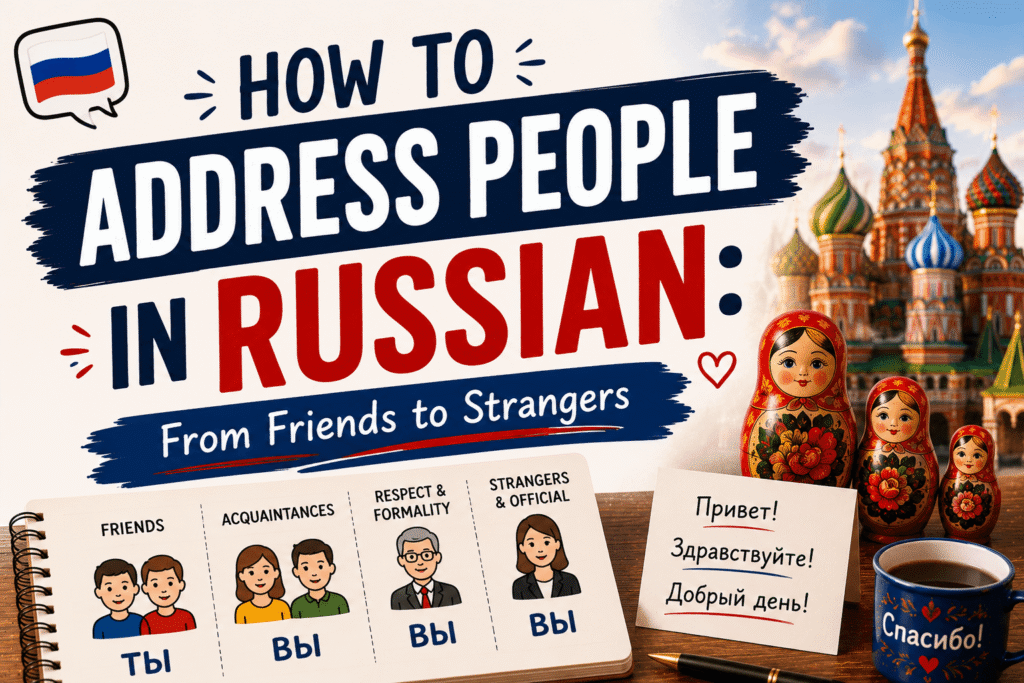
Knowing how to get someone’s attention in Russian is very useful in real-life situations. You may need to ask for directions, call a waiter, speak to a shop assistant, stop someone in the street, or ask a stranger for help.
Good news – I have compiled all these various words and expressions in one video – How to get someone’s attention in Russian. Just watch it, take notes and check yourself in the end.
Before learning how to address people in Russian, it is also useful to know how to say hello in Russian, how to ask “How are you?” in Russian, and how to say goodbye naturally in Russian. I also recommend you to check the lesson on how to introduce yourself in Russian.
Table of Contents
Russian Video Lesson “How to get someone’s attention in Russian”
Different ways to address someone in Russian
Impersonal ways to address people in Russian
1) Извини́те (izvinite) – Excuse me
ИЗВИНИТЕ is a polite and formal way to get someone’s attention.
It is impersonal and can be used to get attention of any person or people whose names you don’t know. It is usually followed by a request or a question.
извини́те (formal)
извини́ (informal)
Извини́те меня́, пожа́луйста (izvinite minyá pazhálsta) – Excuse me, please (formal)
Извини́ меня́, пожа́луйста (izvini minyá pazhálsta) – Excuse me, please (informal)
2) Прости́те (Prastite) – I beg your pardon
ПРОСТИТЕ is another polite and formal way to get someone’s attention.
It has a stronger meaning and shows that one is really sorry to bother another person.
Notice that a word ПРОСТИТЕ is also used when one feels sorry about something already done and he/she wants to apologize for that.
Прости́те меня́, пожа́луйста (prastite minyá pazhálsta) – I beg your pardon, please (formal)
Прости́ меня́, пожа́луйста (prasti minyá pazhálsta) – I beg your pardon, please (informal)
3) Мо́жно вас? (mózhna vas) – May I have a word with you?
МОЖНО ВАС? – a polite and formal way to get someone’s attention
It can be used either separately or be followed after another expression like ИЗВИНИТЕ, ПРОСТИТЕ and some gender/job specific words
Мо́жно тебя́? (mózhna tibyá) – May I have a word with you?
МОЖНО ТЕБЯ? – a polite and informal way to get attention of smb you know
It can be used either separately or be followed after another expression like ИЗВИНИ, ПРОСТИ or a name
Извини́те (пожалуйста)
Прости́те (пожалуйста)
Мо́жно вас?
These expressions can be used with any strangers, service workers. They are impersonal and polite.
Gender-specific ways to address a female stranger in Russian
1) Де́вушка (dévushka) – Young lady
ДЕВУШКА (young lady) is the most common way to address a woman whose name you don’t know: shop assistant, waitress, female bypasser and so on.
It is a tricky word because there is no general rule to say until what age you can call a woman
ДЕВУШКА (young lady)
While some middle-aged women would take this word as a compliment, others might consider it as sarcasm.
2) Же́нщина (zhénchshina) -Woman
Nobody knows when it is ok to call a woman ЖЕНЩИНА.
This word has rather a negative nature as it refers to the age and implies that a woman does not look young anymore.
Many women can take a word ЖЕНЩИНА addressed to them as the worst offence.
Though there is nothing wrong with this word itself as it signifies a gender.
Just avoid using a word ЖЕНЩИНА to address to women of any age as it sounds somewhat rude and you can never know what a Russian woman can do or tell you in revenge.
3) Ба́бушка (bábushka) – Old lady / grandmother
БАБУШКА (old lady) can be used to address an old lady (approximately starting from the age of 70). There are other different forms of this word to address to old ladies.
There are many cute / affectionate ways to address old ladies in Russian:
– Бабу́ля, бабу́ль
– Бабу́ська
– Бабу́лька
– Стару́шка
4) Де́вочка (Dévachka) – Girl (child)
Some old Russian ladies can address young ladies as ДОЧКА (daughter) in a friendly way.
5) As for kids, they can address middle-aged and old ladies as ТЁТЯ (literally – aunt) or ТЁТЕНЬКА (Mrs) in a friendly way.
Gender-specific ways to address male stranger in Russian
1) Молодо́й челове́к (maladói chelavék) – Young man
МОЛОДОЙ ЧЕЛОВЕК (young man) is the most common way to address a man whose name you don’t know: shop assistant, waiter, male bypasser and so on.
Just as a word ДЕВУШКА (young lady), МОЛОДОЙ ЧЕЛОВЕК is a gender-based form to address a young man.
2) Other variations of МОЛОДОЙ ЧЕЛОВЕК (better not to use to address, slang):
Па́рень (guy)
Паренёк
3) Мужчи́на (muchshina) – Man
МУЖЧИНА (man) – can be addressed to a middle-aged man
However, any middle-aged man would take as a compliment to be addressed as МОЛОДОЙ ЧЕЛОВЕК instead of МУЖЧИНА
4) Де́душка (Dédushka) – Old man / grandfather
ДЕДУШКА (old man) can be used to address an old man (approximately starting from the age of 70).
To address young male kids you shouldn’t use МОЛОДОЙ ЧЕЛОВЕК (young man)
5) Ма́льчик (mal’chik) – Boy
As for kids, they can address middle-aged and old men as ДЯДЯ (literally – uncle) or ДЯДЕНЬКА (Mr) in a friendly way.
Official forms to get someone’s attention in Russian
1) Господи́н (Mister) is mainly used in official correspondence
Can also be used in speech to address:
– high officials (Господин президент);
– some people in authority;
– business communication.
Female form of ГОСПОДИН is ГОСПОЖА (Missus) mainly used in official correspondence.
2) Да́мы и господа́ (dámy i gaspadá) – Ladies and Gentlemen is used to address an audience of people.
ДАМЫ И ГОСПОДА is usually used at concerts, official meetings, conferences, public events.
3) Граждани́н (m) (grazhdanin)
Гражда́нка (f) (grazhdánka)
Very formal, was used in Soviet times to address to people.
Brings to mind pictures of Soviet police.
Nowadays it is used to specify citizenship of a person.
Ex.: Он гражданин России (He is a citizen of Russia)
4) Това́рищ (comrade). This word was used in Soviet times as unisex and democratic way of addressing people in order to eliminate all social and gender differences.
No longer used in everyday speech. Used by military men to address individuals by ranks.
5) Ребя́та (ribyáta) – Guys
– A group of your friends or acquaintances;
– A group of children (whether you know them or not);
– Several young people you don’t know
It is commonly used to address children at school or students at university
6) Молоды́е лю́ди (young people) is a less common and more formal way to address to:
– A group of young people you don’t know (both women and men)
Slang forms to get someone’s attention in Russian
If you come to Russia, you might notice that some people address others as БРАТ (brother) or СЕСТРА (sister) even though they are not relatives and may not even know each other.
When you are in Russia don’t walk at night and beware people shouting “Эй”, “Слышь” and other informal ways to get your attention. It might be dangerous.
Чувáк (chuvák) is a popular Russian slang word that means DUDE. Don’t use it with strangers and people you don’t know well.
You should learn more Russian slang words to sound like a native.
How to Ask a Stranger for Help in Russian
If you want to ask a stranger for help, start with извини́те and then ask your question politely.
Useful phrases:
Извини́те, вы не подска́жете…?
Excuse me, could you tell me…?
Извини́те, вы не зна́ете…?
Excuse me, do you know…?
Извини́те, мо́жно вас спроси́ть?
Excuse me, can I ask you something?
Извини́те, вы мо́жете мне помо́чь?
Excuse me, can you help me?
Examples:
Извини́те, вы не подска́жете, где апте́ка?
Excuse me, could you tell me where the pharmacy is?
Извини́те, вы не зна́ете, где остано́вка?
Excuse me, do you know where the bus stop is?
Извини́те, вы мо́жете мне помо́чь? Я потеря́лась.
Excuse me, can you help me? I’m lost. — said by a woman
How to Call a Waiter or Shop Assistant in Russian
In a café, restaurant, shop, or market, you can use polite impersonal phrases first:
Извини́те.
Excuse me.
Мо́жно вас?
May I have a word with you?
Мо́жно вас спроси́ть?
Can I ask you something?
You may also hear people say:
Де́вушка!
Young lady! — to a female shop assistant or waitress
Молодо́й челове́к!
Young man! — to a male shop assistant or waiter
However, these gender-specific words can be tricky. Де́вушка is common, but it may sound awkward depending on the woman’s age or situation. Молодо́й челове́к is common for men, but not always natural for everyone.
Safer phrases:
Извини́те, мо́жно вас?
Excuse me, may I have a word with you?
Извини́те, мо́жно счёт?
Excuse me, can I have the bill?
Извини́те, вы не могли́ бы помо́чь?
Excuse me, could you help?
How to Get Someone’s Attention in Public Transport
Public transport has its own useful phrases. You may need to ask someone to move, check if they are getting off, or politely pass through.
Useful phrases:
Извини́те, вы выхо́дите?
Excuse me, are you getting off?
Разреши́те пройти́.
Let me pass, please.
Мо́жно пройти́?
Can I pass?
Осторо́жно!
Careful!
Examples:
Извини́те, вы выхо́дите на сле́дующей?
Excuse me, are you getting off at the next stop?
Разреши́те пройти́, пожа́луйста.
Let me pass, please.
Мо́жно пройти́?
Can I pass?
These phrases are very practical and will make you sound more natural in everyday situations.
Learning how to address people in Russian is quite useful, but depending on the situation, you may also need other useful phrases: learn how to praise someone in Russian, how to encourage someone in Russian, and how to wish luck in Russian. These phrases will help you react naturally when someone does something well, feels nervous, or needs support.
Want more lessons like this? Explore my Russian learning resources.
If you have recently started to learn Russian language, you should absolutely have my free guide ‘Essential Russian Words and Expressions to Understand Spoken Russian’.
It’s also very important to know how to pronounce Russian words correctly as not every Russian letter is pronounced the same way as it’s written. There are certain Russian pronunciation rules that are really easy to learn.
If you wish to speak Russian, you should absolutely learn how to use Russian cases. Check the most comprehensive guides to Russian cases:

Mini-Dialogues: Getting Someone’s Attention in Russian
Dialogue 1: Asking for Directions
— Извини́те, вы не подска́жете, где метро́?
— Да, метро́ пря́мо и напра́во.
— Спаси́бо большо́е!
— Пожа́луйста.
Translation:
— Excuse me, could you tell me where the metro is?
— Yes, the metro is straight ahead and to the right.
— Thank you very much!
— You’re welcome.
Dialogue 2: In a Café
— Извини́те, мо́жно счёт, пожа́луйста?
— Коне́чно.
— Спаси́бо.
Translation:
— Excuse me, can I have the bill, please?
— Of course.
— Thank you.
Dialogue 3: Public Transport
— Извини́те, вы выхо́дите?
— Да, выхожу́.
— Хорошо́, спаси́бо.
Translation:
— Excuse me, are you getting off?
— Yes, I am.
— Okay, thank you.
Common Mistakes When Addressing People in Russian
1. Using ты with strangers
When speaking to strangers, use вы and formal phrases.
Better:
Извини́те, вы не подска́жете?
Excuse me, could you tell me?
Not:
Извини́, ты не подска́жешь? — to a stranger
2. Using женщина too freely
Же́нщина literally means “woman,” but as a direct address it can sound rude or unpleasant. Use извини́те instead.
3. Using slang with people you do not know
Words like эй, слышь, чувак, брат, and сестра can sound rude or too familiar. It is better to understand them passively than to use them with strangers.
4. Translating “sir” and “madam” directly
Russian does not use господи́н and госпожа́ in everyday speech the same way English uses “sir” and “madam.” In daily situations, извини́те is more natural.
5. Forgetting пожалуйста in requests
When asking for something, add пожа́луйста to sound softer and more polite.
Example:
Мо́жно счёт, пожа́луйста?
Can I have the bill, please?
FAQ: How to Get Someone’s Attention in Russian
How do you say “excuse me” in Russian?
The most common way to say “excuse me” in Russian is Извини́те. It is polite, formal, and useful when you want to get someone’s attention, ask a question, or apologize.
What is the difference between извините and простите?
Извини́те is the most common neutral way to say “excuse me” or “sorry.” Прости́те can sound stronger or more apologetic, and it may suggest that you are sorry for bothering someone or interrupting.
How do you politely ask a stranger for help in Russian?
You can say Извини́те, вы не могли́ бы мне помо́чь? This means “Excuse me, could you help me?” You can also say Извини́те, вы не подска́жете…? when asking for directions or information.
How do you call a waiter in Russian?
A safe phrase is Извини́те, мо́жно вас? You can also say Извини́те, мо́жно счёт, пожа́луйста? if you want the bill.
Can I say девушка to a waitress or shop assistant?
Yes, де́вушка is commonly used to address a female waitress, shop assistant, or stranger. However, it can be tricky depending on age and context. If you are not sure, use извини́те instead.
How do you address a man in Russian?
You may hear молодо́й челове́к for a young man or мужчи́на for a man, but these words can sound awkward depending on the situation. A safer neutral option is извини́те.
How do you say “Can I ask you something?” in Russian?
In formal Russian, say Извини́те, мо́жно вас спроси́ть? In informal Russian, say Извини́, мо́жно тебя́ спроси́ть?
How do you get someone’s attention in public transport?
Useful phrases include Извини́те, вы выхо́дите? — “Excuse me, are you getting off?” and Разреши́те пройти́, пожа́луйста — “Let me pass, please.”