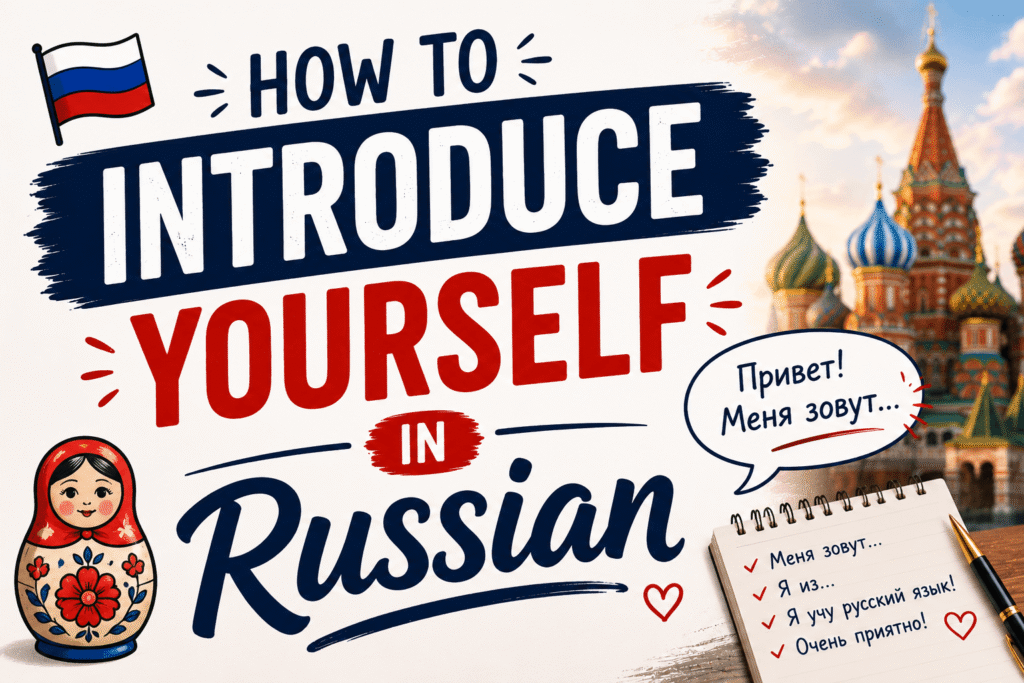
Introducing yourself in Russian is one of the first things you should learn as a beginner. It helps you start a conversation, meet new people, ask someone’s name, and talk about basic personal information.
However, you also need to make sure first that you know how to greet in Russian as well as how to say goodbye. Otherwise, your self-introduction will not be as complete as it should be. So, I recommend you to first learn the basic phrases in Russian.
There are different ways to introduce in Russian.
I suggest you to watch the following video in order to learn how to introduce somebody, to make a self-introduction, some questions to get acquainted, useful expressions to get acquainted, expressions to use when you already know a person, expressions to show how happy you are to get acquainted as well as some interesting cultural insights.
Table of Contents
Free Russian Video Lesson “How to introduce yourself in Russian”
Phrases to introduce yourself and others in Russian
Introducing someone in Russian
1. Знакóмься (znakóm’sya) – Get acquainted
“ЗНАКОМЬСЯ” is an informal imperative form of the verb “ЗНАКОМИТЬСЯ” (to get acquainted). It is a like a call to action to let somebody get acquainted with another person.
When you meet new people, you can hear somebody using this word to introduce you to others (or vice versa). If you want to introduce somebody, make sure that you use this form only with individuals you know well:
– Friends, family members and good acquaintances;
– Colleagues not older than you
2. Знакóмьтесь (znakóm’tes’) – Get acquainted
“ЗНАКОМЬТЕСЬ” is a formal / plural imperative form of the verb “ЗНАКОМИТЬСЯ” (to get acquainted).
As a plural (both formal and informal) form you can use ЗНАКОМЬТЕСЬ with:
– Friends, family members and good acquaintances;
– Colleagues;
– Other types of acquaintances.
As a singular formal way you can use ЗНАКОМЬТЕСЬ with:
– People in authorities (boss, professor, etc.)
– People older than you (colleagues, acquaintances);
– People you don’t know well.
Self-introduction in Russian
3. Позво́льте предста́виться (pazvól’te pritstávitsa) – Let me introduce myself
Позво́льте предста́виться is a very formal and official way to introduce yourself
You can use a word Разреши́те (razrishite) = “allow me” instead of ПОЗВОЛЬТЕ (pazvól’te) to sound even more official
Отчество (ótchestva) – middle name / patronymic
Имя (imya) – first name
Называ́й(те) меня́ по и́мени (nazyvái(te) minyá pa imeni) – Call me by my first name.
Называ́й(те) меня́ по и́мени-о́тчеству (nazyvái(te) minyá pa imeni-ótchestu) – Call me by my first and middle names.
Назва́ть в честь… (nazvát’s f chest’) – To name after somebody
Фами́лия (familiya) – surname
Как ва́ша фами́лия? (kak vásha familiya?) – What is your surname?
Как ва́ша фами́лия? (kak vásha familiya?) – What is your surname?
Some questions to get acquainted in Russian
4. Как вас зову́т? (kak vas zavút) – What is your name?
КАК ВАС ЗОВУТ? is the most common way to ask somebody’s name.
It is formal and it is better to use it with any groups of people you meet for the first time (except for children).
Как тебя́ зову́т? (kak tibyá zavút) – What is your name?
КАК ТЕБЯ ЗОВУТ? is an informal way to enquire somebody’s name
Use this form with children, people younger than you or the same age (depends)
You might also hear a colloquial version “КАК ЗВАТЬ?” (kak zvat’) in cartoons, movies (not used in speech anymore).
Useful expressions to get acquainted in Russian
5. Мо́жет вы нас познако́мите? (Mózhet vy nas paznakómite?) – Maybe you will introduce us to each other?
It is a formal and polite request to introduce you to a person you don’t know and want to get acquainted with.
Может ты нас познакомишь? (Mózhet ty nas paznakómish?) -To make it informal just switch ВЫ with ТЫ and ПОЗНАКОМИТЕ with ПОЗНАКОМИШЬ.
6. Дава́йте знако́миться (Daváite znakómit’sya) – Let’s get acquainted
ДАВАЙТЕ ЗНАКОМИТЬСЯ is a great way to let somebody know that you want to get acquainted and know them better.
Russian expressions to use when you already know a person
Sometimes you meet someone and feel that you have seen this person before. Russian has several useful phrases for this situation.
7. Прости́те, мы знако́мы? (prastite, my znakómy?) – Excuse me, do we know each other?
8. Мы с ва́ми где́-то встреча́лись? (my s vámi gdéta fstrechális’?) Have we already met?
9. Я вас узна́л (masculine form) – ya vas uznál – I have recognized you
Я вас узна́ла (feminine form) – ya vas uznála – I have recognized you
10. Мы уже́ знако́мы (my uzhé znakómy) – We already know each other
11. Ра́д(а) познако́миться (rad(a) paznakómit’sya) – I am glad to get acquainted
РАД(А) ПОЗНАКОМИТЬСЯ is a very nice and polite way to say that you are happy to get acquainted with a person.
Another version is Прия́тно познако́миться (priyátna paznakómit’sya) – Pleased to get acquainted.
Often reduced to just (ОЧЕНЬ) ПРИЯТНО = (óchin’ priyátna)
As a follow-up reply to “ПРИЯТНО ПОЗНАКОМИТЬСЯ” and its other variations.
You can use a short phrase “И МНЕ” (i mne) – me too
Otherwise, if you want to impress people with your knowledge, you can use this phrase
Мне то́же о́чень прия́тно с ва́ми познако́миться (mne tózhe óchin’ priyátna s vámi paznakómit’sya) – I am very glad to meet you, too
12. Добро́ пожа́ловать (Dabró pazhálavat’) – Welcome
ДОБРО ПОЖАЛОВАТЬ is a great way to greet a new person in a team (at work, at courses, neighbours, etc.).
Useful Questions After Introducing Yourself
After saying your name, you can continue the conversation with simple beginner-friendly questions.
Отку́да вы?
Where are you from? — formal
Отку́да ты?
Where are you from? — informal
Вы говори́те по-англи́йски?
Do you speak English? — formal
Ты говори́шь по-англи́йски?
Do you speak English? — informal
Вы учи́те ру́сский?
Are you learning Russian? — formal
Ты у́чишь ру́сский?
Are you learning Russian? — informal
Чем вы занима́етесь?
What do you do? — formal
Чем ты занима́ешься?
What do you do? — informal
These questions help you move from a simple introduction to a real conversation.
If you have recently started to learn Russian language, you should absolutely have my free guide ‘Essential Russian Words and Expressions to Understand Spoken Russian’.
It’s also very important to know how to pronounce Russian words correctly as not every Russian letter is pronounced the same way as it’s written. There are certain Russian pronunciation rules that are really easy to learn.
If you wish to speak Russian, you should absolutely learn how to use Russian cases. Check the most comprehensive guides to Russian cases:

Mini-Dialogues: Introducing Yourself in Russian
Dialogue 1: Informal Introduction
— Приве́т! Как тебя́ зову́т?
— Меня́ зову́т Анна. А тебя́?
— Я Макс. Прия́тно познако́миться!
— И мне.
Translation:
— Hi! What is your name?
— My name is Anna. And you?
— I am Max. Nice to meet you!
— Me too.
Dialogue 2: Formal Introduction
— Здра́вствуйте! Как вас зову́т?
— Меня́ зову́т Еле́на. А вас?
— Меня́ зову́т Джон. О́чень прия́тно.
— Взаи́мно.
Translation:
— Hello! What is your name?
— My name is Elena. And you?
— My name is John. Very nice to meet you.
— Likewise.
Dialogue 3: Introducing Someone Else
— Знако́мься, э́то моя́ подру́га Маша.
— Приве́т, Маша! Прия́тно познако́миться.
— И мне.
Translation:
— Meet Masha, this is my friend.
— Hi, Masha! Nice to meet you.
— Me too.
Dialogue 4: At Work
— Знако́мьтесь, э́то наш но́вый колле́га.
— Здра́вствуйте! Меня́ зову́т Павел.
— О́чень прия́тно. Добро́ пожа́ловать в кома́нду!
Translation:
— Meet our new colleague.
— Hello! My name is Pavel.
— Very nice to meet you. Welcome to the team!
Common Mistakes When Introducing Yourself in Russian
1. Using ты with strangers
If you meet someone for the first time in a formal situation, use вы.
Better:
Как вас зову́т?
What is your name?
Not:
Как тебя́ зову́т? — to a stranger or older person
2. Translating “my name is” word for word
Do not translate “my name is” as моё имя есть. The natural Russian phrase is:
Меня́ зову́т…
My name is…
3. Using Позвольте представиться in casual situations
Позво́льте предста́виться is correct, but it sounds very formal. Do not use it when meeting friends, classmates, or people in casual situations.
4. Confusing фамилия and family
Фами́лия means surname or last name. It does not mean family. Family in Russian is семья́.
5. Forgetting gender in рад / рада
A man says:
Ра́д познако́миться.
Glad to meet you.
A woman says:
Ра́да познако́миться.
Glad to meet you.