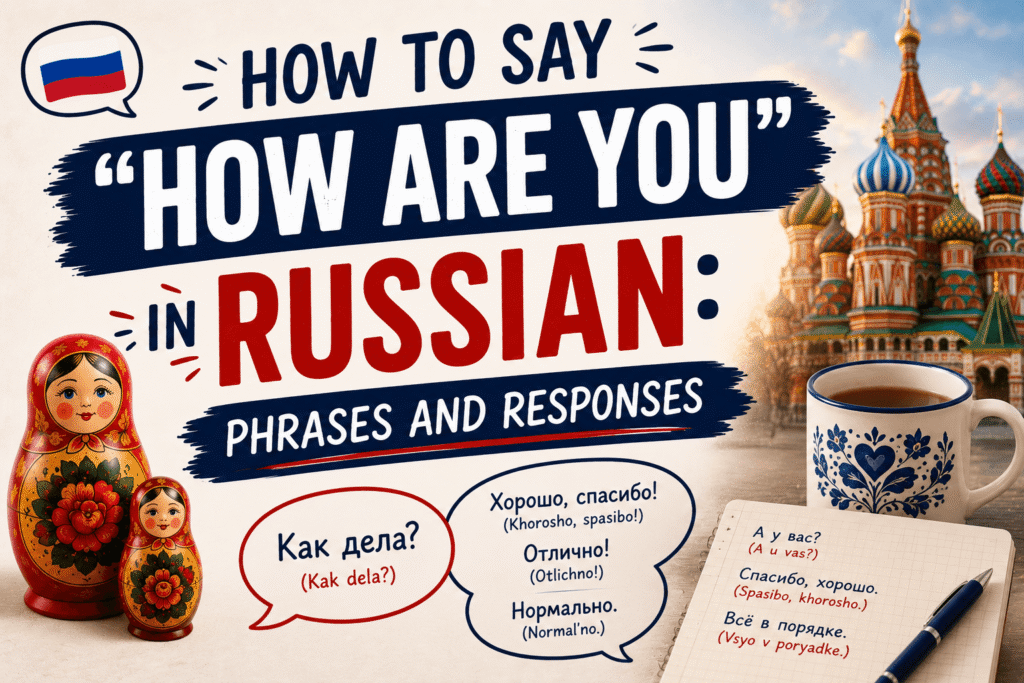
The most common way to ask “How are you?” in Russian is Как дела́? This phrase is short, useful, and easy to remember. However, Russian has many other ways to ask about someone’s mood, life, news, or general situation.
In English, “How are you?” can sometimes be just a polite greeting. In Russian, Как дела́? can also be casual, but it often feels a little more personal. If you ask Как дела́?, the person may think you are genuinely interested in the answer, especially if you are friends or know each other well.
That is why it is useful to learn not only how to ask the question, but also how to answer it naturally.
For example:
— Как дела́?
— Хорошо́, спаси́бо. А у тебя́?
Translation:
— How are you?
— Good, thank you. And you?
This simple exchange is perfect for beginners, but as you become more confident, you can use more natural and expressive Russian phrases.
Before learning how to ask “How are you?” in Russian, it is also useful to know how to say hello in Russian, how to say goodbye in Russian and how to introduce yourself in Russian naturally.
Table of Contents
Russian Video Lesson “Different ways to ask How are you? in Russian”
Different ways to ask “How are you?” in Russian
Common ways to ask “how are you?” in Russian:
1) Как дела́? [kak dilá] – How are you?
КАК ДЕЛА is the most popular way to ask “How are you?” in Russian
It is rather informal than formal and you should avoid using this form with:
– Strangers (Ex. social workers);
– Elderly people (if you don’t know them well);
– People in authority (your boss, professors, etc.)
2) Как твои́ дела́? [kak tvai dilá] – How are you doing?
“Как твои́ дела́?” is another informal and more personal variation of “Как дела́?”
You can use this expression with:
– Friends, family members and good acquaintances;
– Colleagues;
– Children
3) Как ва́ши дела́? [kak váshi dilá] – How are you doing?
“Как ва́ши дела́?” is a formal and very polite variation of “Как дела́?”
You can use this expression with:
– Strangers (Ex. social workers, officials, etc.);
– Colleagues older than you;
– People in authority (your boss, professors, etc.);
– Elderly people
Casual ways to ask “how are you?” in Russian:
1) Как ты? [kak ty] – What’s up?
“Как ты?” is a casual and short variation of “Как дела́?”
You can use this expression with:
– Friends, family members and good acquaintances;
– Colleagues not older than you;
– Children
2) Как вы? is a formal variation of “Как ты?”
It can also be addressed to a group of people
This expression is less formal than “Как ва́ши дела́?”
You can use this expression with:
– People you don’t know well;
– Colleagues older than you;
– People in authorities (your boss, professors, etc.)
3) Как сам? [kak sam] – And you?
“Как сам?” is a common casual follow-up question after responding to somebody’s question “Как дела?” or its other version
You can use this expression with:
– Friends, family members and good acquaintances;
– Colleagues not older than you;
4) Other versions of follow-up questions
– У тебя́ как?
Ex. – Приве́т! Как дела́?
– Спаси́бо, хорошо́. У тебя́ как?
5) Что но́вого? [shto nóvava] – What’s new?
“Что но́вого?” is a casual expression that is usually used when you haven’t seen a person for some time and you enquire about his/her news
You can use this expression with:
– Friends, family members and good acquaintances;
– Colleagues and other types of acquaintances
In informal conversations a question word ЧТО (shto) is often reduced to just ЧЁ (cho)
Ничего́ но́вого [nichevó nóvava] – No news
“Ничего́ но́вого” is a common answer to the question “Что но́вого?” if a person doesn’t have any news (or don’t want to share)
Short, super casual versions of “НИЧЕГО НОВОГО” are НИЧЕГО, НИЧЁ НОВОГО, НИЧЁ
6) Как жизнь? [kak zhizn’] – How is life?
“Как жизнь?” is a casual way to ask “Как дела?”More popular among men.
It may sound a little dramatic and outdated.
You can use this expression with:
– Friends, family members and good acquaintances;
– Colleagues not older than you;
– Elderly people.
7) Как пожива́ешь? [kak pazhiváyesh] – How is life?
“Как пожива́ешь?” is a less casual and more polite version of “Как жизнь?”
You can use this expression with:
– Good acquaintances;
– Friends (may sound a little outdated);
– Colleagues.
A formal version of “Как поживаЕШЬ?” is “Как поживаЕТЕ?” (kak pazhivá́́yete)
Ех.: Здра́сте, как пожива́ете?
Hello (colloquial), how is your life?
8) Как настроение? [kak nastrayéniye] – How is it going?
“Как настроéние?” is a common way to enquire about a person’s morale and mood in general It is often used on TV-shows, games, special occasions in order to cheer up the audience
Нет настроéния [net nastrayéniya]
Meaning: No mood
It is a common way to let somebody know that you are not in a good mood

Common ways to respond to “how are you?” in Russian
There are many different ways to Как дела? in Russian. The most common ones are хорошо́ and норма́льно.
However, if a Russian person replies to you one of these without any other details, most likely that they just feel that you are not really intererested and they don’t want to bother you.
Note that some words can be reduced in speech. Норма́льно is usually pronounced as just норм, но́рмик or even норму́ль, ничего́ as ничё

Slang ways to respond to “how are you?” in Russian
In informal speech, Russians often use shorter, more expressive answers.
Норм.
Fine / okay.
Норми́к.
Pretty good / okay. — informal
Всё норм.
Everything is fine. — informal
Ничё.
Not bad / nothing much. — very informal
Ништя́к [nishtyák]
Meaning – really good, cool
Comes from the expression “ничё так”that means it not is that bad
It is a slang word. You should better use it only with your friends
Капéц or пипéц
[kapéts] or [pipéts]
Meaning – it is a disaster, the end
It is not a swear word and young people use it a lot in different contexts
You can also use it to express:
– Surprise
Ex. Капец, у нее уже двое детей!
No way! She already has two children!
You can also use it to express:
– Despair / anger
Ex. Капец, мы завалили экзамен!
Damn it! We have failed an exam!
Пиздéц [pizdéts]
Meaning – a complete disaster.
Be careful, it is a strong swear word but young people use it a lot in different contexts.
Be careful with slang. These words can sound very natural with friends, but they are not appropriate in formal situations. Some slang answers can sound rude, dramatic, or too emotional if you use them in the wrong context.
For beginners, the safest answers are хорошо́, норма́льно, непло́хо, and так себе́.

You can listen to how these phrases are pronounced here.
Idiomatic ways to respond to “how are you?” in Russian

1) Пока́ не родила́ [paká ne radilá]
Everything is fine
“Пока́ не родила́” (I haven’t given birth yet) is a funny way to respond to the question
“Как дела?” as it rhymes with a word “дела”.
Use it only if you are a woman.
And no, you don’t need to be pregnant to use it =)
2) Всё пучкóм [fsyo puchkóm] – Everything is great
Direct translation: Everything is in the form of a bunch
Всё пучком (fsyo puchkóm) is an idiomatic colloquial expression
You can use this expression with:
– Friends, family members and good acquaintances;
– Colleagues not older than you.
You can find the audio files with pronunciation of these Russian phrases in my free guide ‘Essential Russian Words and Expressions to Understand Spoken Russian’.
It’s also very important to know how to pronounce Russian words correctly as not every Russian letter is pronounced the same way as it’s written. There are certain Russian pronunciation rules that are really easy to learn.
Want more lessons like this? Explore my Russian learning resources. You can also browse my free Russian video lessons.
If you wish to speak Russian, you should absolutely learn how to use Russian cases. Check the most comprehensive guides to Russian cases:

Mini-Dialogues: How Are You in Russian
Dialogue 1: Simple Beginner Conversation
— Приве́т! Как дела́?
— Хорошо́, спаси́бо. А у тебя́?
— То́же хорошо́.
Translation:
— Hi! How are you?
— Good, thank you. And you?
— Good too.
Dialogue 2: Formal Conversation
— Здра́вствуйте! Как ва́ши дела́?
— Непло́хо, спаси́бо. А у вас?
— Всё хорошо́, благода́рю.
Translation:
— Hello! How are you doing?
— Not bad, thank you. And you?
— Everything is fine, thank you.
Dialogue 3: Casual Conversation
— Приве́т! Что но́вого?
— Да ничего́ осо́бенного. А у тебя́?
— У меня́ то́же всё по-ста́рому.
Translation:
— Hi! What’s new?
— Nothing special. And you?
— Same old for me too.
Dialogue 4: Talking About Mood
— Как настрое́ние?
— Не о́чень. Я уста́л.
— Понима́ю. Держи́сь!
Translation:
— How is your mood?
— Not great. I’m tired. — said by a man
— I understand. Hang in there!
Common Mistakes When Asking “How Are You?” in Russian
1. Using Как дела? in every situation
Как дела́? is very common, but it is not always the best choice. With strangers, older people, teachers, or people in authority, Как ва́ши дела́? or Как вы? may be more polite.
2. Forgetting formal and informal forms
Use Как ты? with friends and people you know well. Use Как вы? in formal situations or when speaking to several people.
3. Answering too literally
If someone asks Как дела́?, they are not asking about “business” in the literal sense. It simply means “How are you?” or “How are things?”
4. Using slang with the wrong person
Words like ништя́к, норму́ль, капе́ц, or пипе́ц are informal or slang. Do not use them in formal conversations.
5. Forgetting to ask back
In Russian, it is natural to ask back:
А у тебя́?
And you? — informal
А у вас?
And you? — formal
This makes the conversation feel more natural and polite.
FAQ: How to Say “How Are You” in Russian
How do you say “What’s up?” in Russian?
A casual way to say “What’s up?” in Russian is Как ты? You can also say Что но́вого? if you mean “What’s new?”
How do you answer Как дела?
Common answers include Хорошо́ — good, Норма́льно — fine, Непло́хо — not bad, Отли́чно — excellent, Так себе́ — so-so, and Пло́хо — bad.
How do you ask “And you?” in Russian?
In informal Russian, say А у тебя́? In formal Russian, say А у вас? You can also say А ты как? informally or А вы как? formally.
What does Как дела literally mean?
Как дела́? literally means “How are things?” The word дела́ means things, affairs, or matters. In natural English, it is translated as “How are you?”