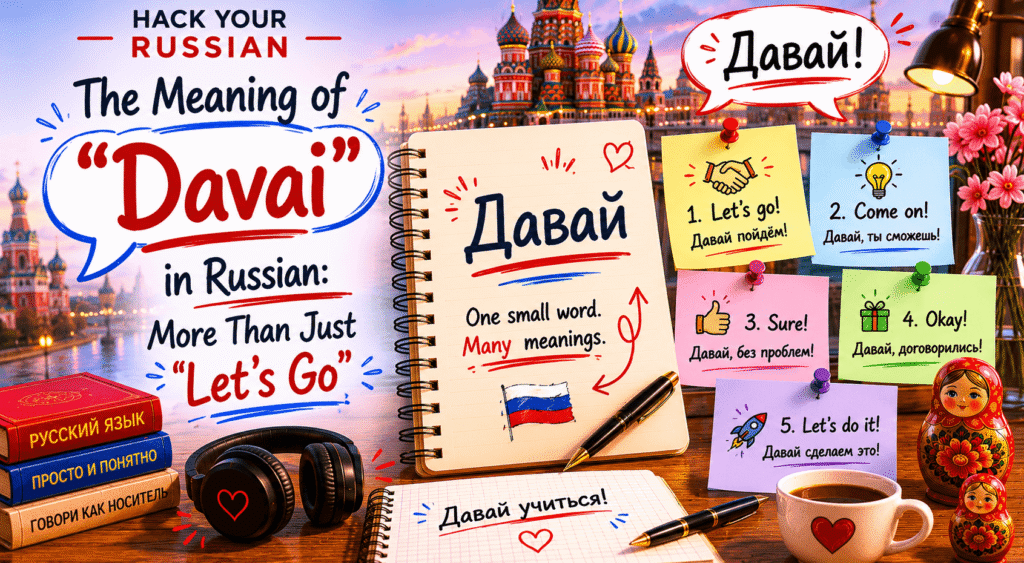
If you have watched Russian movies, listened to Russian conversations, or talked to native speakers, you have probably heard the word дава́й many times. It is one of those Russian words that seems simple at first, but becomes confusing very quickly.
The problem is that дава́й does not have only one English translation. Depending on the context, it can mean “give it”, “come on”, “let’s”, “go ahead”, “hurry up”, “okay”, or even be used as a casual way to say goodbye.
For example:
Дава́й!
Come on! / Go ahead! / Hurry up!
Дава́й пойдём.
Let’s go.
Дава́й встре́тимся за́втра.
Let’s meet tomorrow.
Ну всё, дава́й. Пока́!
Alright then, bye!
This is why дава́й is such an important word for Russian learners. You will hear it in everyday conversations, messages, movies, sports, work situations, and casual plans with friends.
In this guide, you will learn the most common meanings of дава́й, how to use дава́й and дава́йте correctly, when it sounds friendly or pushy, and how to understand this word in real Russian speech.
If you are just starting Russian, you may also like my list of basic Russian phrases for beginners.
Free Russian video lesson to learn different ways to use a word ДАВАЙ
Ways to use a word ДАВАЙ in Russian:
1) Literal meaning
Дава́й (singular / informal) and Дава́йте (plural / formal) are imperative forms of the verb ‘дава́ть‘ (to give – general meaning). These imperative forms are mostly used in a negative form.
Why? This verb дава́ть has a meaning of a continuous or repetitive action that is done in general (without any particular result). So, if it is used in a positive sentence, it will mean that the process of giving is continuous that is not the case if one is asking for something at a particular moment. However, it is fine to use it in negative sentences as we are talking in general.
Ex.: Не дава́й ему́ де́нег (Don’t give him money) – meaning that you don’t have to give him any money ever.
And if you are wondering which forms you should use in positive requests, here they are:
Дай (singular / informal) and Да́йте (plural / formal). These are imperative forms of the verb ‘дать’ (to give – exact meaning, result). Used mostly in a positive form.
Ex.: Дай ему́ де́нег (Give him money).
However, you can use ‘Дава́й’ and ‘Дава́йте’ in positive requests without specifying what exactly you want (in cases when it’s obvious what you are asking for). For example, a person brings you something and holds in his/her hands. So, you can say “Дава́й” (Give it). Watch the video lesson to see more examples.
2) Call to action | Encourage
The most common way to use these imperative forms Дава́й / Дава́йте is to motivate or encourage someone to do something (in sport, competitions, battles, work. studies and variouslife situations). The equivalent of this in English would be “Come on!” In this case, these forms Дава́й / Дава́йте can be used separately or together with some verbs (watch the video to find more examples).
3) Call to action | Hurry up
Дава́й can also be used in order to hurry up a person.
Come on, hurry up! = Дава́й, торопи́сь!
Examples:
– Дава́й быстре́е! (Come on, quickly!)
– Дава́й уже́! (Come on now!)
– Дава́й, дава́й, дава́й! (Come on, come on, come on!)
4) Call to action | Let’s do something together
And the last example of call to action is the way to encourage someone to do something together with you = Let’s do something together. Find below the constructions to form sentences with Дава́й / Дава́йте.
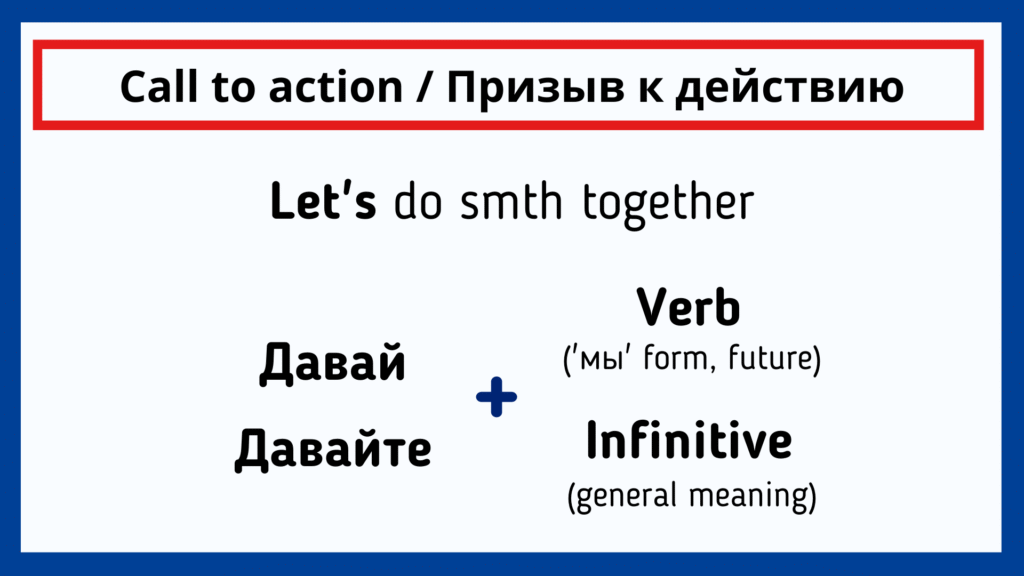
In the first construction, you need to use one of the forms of Давай and then a verb in a future tense that corresponds to a pronoun Мы (We).
Examples:
Дава́й посмо́трим фильм (Let’s watch a movie).
Дава́й схо́дим в кино́ (Let’s go to a cinema).
Дава́йте устро́им пикни́к (Let’s have a picnic).
In the second construction, you need to use an infinitive form of a verb with a general meaning (imperfective).
Examples:
Дава́й танцева́ть (let’s dance).
Дава́й жить вме́сте (let’s live together).
Дава́йте весели́ться! (let’s have fun).
Watch more examples in a video lesson.
5) Call to action | Colloquial
There are some colloquial ways to use these words Дава́й / Дава́йте with a particle -КА. This was mostly used in the past, but you can still hear it in some movies. It gives a playful meaning to an offer.
Дава́й-ка
Дава́йте-ка
Ex.: Дава́й-ка устро́им вечери́нку (Let’s organize a party)
6) Call to action | Please, keep your…
Another way to use Дава́й as a call to action is to ask someone not to use something.
Дава́й без … (Please, keep your…) and then you need to add a noun in a Genitive case.
Examples:
Дава́й без шу́ток (Please, keep your jokes) – meaning that it’s not the right moment)
Дава́йте без сарка́зма (Please, keep your sarcasm)
7) Asking a permission / Offering help
A very common way to use Дава́й / Давайте in Russian is to ask for a permission or offer some help. In this case, it is equivalent to English versions of ‘Let me/us’ and ‘What if I / What if we’. Find below two constructions to follow.

Please, note that you can omit the pronoun in these constructions as it will be obvious from the verb one is using.
Examples:
Дава́й я помогу́ (Let me help).
Дава́й мы помо́жем (Let us help).
Дава́йте я посмотрю́ (Let me have a look).
Дава́йте мы посмо́трим (Let us have a look).
8) Agreement / Giving permission
One can use Дава́й not only to offer help and ask for a permission, but also to agree and to give a permission. Equivalent in English: agree, OK, it works for me.
Examples:
– Дава́й (я) помогу́ (Let me help you)
– Дава́й (Ok, go ahead)
– Дава́йте (мы) запла́тим (Let us pay)
– Дава́йте (Ok, we agree)
9) Proposing a toast / Предлагать тост
Russian people use a word Дава́й to propose a toast.
Дава́й за … = Let’s drink for…
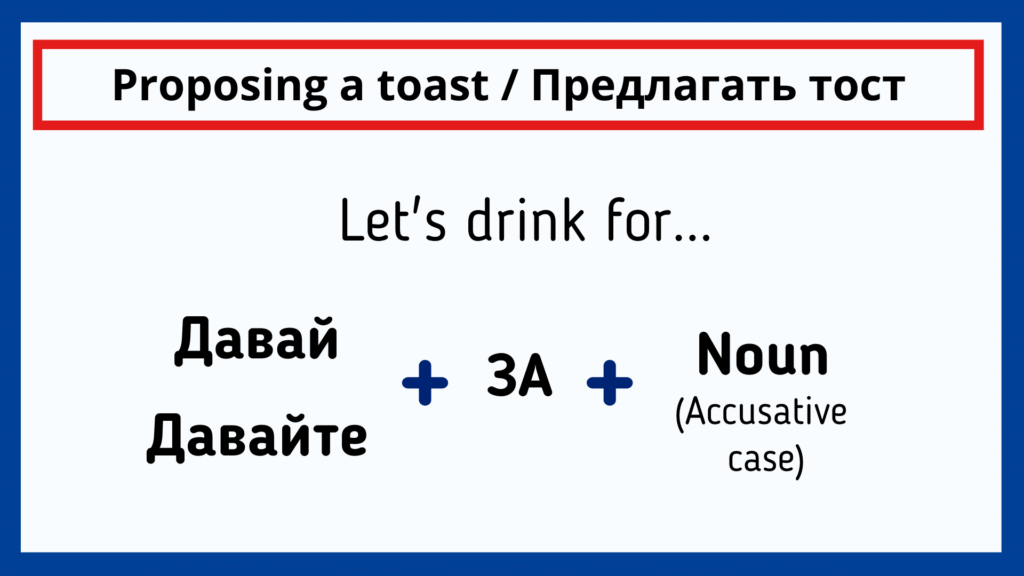
Example:
– Дава́й (вы́пьем) за твоё здоро́вье! (Let’s drink for your health)
– Дава́й (Sure)
Please, notice that the verb (выпьем) can be omitted in toasts because it’s obvious that one is going to drink. The word Дава́й / Дава́йте can also be omitted.
10) Conversational goodbye
The last common way to use Дава́й in Russian is to say goodbye. This is a conversational goodbye that can only be used with people you know very well (family, friends, close acquaintances). In this case, the word Дава́й is equivalent to a Russian Пока (bye). However, these two words can actually be used together
Ex.: Всё, дава́й, пока́! (Ok then bye)
Fixed expressions with Давай:
1) Дава́й(те) сме́ним те́му (разгово́ра)
Let’s change the topic (of conversation)
2) Дава́й(те) по де́лу (по существу́)
Let’s discuss the matter at hand
3) Дава́й(те) по поря́дку
Let’s start with the beginning!
4) Дава́йте по чесноку́* (idiomatic expression) = Let’s be honest
This is a word play as чеснок is a garlic and честно means honestly.
*чесно́к – garlic
че́стно – honestly
As you could see, this Russian word Дава́й is very tricky and can be used in various situations.
But it’s very important to learn how to use it in speech as it’s a very handy and useful word.
How to Respond to Давай
When someone uses дава́й as a suggestion, you can answer in different ways depending on whether you agree, hesitate, or refuse.
To accept
Дава́й! (Sure! / Let’s do it!)
Хорошо́ (Okay).
Ла́дно (Alright).
Коне́чно (Of course).
С удово́льствием (With pleasure).
Почему́ бы и нет? (Why not?)
Example:
— Дава́й встре́тимся за́втра? (Shall we meet tomorrow?)
— Дава́й! (Sure!)
To hesitate
Не зна́ю (I don’t know).
Мо́жет быть (Maybe).
Посмо́трим (We’ll see).
Я поду́маю (I’ll think about it).
To refuse politely
Сего́дня не получи́тся (It won’t work today).
Мо́жет быть, в друго́й раз (Maybe another time).
Я не могу́ (I can’t).
Не хочу́ (I don’t want to).
Example:
— Дава́й пойдём в кино́? (Let’s go to the cinema?)
— Сего́дня не получи́тся. Мо́жет быть, в друго́й раз? (It won’t work today. Maybe another time?)
Meanings of Давай: Quick Summary
| Russian phrase | Meaning | Tone / context |
|---|---|---|
| Дава́й. | Give it / go ahead / okay | depends on context |
| Дава́й пойдём. | Let’s go. | informal suggestion |
| Дава́йте начнём. | Let’s begin. | formal or plural |
| Дава́й! | Come on! | encouragement |
| Дава́й быстре́е! | Hurry up! | can sound pushy |
| Ну всё, дава́й. | Alright, bye. | casual goodbye |
| Дава́й не бу́дем спори́ть. | Let’s not argue. | soft / reasonable |
| Дава́й попробуем. | Let’s try. | friendly suggestion |
| Дава́й встре́тимся. | Let’s meet. | making plans |
This is why дава́й can feel confusing: the word itself is simple, but the meaning comes from the situation, the verb after it, and the speaker’s intonation.
If you have recently started to learn Russian language, you should absolutely have my free guide ‘Essential Russian Words and Expressions to Understand Spoken Russian’.
It’s also very important to know how to pronounce Russian words correctly as not every Russian letter is pronounced the same way as it’s written. There are certain Russian pronunciation rules that are really easy to learn.
If you wish to speak Russian, you should absolutely learn how to use Russian cases. Check the most comprehensive guides to Russian cases:



FAQ: Давай Meaning in Russian
What does давай mean in Russian?
Дава́й has several meanings in Russian. Depending on context, it can mean “let’s”, “come on”, “go ahead”, “hurry up”, “give it”, or even be used as a casual goodbye.
What is the difference between давай and давайте?
Дава́й is informal singular, while дава́йте is formal or plural. For example, дава́й начнём means “let’s start” informally, while дава́йте начнём is formal or addressed to several people.
Is давай rude?
Дава́й is not rude by itself, but it can sound pushy or too familiar in the wrong situation. It depends on intonation, context, and whether you should use informal or formal speech.
What should I say instead of давай in a formal situation?
In formal situations, use дава́йте instead of дава́й. You can also use polite phrases like пожа́луйста, да, коне́чно, можете…, or дава́йте начнём, depending on the context.